
Tips & Tricks for a successful HORIZON-HLTH-2027-01-DISEASE-07 proposal
Opening
10 February 2027
Deadline
Keywords
monoclonal antibodies
emerging viruses
Toga viruses
Crimean-Congo
Rift Valley fever
GMP production
Chikungunya
Ebola/Marburg
pandemic preparedness
Your microfluidic SME partner for Horizon Europe
We take care of microfluidic engineering, work on valorization and optimize the proposal with you
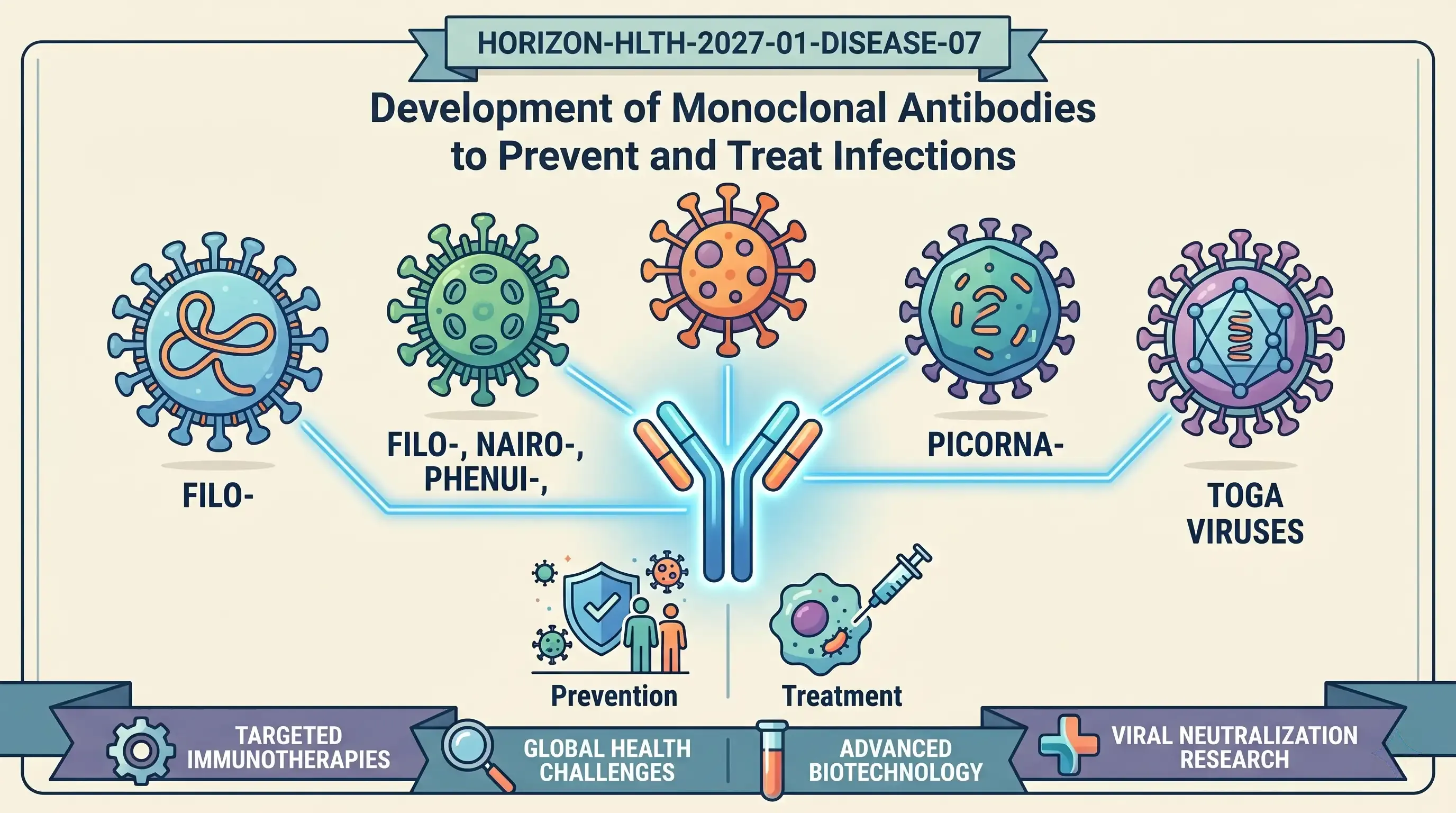
HORIZON-HLTH-2027-01-DISEASE-07: Development of monoclonal antibodies to prevent and treat infections from Filo-, Nairo-, Phenui-, Picorna- and Toga viruses
In this case, the Commission is trying to develop an antibody armamentarium against some of the most notorious emerging pathogens worldwide: Ebola, Marburg, Crimean-Congo hemorrhagic fever, Rift Valley fever, Enterovirus D68, and Chikungunya. One suggestion is a single virus. The proposed projects are not exploratory research; instead, they are the development of an established pipeline, which is expected to advance existing antibody candidates through animal models and GMP production, all the way into a first-in-human clinical safety trial. That is, not a research sprint but a controlled development sprint with a defined termination.
Download the MIC Horizon Europe 2026/2027 Calls Calendar:
Discover more!
Administrative facts: what do we know about the HORIZON-HLTH-2027-01-DISEASE-07 call?
Which call is it, and when is the opening and the deadline?
- Call name: Cluster 1 – Health (Single stage – 2027/1)
- Call identifier: HORIZON-HLTH-2027-01
- Destination: Tackling diseases and reducing disease burden
- Topic: HORIZON-HLTH-2027-01-DISEASE-07
- Opening date: 10 February 2027
- Deadline: 13 April 2027 at 17:00 Brussels time
- Type of action: Research and Innovation Action (RIA)
What about the budget and estimated size of the project?
- Total indicative topic budget: EUR 37.30 million
- Expected EU contribution per project: EUR 9.00 to 10.00 million
- Indicative number of projects funded: 4
What are the key eligibility and evaluation conditions?
- Evaluation thresholds: 4 (Excellence), 4 (Impact), 4 (Implementation); cumulative threshold 12
- US entities explicitly eligible, in recognition of NIH reciprocal opening to European researchers (worth noting: this is uncommon)
- Satellite-based services: if used, Copernicus and/or Galileo/EGNOS mandatory
- Portfolio balance rule: grants awarded not solely by ranking but also to ensure different viruses are represented across the funded portfolio
- Transfer of ownership or exclusive licensing of results: granting authority may object up to 4 years post-project
- Clinical studies annex: mandatory, template provided in the submission system
- Early regulatory engagement required throughout the project
Scientific range: what does the Commission expect from the HORIZON-HLTH-2027-01-DISEASE-08 grant?
What outcomes are expected?
The Commission expects two things by the end of the project: The community has easy access to experimentally proven monoclonal antibodies against viral infections. Second, at least one therapeutic must be at a stage where it may be clinically tested, and a distinct regulatory pathway must be demonstrated. Here, emphasis will be placed on verifiable information and pipeline and not papers.
What is in scope?
The proposals need to address the use of antibodies generated through a single-cell clone by way of recombinant expression. These are B-cell-derived antibodies, hybridoma-derived antibodies, and nanobodies. Each proposal has to be targeted at only one of the six viruses listed:
- Ebola Virus (Filovirus)
- Marburg Virus (Filovirus)
- Crimean-Congo Hemorrhagic Fever Virus (Nairovirus).
- Phenuivirus, Rift Valley Fever Virus.
- Enterovirus D68 (Picornavirus)
- Chikungunya Virus (Togavirus)
There are various virus-targeted proposals that are not supported. The countries that are endemic to a virus ought to be involved too and partners can be brought in by the African and Middle Eastern areas, according to the virus of interest.
What are the specifically proposed research directions?
The present call is especially prescriptive; it is necessary to discuss the following:
- In vitro characterization of antibody candidates: specificity to target, epitope mapping, and viral function inhibition.
- in vivo protection in animal models, or in humanized immune system models, where suitable.
- Non-human primate research ought to proceed when regulatory agencies require it for first-in-human clinical trials.
- Discussion of risks of antibody-dependent enhancement in those cases in which it is present (This point of the call could shock many people unless it is taken into account at the very beginning of the proposal writing).
- GMP manufacture of the best candidates.
- First-in-human clinical safety trials as per regulatory requirements on market authorization with regard to variables of sex, age, ethnicity, and disability status.
Scientific strategy: how can you enhance your chances of being funded through HORIZON-HLTH-2027-01-DISEASE-07?
What scientific choices matter most?
- Find the most beneficial virus. It is important to keep in mind that, due to the diversification of the competition, less popular viruses may have a greater chance of securing successful funding despite lower ranks. Rift Valley fever and Enterovirus D68 should be considered and have not traditionally received much attention from European researchers.
- Develop from existing candidates, don't start from scratch. The call is to advance the available antibody candidates rather than their discovery, and this may prove catastrophic when misconstrued.
- Be sure to evaluate ADE at the very beginning. Do not consider it as an appendix that can be added on. The fact that the proposal will be reviewed by virology experts should be considered. In case it is not applicable to your specific virus, explain why.
- Design a regulation plan right at the start of the research work. There should be a clear roadmap to market authorization. Statements that are not concrete will not fulfill threshold 4. You are better advised to consult a regulation consultant at the beginning.
- Leverage ISIDORe and the European Partnership on Pandemic Preparedness; mention the collaboration in the text and clearly define the synergy.
- The design of clinical studies should include variables as needed, including sex, age, ethnicity, etc., and the description of the need in the proposal is not a superfluous phrase.
Consortium & proposal-writing plan: what works best with this type of call?
- The single-virus rule shapes everything. You need depth in one area, not breadth across several. Between 8 and 12 partners, maybe a little more, should it be considered necessary to carry out clinical testing in different countries
- Have the senior academic investigator with a proven track record on the preferred virus of choice. The general virology labs will not pass the test, as the assessors will review all the CVs and seek a specific level of experience in the field of virology.
- It is not an option but a requirement to have an SME with GMC capabilities to gain credibility in the pipeline, or the proposal will not be able to implement it.
- You need to look at partners in countries that are endemic to the selected virus. The call asks for such participation, which can offer more biological relevance, as well as provide you with unique samples for experimentation that are not accessible through other sources.
- Adding a regulatory affairs specialist is a good idea and usually appears in powerful offers. Either have one as a partner or as a contracted subcontractor.
- In relation to writing, the clinical studies annex is not to be treated as filler, but as a vital aspect where the development path, reasons as to why the site was chosen and why early regulatory plans are to be elaborated effectively.
- The portfolio balance aspect is crucial in case your project gets close to a threshold score in its ranking. Mention this internally.
How would microfluidics contribute to this topic?
Developing monoclonal antibodies is time-consuming under traditional lab bench approaches; the risks associated with high-consequence viruses often restrict us to BSL-3/4 lab settings, which limit capacity. Working with microfluidics reduces risks, enables us to use small sample sizes, and allows us to conduct assays not possible on conventional equipment in BSL-3.
- Screen individual B cells for antibody production using droplet microfluidics. Allows more candidates to be processed on the same timeline as traditional ELISA methods or hybridoma techniques.
- A microfluidic infection model allows you to determine whether the antibody candidate binds the virus and impedes its cellular entry, or binds but allows entry. This eliminates the need for costly, time-consuming animal studies to obtain early data; the tests are performed on a chip under controlled conditions, with no need for a full animal experiment.
- Organ-on-chip microfluidic technology enables an early assessment of the toxicity of antibody candidates and antibody-dependent enhancement of the virus, which is another key criterion in this call. You can effectively model human physiology under certain conditions (e.g., organ-on-chip), which provides more detailed information than cell culture models.
- Microfluidic devices and continuous-flow synthesis processes may enable you to develop effective upstream antibody production processes at lower cost before entering the GMP phase of development. The number of iterative cycles will thus decrease.
Microfluidics enables rapid screening of relevant antibody candidates and, where possible, organ-on-chip technology facilitates the assessment of toxicity and ADE in models that accurately represent human conditions.
This provides substantial leverage for developing regulatory-ready antibody candidates. MIC‘s technology platform for organ-on-chip and single-cell applications has the potential to add significant value for your application and in the development stages of your proposal.
The MIC already brings its expertise in microfluidics to Horizon Europe:
H2020-NMBP-TR-IND-2020

Microfluidic platform to study the interaction of cancer cells with lymphatic tissue
H2020-LC-GD-2020-3

Toxicology assessment of pharmaceutical products on a placenta-on-chip model

FAQ – HORIZON-HLTH-2027-01-DISEASE-07
Which viruses are eligible targets for HORIZON-HLTH-2027-01-DISEASE-07?
The top 6 targets are: Ebola Virus, Marburg Virus, Crimean-Congo Hemorrhagic Fever Virus, Rift Valley Fever Virus, Enterovirus D68 and Chikungunya Virus. Only one of these viruses should be covered by each proposal.
Can a proposal target more than one virus under this call?
No. Each proposal ought to have a specific virus in mind. It may be seen as secondary analysis, but the most important proposal is to consider one target, which could be to investigate only the cross-reactive effects of antibody candidates on the related viruses.
What types of antibodies are accepted under this call?
The proposals need to focus on antibodies generated by a single-cell clone via recombinant expression. The accepted ones are B-cell-derived antibodies, hybridoma-derived antibodies and nanobodies.
Is antibody-dependent enhancement (ADE) evaluation mandatory?
ADE evaluation must be done where it is scientifically applicable. When ADE is not suitable to cover your target virus, you need to explicitly state this and provide scientific reasons in the proposal.
Are US research institutions eligible to participate?
Yes. As reciprocation to European researchers opening up US NIH programs, any legal entity within the United States of America is encouraged to obtain Union funding in this call.
What clinical evidence is expected by the end of the project?
Projects are expected to deliver a preliminary-in-human clinical safety study, and exhibit a certain regulatory route towards market authorization. At least a batch of the most promising antibody candidates in GMP-compliant conditions needs to be manufactured.
How does the portfolio balance rule work in practice?
The grants are not provided on a ranking basis on merit, but to ensure that there is representation of different viruses on which this call targets in the portfolio of grants funded. A proposal targeting a less competitive virus may have this rule a bit lower.
What is the GMP requirement under this call?
Under Good Manufacturing Practices (GMP), the projects are expected to produce batches of the most promising antibody candidates, as a precondition to the first-in-human safety studies. Check the Funding and Tenders Portal for more information.
How should third-country partners be integrated into the consortium?
Inclusion of third countries where the target virus is endemic or where there have been outbreaks is specifically promoted. Such partners offer bio-relevance, access to clinical samples, and epidemiological expertise that European consortia often lack.
What role can an SME play in a HORIZON-HLTH-2027-01-DISEASE-07 consortium?
This invitation specifically invites involvement of start-ups, micro, small and medium-sized enterprises (SMEs). Especially beneficial are SMEs with GMP production capabilities, expertise in regulatory matters, or diagnostics development.