
Tips & Tricks for a successful HORIZON-CL4-2027-04-DATA-08 proposal
Opening
17 November 2026
Deadline
Keywords
3C Network
Telco Edge Cloud
AI Integration
Digital Sovereignty
Open-Source Infrastructure
Vertical Pilots
Post-Quantum Security
Your microfluidic SME partner for Horizon Europe
We take care of microfluidic engineering, work on valorization and optimize the proposal with you
HORIZON-CL4-2027-04-DATA-08: Demand-side 3C pilot demonstrators on converged Telco Edge Cloud Infrastructure
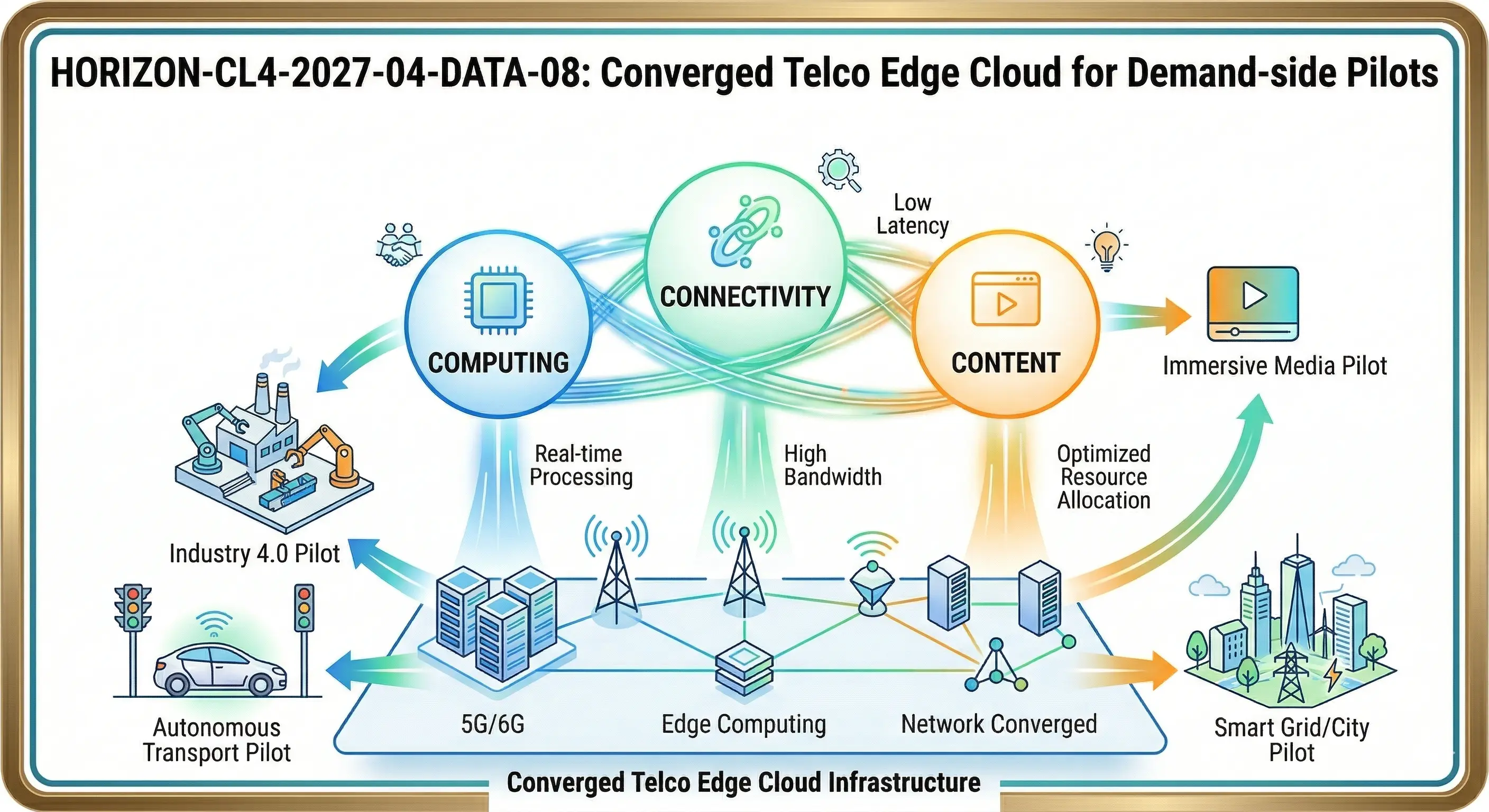
The Commission doesn’t want theoretical or architectural papers. What it wants are real-life demonstrations using the new European telco-edge-cloud infrastructure. So there is a need for two pilot demonstrators, each driving a vertical sector. These must complement a supply-side platform that has already been developed under WP25. The core idea is that 3C networks should generate value for European companies, whether they are working in transport, energy, health, or manufacturing, and bolster Europe’s digital sovereignty.
Download the MIC Horizon Europe 2026/2027 Calls Calendar:
Discover more!
Administrative facts: what do we know about the HORIZON-CL4-2027-04-DATA-08 call?
Which call is it, and when is the opening and the deadline?
- Call name: DIGITAL
- Call identifier: HORIZON-CL4-2027-04
- Destination: Developing an agile and secure single market and infrastructure for data services and trustworthy artificial intelligence services
- Topic: HORIZON-CL4-2027-04-DATA-08
- Opening date: 17 November 2026
- Deadline: 18 March 2027
- Type of action: Innovation Action (IA)
What about the budget and estimated size of the project?
- Overall budget for this topic: EUR 38.00 million
- Number of projects expected to be funded: 2
- Budget per project: EUR 19.00 million
What are the key eligibility and evaluation conditions?
- Standard Horizon Europe evaluation thresholds and award criteria apply (General Annex D). No topic-specific exceptions are mentioned for thresholds.
- Participation is restricted. Eligible entities must be established in EU Member States, Iceland, Norway, or the following associated countries: Canada, Israel, Republic of Korea, New Zealand, Switzerland, or the United Kingdom. Entities from third countries that become associated during 2026-2027 may also qualify, provided the association agreement applies by grant signature.
- Legal entities established in China are not eligible for this topic.
- Entities in eligible countries that are directly or indirectly controlled by a non-eligible country may be excluded unless guarantees are assessed positively by their country of establishment.
- Expected TRL at end of project: 6 to 8.
- The work programme explicitly expects collaboration with the supply-side 3C pilot (WP25), the SNS JU, the CCAM partnership, and the Chips JU.
Scientific range: what does the Commission expect from the HORIZON-CL4-2027-04-DATA-08 grant?
What outcomes are expected?
Commission needs demand-side validation of open orchestration platforms across the telco-cloud-edge ecosystem. By the end of the project, they should have two pilot demonstrators working in real-world environments, each addressing a vertical sector. Through the 3C infrastructure, the Commission aims to demonstrate how AI-powered services are being developed for European industry. Also, new business models and marketplace strategies must be sufficiently mature, with commercialization or replication plans firmly established. Moreover, a vibrant SME and startup community should emerge around the infrastructure.
What is within scope?
- Integration of domain-specific applications and services with European 3C/telco-edge-cloud infrastructure, utilizing network capabilities such as API aggregation, slicing, automation, low latency, ISAC, and reconfigurability
- Security and privacy solutions for quantum attacks, post-quantum cryptography
- Practical applications of AI, generative AI, LLM, cognitive CC, swarm intelligence, and XR/AR for vertical domains
- Data governance models for data sovereignty, data interoperability with Common European Data Spaces, and alignment with Gaia-X
- Exploiting open APIs and open-source components from the Supply-Side Pilot (Sylva, ANUKET, Nephio, CAMARA, Open RAN Security, RIC VNF)
- Transition towards automated green IoT edge computing and decentralized intelligence from virtualized cloud-native network functions
- One pilot should be for mobility (transport, logistics, automotive). The second can be for energy, smart communities, industrial virtual worlds, health, agrifood, manufacturing, etc. No other verticals are specified.
What are the specifically proposed research directions?
- Mobility pilot for the Connected and Autonomous Vehicle Alliance, with a focus on AI model development (Pillar 3) and large-scale testing (Pillar 5) from the Automotive Action Plan
- Demand-side orchestration of workloads across the telco-cloud-edge continuum, especially as AI becomes more compute-intensive
- Benefits realization for infrastructure providers in order to move past connectivity-based business models into more value-added offerings
- Re-use and scale of open-source frameworks from the supply-side pilot, feeding back into the Open Internet Stack Support for Scale
- The work programme for the second pilot vertical is a bit open, so you have some room to think creatively about your proposal. However, you’ll want a vertical with high data flows and EU policy hooks, and energy and health would probably rank best in those criteria.
Scientific strategy: how can you enhance your chances of being funded through HORIZON-CL4-2027-04-DATA-08?
What scientific choices matter most?
- Built on the WP25 supply pilot. Your proposal must demonstrate clear links to the 3C supply side infrastructure. Evaluators will assess this.
- Make no mistake, the Commission wants to see the integration of generative AI, LLMs, and cognitive computing running on the 3C infrastructure in a real vertical scenario. Generic references to AI will not suffice.
- On post-quantum security. Address the quantum-resistant cryptography in your pilot architecture. While your pilot task might be focused on a single area, the absence of a mention would be a gap in your proposal that the evaluators will spot.
- Choose your vertical and commit to it. While the mobility pilot has clear industry definitions (automotive, logistics, autonomous driving), the second slot’s vertical must be anchored in the EU policy framework. Is it the energy transition, smart health, or digital manufacturing? Ambiguous proposals with multiple verticals are a hazard.
- Open-source credentials will carry weight. Demonstrate your use and contribution to existing open-source frameworks (Sylva, Nephio, CAMARA). This requirement is explicit in the work programme, and based on our experience in reviewing proposals, those that ignore open-source credentials will struggle.
- Data governance as a dedicated work package. This is a requirement in the work programme. Propose a detailed model on data sovereignty, interoperability with Common European Data Spaces, and Gaia-X alignment. Treat this as a distinct task with dedicated partners.
Consortium & proposal-writing plan: what works best with this type of call?
- The consortium size should be between eight and fifteen partners, closer to twelve. This is because of the large budget and pilot nature of the project.
- The consortium must have a balanced demand and supply. It must have vertical sector end-users, like transport operators, energy producers, manufacturers, and telecommunication/cloud infrastructure suppliers. It will not have a chance if it is made up of infrastructure suppliers/applications developers.
- The Commission expects two telecommunication operators, active in the field of either mobile networks or fixed networks, and two vertical sector organizations, active in the Internet of Things, automotive, industrial sectors, among others.
- Startups and SMEs are not optional in this case. This is because they have been included in the work program. Including an innovative SME with a proven AI or edge computing product will give you a significant advantage in the presentation.
- The WP25 supply-side pilot consortium should be contacted early enough. This is because the work program assumes that the demand pilots will leverage the platform provided by the supply-side pilot.
- Generally, there must be synergy and coordination with the CCAM partnership and the European Connected and Autonomous Vehicle Alliance.
- The proposed synergies must be clearly presented.
How would microfluidics contribute to this topic?
Although microfluidics and telco edge cloud infrastructures appear to be completely unrelated at first glance, it is possible for the second pilot vertical to include cases where microfluidic devices act as smart sensors and data analysis endpoints, sending results to the 3C network. In fields such as health, agrifood, and environmental monitoring, distributed microfluidics systems can create data streams in real time, which need to be analyzed with low latency at the edge.
- In terms of a health pilot, ultra-miniature diagnostic chips can process patient samples at the point of care, sending results to an AI engine at an edge node. The 3C infrastructure can handle the orchestration, whereas the microfluidic device can handle the biological process. This can create a closed system without needing to rely on a central lab.
- In agrifood, microfluidic sensors for detecting pesticides or pathogens can provide time-sensitive data. Integrating these with the edge-cloud continuum can create automated food safety alerts, with pattern recognition performed by the AI at the edge, rather than sending all data to a distant data center.
- Water quality monitoring is another scenario. Microfluidic analyzers deployed across a municipal network produce continuous chemical and biological readings. Connect them via a 3C-enabled mesh and you get real-time environmental intelligence, which is exactly the kind of smart-community use case the Commission names as an eligible vertical.
- Your consortium benefits from having a microfluidics partner because it grounds the demand-side in a physical device that produces actionable data. Evaluators respond well to proposals where the data flow starts with a tangible sensor, not with an abstract data source.
For a proposal targeting the health, agrifood, or smart communities vertical, a microfluidics partner brings the sensing layer that makes the 3C infrastructure demonstration concrete and credible. It also opens a direct line to commercialization, since portable analytical devices are already entering real markets.
The MIC already brings its expertise in microfluidics to Horizon Europe:
H2020-NMBP-TR-IND-2020

Microfluidic platform to study the interaction of cancer cells with lymphatic tissue
H2020-LC-GD-2020-3

Toxicology assessment of pharmaceutical products on a placenta-on-chip model

FAQ – HORIZON-CL4-2027-04-DATA-08
What exactly is a 3C network and how does it differ from standard cloud infrastructure?
The 3C network is also known as Connected, Collaborative, Computing Network. It is a telco-edge cloud, secure, multi-provider, multi-technology network system that implements network functions and workloads both inside and outside connectivity-as-a-service. Programmability, quick service creation, security, privacy, mobility, and service continuity across inter-domain deployments are key characteristics. The concept is to integrate communication, collaboration and computing capabilities in competitive and sustainable business models contributing to EU competitiveness and digital sovereignty.
How does this demand-side topic relate to the WP25 supply-side pilot?
With the help of HORIZON-CL4-2025-03-DATA-08, the supply-side 3C pilot is building an end-to-end integrated infrastructure, where players at multiple levels of the connectivity and compute value chain are brought together. It creates an open orchestration platform spanning the telco-cloud-edge spectrum. The demand-side pilots of this 2027 subject matter will be anchored on the same supply platform with future domain-specific applications and services being integrated in the new European 3C infrastructure
What are the vertical areas that the two pilot demonstrators are eligible?
Two pilot slots are named by the work program. The mobility, such as transport and logistics and the automotive industry, needs to be addressed and related to the Connected and Autonomous Vehicle Alliance. The latter can be related to a different vertical, including energy, smart communities, industrial virtual worlds, health, agrifood, or manufacturing. The text does not mention any other verticals.
Are entities from China allowed to participate in this call?
No. This destination expressly states that legal entities incorporated in China may not engage in either RIAs or IAs. Participation is allowed only to entities located in Member States of the EU, Iceland, Norway, and a designated list of related countries (Canada, Israel, the Republic of Korea, New Zealand, Switzerland, and the United Kingdom). Entities controlled by the countries that are not eligible might be restricted as well.
How long will a project under this topic take?
There is no particular length of time given on this topic in the work program. However, due to the budget amount (around EUR 19 million per project) and target TRL 6-8, the time frame of 36 to 48 months would be typical with such a large-scale pilot Innovation Action. Other work programs that dealt with similar topics had similar times.
How important is the use of open-source frameworks in the proposal?
Very. The work program particularly requires pilots to exploit open APIs and open-source elements created by the Supply-side pilot including structures like Sylva, ANUKET, Nephio, and CAMARA. Open-source frameworks are also supposed to be made available by proposals to the Open Internet Stack Support to Scale. Open-source should not be a back issue to the proposal.
What is the role of SMEs and startups in this call?
The work program asks to pay special attention to the contribution of SMEs, scale-ups, and startups. One of the promising strategies is to establish a rich 3C infrastructure ecosystem which can provide innovative services and new business models. Practically, the existence of an SME in which the proposal suggests an actual technology product (AI, edge computing, sensor systems) makes the proposal seem more realistic in terms of innovation and exploitation.
Does it necessarily require post-quantum security?
Some of the features of the demand-side pilots included in the work program are security and privacy solutions resistant to any newly introduced quantum threats, such as post-quantum cryptography. It is not mentioned as a specific obligatory condition, but its omission would create a glaring hole. At least, think of it as a special activity (or cross-cutting security level) within your pilot architecture.
What is the data governance model that the Commission anticipates?
The proposals will contain a description of a data governance framework of the data created and processed in the pilots. This model should take the issues of data sovereignty, interoperability with the Common European Data Spaces, and alignment with Gaia-X into account. It should outline transparent data-sharing protocols between the demand side (users) and the supply-side (infrastructure providers) to create confidence in a working data economy that operates on the 3C infrastructure. Check the Funding and Tenders Portal for more information.