
Tips & tricks for a successful HORIZON-CL4-2027-01-MAT-PROD-22 proposal
Opening
13 October 2026
Deadline
Keywords
Critical raw materials
Strategic raw materials
Advanced materials
Industrial processes
Substitution
SSbD
Flow synthesis
Your microfluidic SME partner for Horizon Europe
We take care of microfluidic engineering, work on valorization and optimize the proposal with you
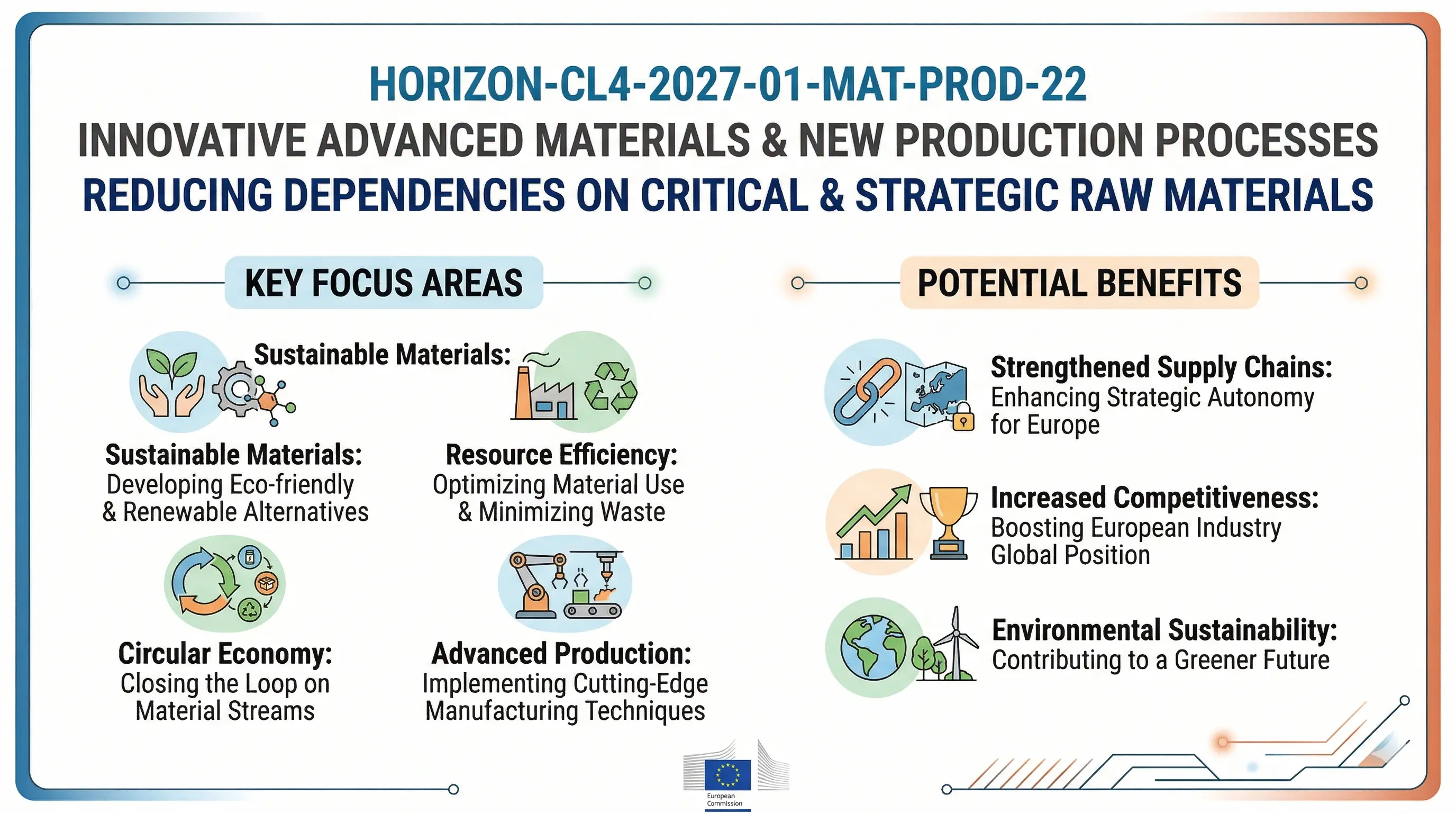
HORIZON-CL4-2027-01-MAT-PROD-22: Innovative advanced materials and new production processes – reducing dependencies on Critical and Strategic Raw Materials (IA) (Innovative Advanced Materials for the EU and Processes4Planet partnerships)
How can a catalyst use less critical metal without replacing it?
By making more of its metal available at effective reaction sites. Single-atom catalysts distribute isolated metal atoms on a support. Tian and colleagues used continuous flow to prepare platinum single-atom catalysts on nitrogen-doped carbon nanocages, then demonstrated hydrogen production with a low platinum loading in a laboratory proton-exchange membrane water electrolyser. [1]
For HORIZON-CL4-2027-01-MAT-PROD-22, this illustrates more efficient use, alongside partial or total substitution. Platinum belongs to the EU’s critical and strategic platinum-group metals; reducing the amount needed for a useful function can therefore address the topic’s dependency challenge.
Microfluidics Innovation Center (MIC) designs controlled-flow systems. Its Microfluidics Nanomaterial Synthesis Pack combines two pumping channels with hydrodynamic flow focusing. MIC could contribute fluid delivery and process integration to a consortium developing liquid-phase catalysts that reduce critical-metal demand.
Download the MIC Horizon Europe 2026/2027 Calls Calendar:
Discover more!
Call facts and participation conditions
Which call is it, and when are the opening and deadline?
- Topic: HORIZON-CL4-2027-01-MAT-PROD-22 (Official page)
- Call and destination: INDUSTRY – HORIZON-CL4-2027-01; Leadership in materials and production for Europe.
- Opening: 13 October 2026.
- Deadline: 02 February 2027, 17:00 Brussels time.
- Action: Innovation Action (IA).
- Indicative topic budget: EUR 36 million.
- Expected EU contribution per project: EUR 6.00–7.50 million. Proposals requesting different amounts may also be submitted and selected.
- Indicative number of projects: 6.
Which conditions need particular attention?
Activities are expected to start at Technology Readiness Level (TRL) 5 and achieve TRL 7 by project completion. A business case and exploitation strategy are required; the page limit is extended by three pages to accommodate them. This does not prescribe a separate three-page chapter.
Participation is geographically restricted. Eligible establishment categories are EU Member States, Associated Countries, OECD countries, African Union Member States, MERCOSUR, CARIFORUM, the Andean Community, countries with EU strategic partnerships on raw materials, and countries covered by EU trade, association, economic partnership or equivalent agreements containing raw-materials cooperation provisions, including the new Clean Trade and Investment Partnerships.
A proposal including an entity established outside these categories is ineligible. Entities established in an eligible country are also excluded if directly or indirectly controlled by an ineligible country or an entity from such a country. Participation eligibility does not itself establish entitlement to EU funding; apply General Annex B as well.
The destination excludes entities established in China from IAs, subject to the justified case-by-case exceptions described in General Annex B. The topic’s specific establishment and control conditions must also be satisfied. The work programme additionally applies the restriction concerning Chinese public universities administered by or under the supervision of the Ministry of Industry and Information Technology (MIIT).
The granting authority may object to transfers of ownership or exclusive licensing of results for up to four years after the action ends. The Cluster 4 work programme and General Annexes contain the full conditions; use the submission template for the applicable page limit.
Scientific scope: substitution and more efficient material use
The topic seeks reduced dependencies through partial or total substitution of critical and strategic raw materials, more efficient use in production processes, or both. Expected outcomes also include faster innovation cycles, stronger competitiveness and improved operational costs, more secure supply chains, and safer, more sustainable materials, products and processes.
Proposals should address one or several of three approaches:
- Materials: Design, develop and produce innovative advanced materials (IAMs) with performance, safety and sustainability targets.
- Processes: Develop industrial processes that reduce critical-material use while improving safety, sustainability, flexibility, scalability and cost-efficiency.
- Co-development: Develop IAMs and industrial processes together, demonstrating the value through specific use cases while maintaining broad relevance across materials and process types.
Energy, mobility, construction, electronics, medical devices and chemical industries are examples of relevant sectors. Identify clear use cases, markets and growth potential. Explain substitution barriers and the mechanism for maximising substitution in the targeted value chains; the topic sets no universal threefold substitution target.
Connect materials and process redesign to product integration. Address necessary manufacturing adaptations and, where relevant, barriers to modifying existing production lines.
Apply the Safe and Sustainable by Design (SSbD) framework throughout innovation, showing how it changes decisions transparently and traceably while technical functions are maintained. Ensure generated data can be shared with the Common Data Platform for Chemicals. Where data exchange is relevant, follow the work programme’s FAIR principles: findable, accessible, interoperable and reusable data.
The topic implements the Innovative Advanced Materials for the EU (IAM4EU) and Processes4Planet partnerships.
Design a measurable route to industrial deployment
Use the following design recommendations to connect the proposed innovation to measurable industrial benefits:
- Define the dependency and baseline. Name the critical or strategic input, its supply-chain role and the existing product or process. Measure the reduction against a specified technical function, including yield and service life.
- Justify the selected approach. Choose materials development, process innovation or co-development according to the barrier being addressed. Explain why the proposed changes should preserve the application’s required performance.
- Plan qualification before scale-up. Link starting evidence to the TRL 5 expectation, define the operational demonstration needed for TRL 7, and identify acceptance criteria with industrial users. A laboratory result alone does not establish the final demonstration level.
- Use SSbD at decision points. Compare candidate routes before committing to a process. Include worker and consumer safety where relevant, and document trade-offs rather than treating sustainability as a final reporting task.
- Make exploitation concrete. Describe customer needs, EU and global market estimates, cost-effectiveness and a supported competitive advantage. Identify investments, skills, value-chain partners and industrial integration needed for deployment.
The destination expects a credible initial exploitation strategy backed by company management. For TRL 7, explain the route to future full-scale deployment in the EU and the industrial partners’ intentions after the project.
Build the consortium around the selected value chain
Organise the consortium around the selected material, process and application. The general minimum is three independent beneficiary entities in three different countries: at least one in an EU Member State and two others in different Member States or Associated Countries. The topic does not prescribe an ideal consortium size, a private-sector percentage or an industry-led coordination model.
Select partners for the following functions:
- Materials and chemistry: Define composition, structure and performance; quantify the targeted critical-material reduction.
- Process engineering and manufacturing: Develop scalable processing, assess existing production-line constraints and integrate the solution.
- Industrial users: Set application requirements and validate the material or product in representative operating conditions.
- Safety, sustainability and uptake: Provide SSbD assessment, relevant data management, market analysis and exploitation expertise.
Define who supplies feedstocks, reference materials, process data and validation facilities, and who accepts each deliverable. One partner may cover several functions.
Cooperation with relevant projects is encouraged. Where relevant, actively contribute to and cooperate with the EU Innovation and Substitution Hub(s), allocating resources to the proposed activities. Under the destination conditions, selected projects will also be called upon to cooperate with relevant Joint Research Centre (JRC) activities.
Microfluidics for critical-metal-efficient catalyst synthesis
Controlled precursor delivery matters when concentration differences affect metal dispersion. Tian and colleagues combined experiments and simulations to link flow mixing, support chemistry and stable platinum anchoring. [1]
MIC integrates flow control, sensing and microfluidic channels in its nanomaterial synthesis setup. The setup uses hydrodynamic focusing and includes third-party Microfluidic ChipShop chips. This engineering capability supports a defined contribution to liquid processing.
As a consortium partner, MIC could develop a controlled-feed and mixing module for the selected catalyst synthesis route, integrate flow measurements, and establish sampling points for comparison with the reference process. Proposed outputs could include the integrated module, an operating protocol and a transfer report linking flow conditions to the partners’ material-quality measurements.
Materials specialists would define the chemistry and characterise metal loading and dispersion. Application partners would test catalytic performance and durability; manufacturing partners would validate throughput and production integration. Solvent compatibility, temperature, suspended solids, fouling and the required flow range must guide hardware selection and qualification. The contribution should connect synthesis control to critical-metal savings and the project’s industrial demonstration.
The MIC already brings its expertise in microfluidics to Horizon Europe:
H2020-NMBP-TR-IND-2020

Microfluidic platform to study the interaction of cancer cells with lymphatic tissue
H2020-LC-GD-2020-3

Toxicology assessment of pharmaceutical products on a placenta-on-chip model

About the author

Céleste Chidiac, PhD
Scientific writer and digital marketing specialist
Céleste Chidiac holds a doctorate in neuroscience and molecular biology from the University of Strasbourg. Since joining the Microfluidics Innovation Center in 2023, she has combined scientific writing with website management. For MIC’s Horizon Europe topic pages, she draws on her research background to explain scientific challenges and clarify funding priorities. Her writing helps prospective applicants understand each topic’s scope, expected outcomes and research directions.
FAQ – Critical-material substitution and process validation
These questions examine measurement choices, catalyst evidence and the practical limits of transferring a material process into production.
Are raw-material criticality and chemical hazard the same thing?
No. EU raw-material criticality concerns economic importance and supply risk. Chemical hazard concerns harmful properties. A substitute therefore needs separate safety and sustainability assessment; reducing dependency does not by itself demonstrate that a material is safer.
How should a proposal measure critical-material savings?
Define the functional unit first: for example, metal consumed per quantity of qualified product or per service delivered over a specified lifetime. As a measurement plan, include rejected output, replacement frequency and recovery. A lower material percentage alone does not quantify the dependency reduction.
Is catalyst metal content the same as electrode metal loading?
No. Metal content is the metal’s mass fraction in catalyst powder; electrode loading is metal mass per electrode area. Tian and colleagues reported both for their platinum catalysts. A concentrated powder can still be applied at low metal loading. [1]
How can isolated metal atoms be distinguished from nanoparticles?
Use complementary measurements. Tian and colleagues combined atom-resolution electron microscopy with X-ray absorption measurements to assess atomic dispersion and coordination in their tested catalysts. Particle-size measurements alone would not reproduce that assessment. [1]
What should a metal balance include during process development?
Track metal entering with feedstocks and leaving in qualified product, rejected material, wash liquids, equipment residues and recoverable streams. Identify sampling uncertainty and unaccounted losses. This recommended balance separates efficient incorporation into a product from merely feeding less precursor.
What needs checking before a particle-containing feed enters a microreactor?
Qualify the suspension, wetted materials, channel dimensions and operating conditions together. A useful test plan covers settling during feeding, deposition, pressure changes, cleaning and product quality over the intended run. Hardware selection should follow those tests and the process requirements.
How should parallel flow channels be qualified for higher production?
Compare individual channels as well as the combined outlet. Check flow distribution, temperature, residence conditions and product quality during representative runs. Increasing the number of channels is a proposed scale-up route; acceptance criteria should establish whether each channel maintains the required process conditions.
What information makes synthesis data reusable by another partner?
Record material and sample identifiers, concentrations, flow settings, geometry, temperature, sampling time, analytical methods, calibration and uncertainty. Link these records to product-quality results and define access and reuse conditions. A sensor log alone does not satisfy the work programme’s FAIR data principles.
How should partners test a flow-synthesis module developed with MIC?
Agree separate acceptance tests for the fluidic module and the catalyst it produces. Microfluidics Innovation Center (MIC) develops and transfers custom microfluidic systems to partner laboratories. For this application, a proposed test plan should connect flow-control measurements to the materials partner’s composition and structure measurements, then to the user’s catalytic tests.
What evidence links a promising catalyst to an industrial use case?
An industrial validation plan should connect catalyst quality to product performance, sustained operation, manufacturing yield, throughput and cost under defined conditions. Include representative feedstocks and operating cycles. These measurements provide the basis for judging whether the proposed process can meet the user’s requirements at the intended production scale.
References
[1] Tian J, Zhou C, Feng B, Liu X, Deng M, Yang H, Huang H, Wang X, Wu Q, Yang L, Hu Z. Scalable microfluidic synthesis of noble metal single-atom catalysts. National Science Review. 2026;13(15):nwag276. doi:10.1093/nsr/nwag276