Tips & Tricks for a successful HORIZON-CL5-2026-07-D1-05 proposal
Opening
18 December 2025
Deadline
Keywords
climate neutrality
weather models
Climate changes
African communities
Sustainable Energy
Earth System
African dynamics
rainfall
extreme weather events
Your microfluidic SME partner for Horizon Europe
We take care of microfluidic engineering, work on valorization and optimize the proposal with you
HORIZON-CL5-2026-07-D1-05: Improving climate and weather models for Africa
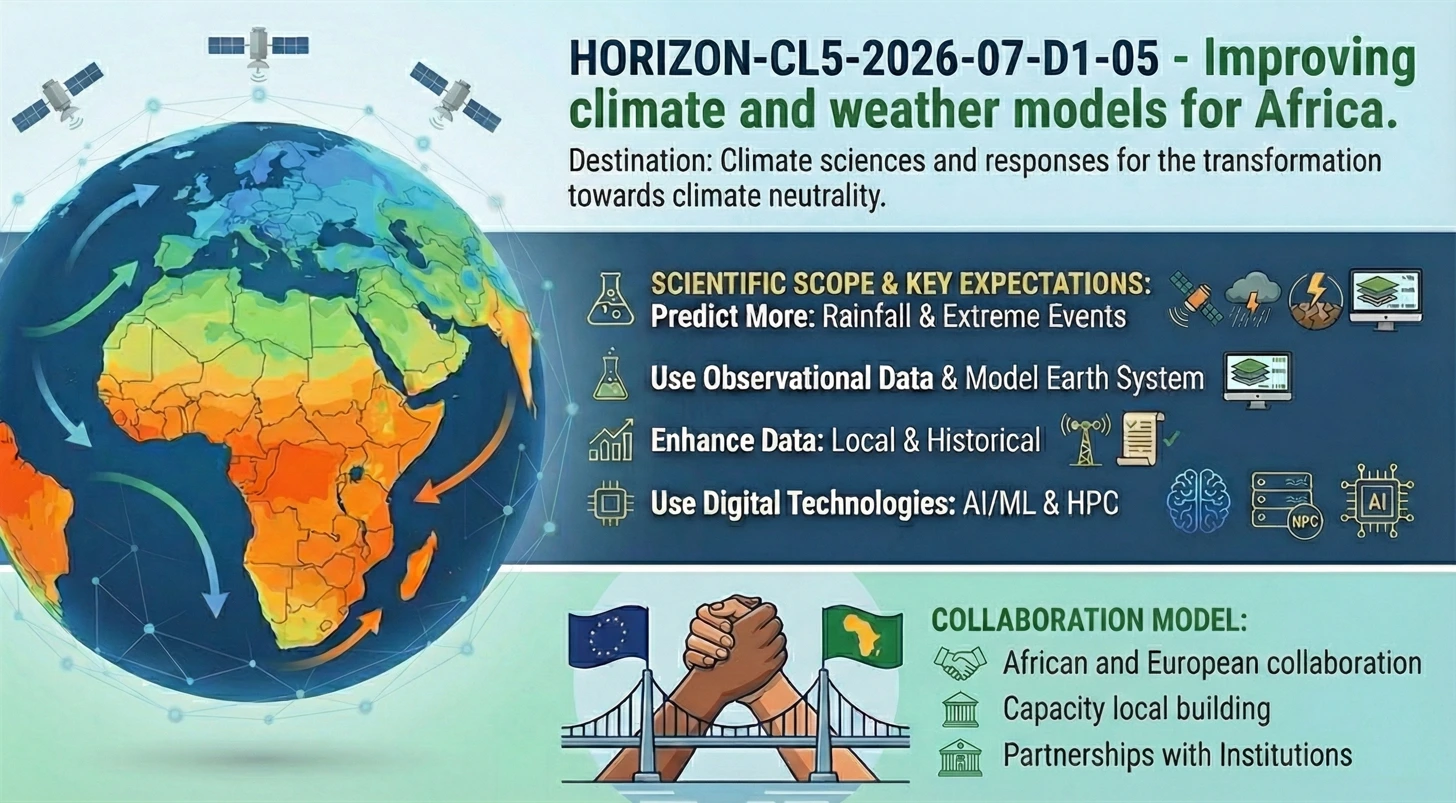
The Commission desires improved weather and climate models to be constructed in Africa, through mixed African-European groups. The vulnerability of the continent to climatic changes is known in books, but the modelling tools to anticipate the same are underpowered in the African context. This subject will finance studies so as to bridge that divide: more accurate rain predictions, reduced doubts about extreme conditions, and actual possession of such instruments by African researchers. Not merely co-operation, but co-creation in which the African institutions would be left with sustainable capacity.
Download the MIC Horizon Europe 2026/2027 Calls Calendar:
Discover more!
Administrative facts: What do we know about the HORIZON-CL5-2026-07-D1-05 call?
Which call is it, and when is the opening and the deadline?
- Call: HORIZON-CL5-2026-07 (CLIMATE)
- Destination: Climate sciences and responses for the transformation towards climate neutrality (Destination 1)
- Topic: HORIZON-CL5-2026-07-D1-05
- Opening date: 18 December 2025
- Deadline: 15 April 2026, 17:00:00 Brussels local time
- Type of action: Research and Innovation Action (RIA)
What about the budget and estimated size of the project?
- Overall indicative budget for the topic: EUR 21.00 million
- Indicative number of projects expected to be funded: 3
- Expected EU contribution per project: around EUR 7.00 million
What are the key eligibility and evaluation conditions?
- Standard eligibility conditions according to General Annex B except as follows:
- In case the projects involve the utilization of satellite-based earth observation, positioning, navigation and/or other timing information and services, beneficiaries have to utilize Copernicus and/or Galileo/EGNOS (the usage of other data and services can also be considered).
- Legal entities that have been put in place in all members of the African Union are exceptionally eligible to EU funding.
- Legal entities that are incorporated in the member states of the African Union must form at least 30 percent of the beneficiaries.
- Open access requirement: all modules, models or tools, which are created completely new or significantly enhanced must be documented and made available including model code and input data.
- The eligible costs will be in the form of a lump sum.
- Normal RIA assessment levels are used (General Annex D).
- It is highly advisable to cluster with other funded projects.
Scientific range: what does the Commission expect from the HORIZON-CL5-2026-07-D1-05 grant?
The Commission is after real improvements in how we model weather and climate over Africa. Not gradual changes to current world paradigms, but focused interventions on the processes that are the most critical on the continent: rainfall dynamics, extreme weather, and the interactions between land, ocean, and atmosphere at regional or continental scale.
- The gaps in the knowledge on weather and climate modelling that are particular to African settings should be addressed with proposals. Consider large-scale dynamics of the atmosphere, the monsoon circulation, dust-atmosphere interactions (check again as this is one of those details that reviewers will seek to find).
- The focus of what the Commission anticipates is the development of model predictive capability in rainfall and extreme events. The game is known as uncertainty reduction.
- The scope includes a lot of harnessing of observational data. That incorporates a more effective data collection, enhancement of assimilation, quality verification, and introduction of recovered historical data and local datasets which are frequently underutilized.
- Artificial intelligence, machine learning and high performance computing are expressly promoted. The Commission obviously regards digital approaches as accelerators in this case, but not as a different track.
- African-European team co-creation is not a choice. The text of the work programme is rather direct: the research must be conducted in collaboration, and at all stages, the relevance and co-ownership by the African stakeholders should be present.
- The development of sustainable capability in Africa is in the forefront. Educating the future generation of African climate researchers, lessening the reliance on foreign know-how, and making Africans more represented in institutions such as the IPCC and the UNFCCC.
- Projects would be connected with the current EU-funded projects on climate modelling in Africa such as Regional Centres of Excellence. And they ought to provide European supercomputers resources and data repositories to African researchers.
Its anticipated deliverables are crude: superior models, superior projections, more African scholars at the table when global climatic policies are being crafted. Publication lists will not be sufficient here.
Scientific strategy: how can you enhance your chances of being funded through HORIZON-CL5-2026-07-D1-05?
So which scientific decisions are the most important?
- Selection of regional focus is wise. Do not attempt to make the continent in equal measure. The reviewers will be interested in seeing that you are aware of what climate dynamics are not being well represented by the existing models in your region of interest, and why. West African monsoons, East African drought, Southern African heat: choose and defend.
- Get your modelling based on observation data. Pure numeric experiments are not sought by the Commission. They desire the presence of better pipelines of data into the models, actual consideration of data rescue, local station networks and quality control. We are presented with numerous ideas that consider data as an appendage. Here, it’s the backbone.
- Demonstrate how AI/ML speeds up and not eliminates. Apply machine learning to downscale, to fill in gaps in the observation records, or to hybrid methods which use both process-based and data-driven models. But have the physical understanding at the fore. A black-box neural network will most likely not persuade this panel.
- Bring the capacity-building plan into life. What is the number of African early-career researchers who receive training? What skills do they acquire? Which organizations will be able to self-sufficient after the project concludes? The empty declarations of the knowledge sharing will not score high. Put numbers on it.
- Anticipate Copernicus integration at the beginning. The satellite data eligibility requirement implies you should integrate Copernicus products in your workflow. Don’t retrofit this later.
- Allot finances towards group work. The work programme says it. About 2-4% of the budget we would argue towards coordination with sibling projects, joint workshops, data sharing arrangements.
Consortium and proposal-writing plan: what works best with this type of Climate RIA?
- Stake to 10 or 14 partners, more or less. Under the 30% African beneficiaries rule, it implies that there must be at least 3 to 5 African beneficiaries as opposed to being associated.
- At least one or two of these should be good climate modelling centres (think national meteorological services or university groups with CMIP track records), as well as a data management specialist. Even better, should you be able to engage an entity that is in connection with a European supercomputing centre.
- The natural anchors on the African side are National Meteorological and Hydrological Services and Regional Climate Centres. Match them with African institutions of higher learning with active PhD programmes in atmospheric sciences or other related subjects.
- A new SME specializing in climate information processing, weather data analytics with AI technologies, or geospatial data platforms is naturally suited here and can provide the necessary tools development that does not always succeed in large organizations.
- The lump sum format implies that your budget framework must be legitimate and transparent at the beginning. No fuzzy work packages. The contribution and cost of each partner should be reflected in the proposal and not to be determined later.
- Use the Nairobi Declaration, the Team Europe Initiative on Adaptation and Resilience in Africa and the AU-EU Partnership on Climate Change and Sustainable Energy as clear hooks to write out the impact section. Reviewers will check
How would microfluidics contribute to this topic?
This is more of an atmospheric and climate modelling subject and hence the indirect relationship with microfluidics. Nevertheless, some angles need to be mentioned, namely those involving environmental monitoring and sensor technology.
- African climate observation systems use sensor equipments, which frequently collapse when the conditions are not favorable. Microfluidic-based environmental sensors are capable of measuring low power aerosols, dust load, or trace gases, and are portable. It would be value added to your consortium to have a partner that can deliver compact, ruggedised sensor platforms in remote locations.
- Suppose you wish to monitor the way that dust in the Sahara is related to the formation of clouds. A microfluidic particle analyser will enable you to sort and count aerosol fractions on site in nearly real time, rather than having to ship samples to a European laboratory and wait many weeks to get an answer. Equal data quality, percentage of the logistics cost.
- Land-atmosphere coupling models are provided by water quality and soil moisture data. Microfluidic platforms, which operate field-ready chemical assays, can produce spatially distributed datasets which are difficult to acquire otherwise. And these instruments do not require a professional technician to take each measurement.
- Microfluidic sensor kits are also handy in case of training in capacity building. African scientists learn how to use and repair the hardware in their home countries, which is precisely in line with the self-sufficiency goal.
The microfluidics business case here is about closing gaps in observation with inexpensive, deployable sensors. If your proposal requires more ground-truth data to support the models and the current infrastructure does not cover your target area, the argument that a small sensor platform and enhanced model inputs are directly connected is not hard to make.
The MIC already brings its expertise in microfluidics to Horizon Europe:
H2020-NMBP-TR-IND-2020

Microfluidic platform to study the interaction of cancer cells with lymphatic tissue
H2020-LC-GD-2020-3

Toxicology assessment of pharmaceutical products on a placenta-on-chip model

About the author
Céleste Chidiac, PhD
Scientific writer and digital marketing specialist
Céleste Chidiac holds a doctorate in neuroscience and molecular biology from the University of Strasbourg. Since joining the Microfluidics Innovation Center in 2023, she has combined scientific writing with website management. For MIC’s Horizon Europe topic pages, she draws on her research background to explain scientific challenges and clarify funding priorities. Her writing helps prospective applicants understand each topic’s scope, expected outcomes and research directions.
FAQ - HORIZON-CL5-2026-07-D1-05 Horizon Europe proposal
What is this issue, and what is its position in Horizon Europe?
It is a one-stage Research and Innovation Action in Cluster 5 (Climate, Energy and Mobility), Destination “Climate sciences and responses towards the transformation towards climate neutrality. The specific objective is to enhance climate and weather forecasting in Africa through improved observations, process knowledge, modeling, and African-European co-created climate science.
What are the milestones and the fundamental budget calculations?
The application period runs from 18 December 2025 to 15 April 2026 at 17.00 local time in Brussels. The budget stands at 21.00 million EUR, with three projects to be funded provisionally. It means that it is expected to contribute 7.00 million EUR to the project per EU.
What are the scientific and technical works that are within scope?
Consider process-to-prediction rather than model tuning. Typical ingredients:
- Observational data rescue, quality checking, and assimilation (local and historical data).
- Land-ocean-atmosphere Process-based improvements between observations, parameterizations, and assessment protocols.
- Extreme pushing methods and rainfall methods (convection, organization, biases, seasonal problems/generalization).
- Digital and HPC enablers AI/ML as an emulation, downscaling, automation of QC, and hybrid modelling: obviously justifiable and not black-box only.
Operationalisation of “preparedness” in Africa (interfaces with communities of national/regional services and climate services)
So what kind of consortium shape would score well in or about 7M EUR?
A balanced composition is recurrently desired: African universities/research institutes with actual leadership roles; African national meteorological/hydrological services or regional climate centers (relevance and uptake); European modelling centers/universities (methodology); HPC/data specialists (pipelines, scalability, reproducibility); and end-user organizations (risk management, agriculture, water, health). The exploitation and tech transfer are enhanced with the addition of innovative SMEs (data engineering, sensors, AI/ML tooling, digital platforms).
What shall we call Excellence that sounds generic yet?
Be cruel with measurability. Specify a chain of observations – process knowledge–model improvements-validated prediction ability of extremes/rainfall. Indicate the level of change in skill that is expected and its expected amount, what baselines you will compare with, and how the situation of African decision-making motivates your targets. Bring sparse/heterogeneous observations, convection biases, HPC constraints, and reproducibility to the fore–then bind them to go/no-go milestones and fallback options.
What does a professional Impact section entail about this subject?
- Get Africa-specific pathway to impact: Who makes better predictions (through which agencies, to which sectors), when in their decision calendar, and by what channels? Assign outputs to adoption mechanisms: data formats, APIs, documentation, and training cohorts.
- Measure what is measurable: the number of datasets rescued and QC’d, the number of African early-career scientists trained, the number of operating interface pilots, the approximate percentage change in the chosen metrics of forecast skill, and a plan to transfer reproducible workflows.
Writing strategies that evaluators like?
Some of those which are consistent in assisting: parrot the topic language, without copy-pasting the text; have a one-page project logic map (what we have – how we do it – how we have made improvements – how we have validated our model – what we are making – how we are building capacity – what we are uptaking); be very specific on person-months and data management; and remind ourselves of the promise to have co-owners by making African partners lead projects (WP leads, data governance, publication strategy).
What can microfluidics and instrumentation contribute in this case?
Although climate modelling and data systems are the core of the area of interest, microfluidics would support the observation/QC pipeline. Examples include field-deployable lab-on-chip modules for denser networks (water quality proxies coupled to hydrology), standardized pre-processing (filtration, concentration, multiplexing) to minimize variability before assimilation, and even aerosol/cloud microphysics research under controlled conditions. Some microfluidic kits of training grade can be used to build local capacity in measurement and QA.
In what position does the Microfluidics Innovation Center (MIC) belong in a successful proposal?
MIC is a French SME focused on microfluidic engineering, instrument design, and the prototyping of scientific automation. We usually create rugged sensing/pretreatment modules, deploy them in data pipelines with strong QA, assist in implementing reproducible processes, and contribute to exploitation (industrialization roadmaps, tech transfer). Our success rates have historically been twice the official averages in Horizon Europe consortia, due to a combination of practical engineering, proposal-writing background, and R&D management. We have a routine of joining European consortia, and we feel at ease in the role of technical WP or cross-cutting (QA, data flows, validation setups).
How ought we to organize the budget and schedule pragmatically?
As a heuristic to a 7.00M EUR RIA in 36 months, most winning teams will allocate like one third to the data and observation work (rescue, QA, assimilation, infrastructure), one third to the modelling and methods work (including HPC), and one third to the capacity building, validation pilots, and uptake. Have reserves of HPC compute/storage and of maintenance field equipment. Bond significant expenditure on decision milestones to make the risk register financial.
Which evidence and KPIs do evaluators prefer to observe?
Statistical measures are good: number of new or reopened stations; terabytes of archived data recovered and checked; percentage decrease in critical biases; number of users flying services; number of African researchers in managerial positions; counts of training modules completed and retained capacity
Will MIC assist with writing the proposal, or only with the hardware details?
Both. Our responsibilities include co-designing experimental setups, prototyping and testing microfluidic models, and making contributions to data and quality assurance pipelines. We also assist in developing the story, Excellence, Impact, and Implementation, and in making it meet the evaluators’ expectations. As experienced SMEs in European projects, we know how to turn technical depth into a comprehensible, fundable story.