
EIC-2027-TRANSITIONOPEN: turning research results into validated applications
Opening
30 April 2027
Deadline
Keywords
EIC Transition Open
IP protection
Research results
Single beneficiary
Business readiness
User testing
business development
Technology validation
TRL 4
Your microfluidic SME partner for Horizon Europe
We take care of microfluidic engineering, work on valorization and optimize the proposal with you
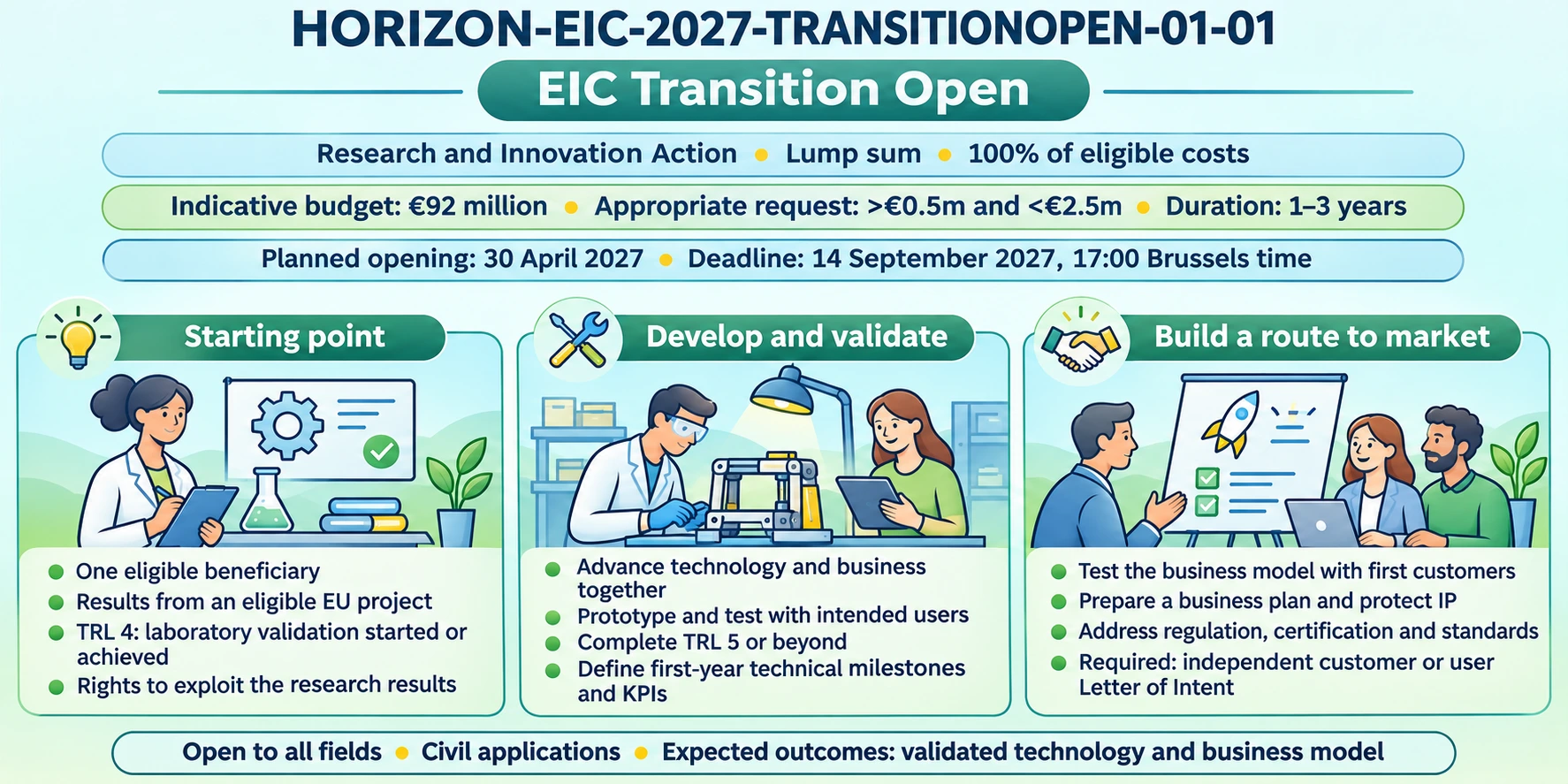
HORIZON-EIC-2027-TRANSITIONOPEN-01-01: EIC Transition Open
How can a prototype be optimised when technical and commercial requirements conflict?
By defining a feasible operating envelope: the combinations of performance, reliability, operating conditions and cost that satisfy the intended application. Increasing one property can make another harder to achieve. A faster process, for example, may require more energy or more expensive components. Development therefore needs explicit trade-offs and experiments that establish which combinations are achievable.
For HORIZON-EIC-2027-TRANSITIONOPEN-01-01, this connects technology maturation to business development. The project must establish that a research result can work in its intended application while testing the assumptions behind its commercial use. User feedback can change the design requirements; technical results can change the business model. EIC Transition Open funds this interaction across fields of science and technology.
Download the MIC Horizon Europe 2026/2027 Calls Calendar:
Discover more!
Call facts and the single-beneficiary application
Which call is it, and when does it open?
Topic: HORIZON-EIC-2027-TRANSITIONOPEN-01-01 – EIC Transition Open. The call is forthcoming, with no predefined thematic priorities.
- Planned opening: 30 April 2027. Submission deadline: 14 September 2027 at 17:00 Brussels local time.
- Action: Research and Innovation Action. Funding takes the form of a lump sum at 100% of eligible costs.
- Indicative call budget: €92 million. The EIC considers requests above €0.5 million and below €2.5 million, for 1–3 years, appropriate. This is the work programme’s stated range, not an expected award for every applicant.
- Applicant: one eligible legal entity established in an EU Member State or Associated Country: a start-up, small or medium-sized enterprise (SME), university or research/technology organisation. Companies larger than SMEs cannot be the beneficiary.
- Submission: Part B sections 1–3 plus the cover page must fit within 22 A4 pages. Include a three-to-five-minute video pitch and the required customer/user Letter of Intent.
Evaluation comprises remote assessment followed by a jury interview for shortlisted proposals. The remote thresholds are 4/5 in each of Excellence, Impact and Implementation. Meeting them does not guarantee an interview or funding.
The EIC Work Programme 2027 sets the conditions, including Annex 2 general requirements. The EIC Transition FAQs clarify the video duration and the 2027 changes. The planned opening may move by up to one month and the deadline may be delayed by up to two months under the work programme’s provisions.
Which research results can enter Transition?
The starting point for EIC-2027-TRANSITIONOPEN is technology readiness level (TRL) 4: laboratory validation has started or been achieved. Results must have progressed beyond experimental proof of concept. Results already at TRL 5 or higher are ineligible; for multiple core technologies, the lowest core-component maturity governs the assessment.
Eligible originating projects comprise:
- EIC Pathfinder, including Horizon 2020 pilot Pathfinder and Future and Emerging Technologies (FET)-Open, FET-Proactive and FET Flagships;
- European Research Council (ERC) Proof of Concept funded under Horizon Europe;
- Research and Innovation Actions under Horizon 2020 Societal Challenges and Leadership in Industrial Technologies, Horizon Europe Pillar II, and the European Defence Fund;
- Research and Innovation Actions under Horizon Europe Research Infrastructures.
The specific programme, action and result must qualify. Results from a previous EIC Transition project and grants awarded through financial support to third parties are excluded. An ongoing originating grant must have started more than 18 months before the deadline, or more than six months for ERC Proof of Concept. For a completed grant, its end must be less than 24 months before the deadline. Only one proposal may be submitted per eligible originating ERC Proof of Concept project.
Identify the originating grant number, acronym and where the result was reported. A previous project participant must confirm the necessary exploitation rights. A new applicant needs a result-owner commitment to negotiate fair, reasonable and non-discriminatory access for the project and at least one year afterwards.
The scope combines further development with application validation, aiming to complete TRL 5 or beyond, alongside a validated business model and business plan. Activities must focus exclusively on civil applications. An indicative eligible-project list does not establish the eligibility of a particular result.
Design validation around an application decision
Define the intended user, operating setting and technical advantage before selecting experiments. The call requires further technology development and user-centred methods. A useful validation plan connects each development task to a decision about performance or practical use.
- Set application-specific criteria. Choose measurable acceptance limits, relevant operating conditions and a suitable comparison with existing solutions.
- Separate evidence types. Identify what is measured in a prototype, predicted by a model or assumed for future production. Record uncertainty and the conditions under which a result applies.
- Link testing to design changes. Use early user feedback to prioritise integration, reliability or usability work where those factors affect adoption.
These are proposal-design recommendations, not additional universal technical requirements. The call does require concrete, verifiable milestones and key performance indicators (KPIs), including realistic technological targets for the first year.
The first-year review examines progress, reasons for shortfalls and continuing relevance. Missing a target triggers assessment; it does not automatically mean termination. A project will not continue if the review concludes that its objectives are no longer achievable or its expected results have lost relevance. Plan evidence that allows that decision to be made transparently.
Organise external contributions around one accountable beneficiary
EIC-2027-TRANSITIONOPEN has one beneficiary. Affiliated entities, associated partners and subcontractors can contribute where permitted and justified. The proposal should define what each external organisation supplies, how the beneficiary accesses it and who integrates the results.
The mandatory Letter of Intent must come from at least one interested potential customer or user, using the official template. Its signatory cannot receive money, subcontracting or other support from the action, and cannot later become a subcontractor or service provider. A supplier’s expression of interest or an expert’s support letter does not meet this condition.
The letter must confirm that no financial or other incentives were exchanged for the endorsement. Describe authentic intended cooperation and available resources; the agency may verify these commitments. Distinguish this customer/user letter from the separate result-owner commitment needed when the applicant did not participate in the originating project.
The beneficiary should generally conduct the central business-planning, market-validation and customer-engagement activities itself. Explain the team’s technical and commercial responsibilities and any plan to build missing capacity. Coaching is mandatory unless a justified exception applies; Business Acceleration Services provide additional support.
Make the route to market testable
The EIC-2027-TRANSITIONOPEN work programme requires an explicit commercialisation route, such as direct exploitation, a spin-off or licensing. It also requires business-readiness work, appropriate intellectual-property protection, and consideration of regulation, certification and standardisation. Proposals targeting niche or very small markets are considered unsuitable.
As a practical approach, connect each important business assumption to evidence: who experiences the problem, who can authorise adoption, what the solution replaces and which costs the customer would bear. Test the incipient business model with first customers while technology development continues.
Camuffo and colleagues studied 759 firms in four randomised trials. Training entrepreneurs to formulate and test hypotheses increased the termination of business ideas during the observation period. The sample covered several sectors and was not an EIC beneficiary cohort. [1] This supports using explicit assumptions as a planning method; it does not predict a Transition applicant’s outcome.
A useful final evidence package connects demonstrated application performance, customer findings, the validated business model and the next development decisions. Explain remaining technical and market risks and the proposed financing or licensing route. A higher TRL alone does not establish commercial readiness.
The MIC already brings its expertise in microfluidics to Horizon Europe:
H2020-NMBP-TR-IND-2020

Microfluidic platform to study the interaction of cancer cells with lymphatic tissue
H2020-LC-GD-2020-3

Toxicology assessment of pharmaceutical products on a placenta-on-chip model
About the author

Céleste Chidiac, PhD
Scientific writer and digital marketing specialist
Céleste Chidiac holds a doctorate in neuroscience and molecular biology from the University of Strasbourg. Since joining the Microfluidics Innovation Center in 2023, she has combined scientific writing with website management. For MIC’s Horizon Europe topic pages, she draws on her research background to explain scientific challenges and clarify funding priorities. Her writing helps prospective applicants understand each topic’s scope, expected outcomes and research directions.
FAQ - EIC-2027-TRANSITIONOPEN: Testing technology and market assumptions
These questions address practical distinctions that matter when research becomes an application: test conditions, user evidence, design changes and the interpretation of results.
What makes an environment relevant for technology validation?
It reproduces the conditions that materially affect the intended function. Depending on the application, those may include inputs, loads, temperature, interfaces or operator actions. State which conditions are represented and which remain outside the test. Relevance should be justified for the particular application.
How should a team choose the comparator for a prototype?
Use a solution that performs the same user task under comparable conditions. Define the comparison boundary, including preparation, operation and supporting equipment where relevant. A favourable component result cannot establish superiority for the complete workflow.
What is the difference between verification and validation?
Verification checks whether a design meets its specified requirements. Validation examines whether it fulfils the intended use. A prototype can meet its design specification while leaving an important user need unresolved, so the requirements themselves also need examination.
Can a simulation replace an application test?
A simulation can guide design and explore conditions that are difficult to test. Its usefulness depends on assumptions and comparison with suitable observations. Label predictions clearly and explain which application claims still require experimental evidence; model output alone is not measured prototype performance.
What should happen to results after a prototype is redesigned?
Check which previous conclusions depend on the changed component, material, software or interface. Repeat the affected validation and record the configuration tested. Keeping design versions with the corresponding datasets prevents evidence from one prototype being attributed to another.
How can a test avoid favouring the preferred design?
Define the comparison, acceptance criteria and analysis before inspecting the final results. Use comparable operating conditions and record failed runs and exclusions with reasons. Where feasible, separate the person operating the prototype from the person judging the outcome.
Why distinguish the user from the customer?
The user operates or benefits from the technology; the customer pays for it. A separate organisation may approve procurement or integration. Interviewing these groups separately helps reveal whether operational usefulness, purchasing authority and adoption constraints support the same value proposition.
How can negative customer feedback improve a development plan?
It can identify a weak application assumption before further design work depends on it. Investigate what the feedback changes and whether it warrants a revised use case or stopping that route. Entrepreneurial experiments by Camuffo and colleagues support testing assumptions, without guaranteeing that every change succeeds. [1]
What is the difference between a business model and a business plan?
A business model explains how an organisation creates, delivers and captures value. A business plan sets out how it intends to implement that model, including resources, milestones and financial assumptions. Both should change when technical or customer evidence challenges their premises.
How should early cost estimates be presented?
Separate observed costs from assumptions about future production volume, yield, maintenance and supply. Show which assumptions drive the estimate and how uncertainty affects the proposed price or adoption case. A prototype bill of materials does not establish the cost of a supported product.
References
[1] Camuffo, A., Gambardella, A., Messinese, D., Novelli, E., Paolucci, E. and Spina, C. A scientific approach to entrepreneurial decision-making: Large-scale replication and extension. Strategic Management Journal. 2024;45(6):1209–1237. doi:10.1002/smj.3580