
EIC 2027 ACCELERATOR CHALLENGES 01: Scaling ocean observations for operational marine monitoring
Opening
Continuous short-proposal submission
Deadline
Keywords
Ocean observation
Autonomous marine systems
High-resolution monitoring
Ocean mapping
Interoperable data
Marine biodiversity
eDNA sampling
Your microfluidic SME partner for Horizon Europe
We take care of microfluidic engineering, work on valorization and optimize the proposal with you
HORIZON-EIC-2027-ACCELERATORCHALLENGES-01: Advanced in-situ Ocean Observation Technologies for Scalable, High-Resolution Marine Monitoring
How much ocean does one water sample actually represent?
A sample collected from a moving vessel represents the water encountered during collection. Its spatial footprint therefore depends on the vessel’s path and the sampling duration. During a 29-day, 4,200-km Pacific transit, Preston and colleagues collected 52 environmental DNA (eDNA) field samples; individual collections integrated water along 0.6–15.1 km of the vessel’s track. [1]
This makes “high resolution” a property of the complete observation method. HORIZON-EIC-2027-ACCELERATORCHALLENGES-01 seeks ocean technologies that deliver sustained, scalable monitoring. A useful proposal should explain which marine features its system can distinguish, how observations are located in space and time, and how that information reaches the intended user.
Download the MIC Horizon Europe 2026/2027 Calls Calendar:
Discover more!
Call conditions and the 2027 application route
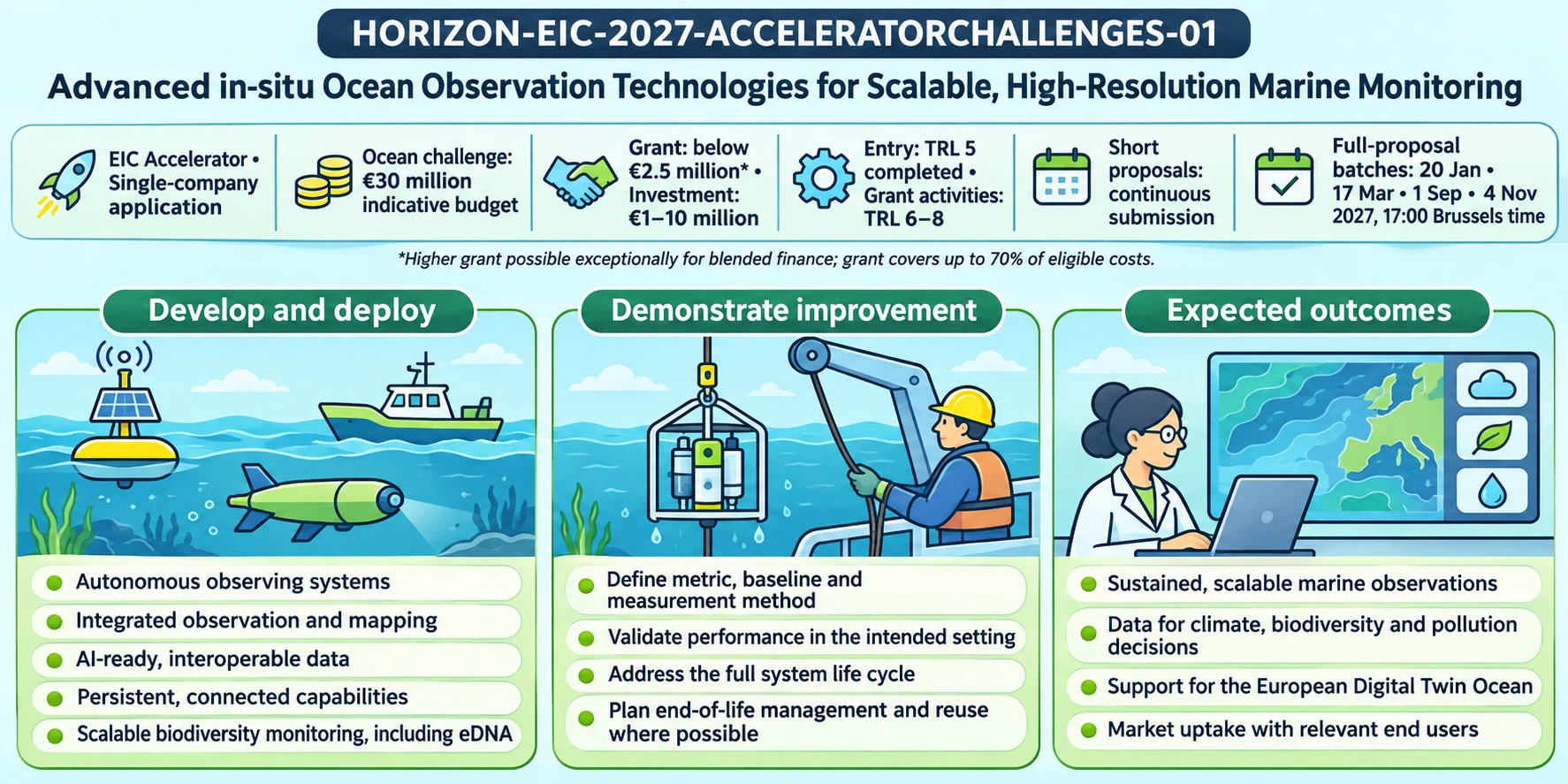
Call identifier: HORIZON-EIC-2027-ACCELERATORCHALLENGES-01. This page covers the ocean-observation challenge in section V.2.1 of the EIC Work Programme 2027. The identifier also covers the wider Accelerator Challenges call; the ocean challenge has its own scientific scope and indicative allocation.
- Funding scheme: EIC 2027 ACCELERATOR CHALLENGES 01, with grant-only, blended finance or investment-only support, subject to the conditions for each route.
- Indicative ocean-challenge budget: €30 million. The €150 million allocation is for all 2027 Accelerator Challenges combined.
- Applicant: a single start-up or small and medium-sized enterprise (SME) established in an EU Member State or an eligible Horizon Europe Associated Country. This is a single-company application. Small mid-caps with up to 499 employees can seek investment-only support, or exceptionally blended finance for rapid scale-up. Establishment and country-specific restrictions apply; UK entities are eligible for grant-only support.
- Technology readiness: all aspects of Technology Readiness Level (TRL) 5 must already be completed, including validation in a relevant environment for the intended application. Grant-funded innovation activities generally cover TRL 6–8.
- Grant component: a lump sum below €2.5 million, covering up to 70% of eligible costs. A higher grant is possible exceptionally for well-justified blended-finance cases. The beneficiary finances the remaining 30% of the grant work packages. Grant-only support is available only once per legal entity during Horizon Europe.
- Investment component: €1–10 million, normally equity or quasi-equity, with terms determined through the investment process.
- Full-proposal batching dates: 20 January, 17 March, 1 September and 4 November 2027, each at 17:00 Brussels time.
Short proposals can be submitted at any time and are batched for evaluation on the first Tuesday of each month at 17:00 Brussels time. A successful short proposal gives access to the full-proposal stage. Selected full-proposal applicants then attend an EIC jury interview. Follow the EIC Accelerator application procedure for the relevant forms and permitted application routes. Grant-supported innovation activities should normally finish within 24 months; longer durations need justification.
Which ocean-observation innovations fit the challenge?
EIC 2027 ACCELERATOR CHALLENGES 01 applicants must develop and deploy a deep-tech innovation addressing one or more of five priorities:
- Autonomous observation: sensor networks, autonomous marine vehicles, long-endurance systems, underwater communications and adaptive observation.
- Integrated observation and mapping: platforms and scales combined to improve marine mapping and persistent coverage.
- AI-ready, interoperable data: artificial intelligence (AI), heterogeneous data integration and datasets that are findable, accessible, interoperable and reusable (FAIR).
- Persistent, connected capabilities: scalable sensing and adaptive systems with potential environmental, economic, civil and security applications.
- Biodiversity monitoring: approaches using eDNA and AI-assisted species or habitat detection.
The expected outcomes connect observation technology to European ocean services, including the European Digital Twin Ocean, a stronger industrial value chain and market uptake. A proposal can focus on a particular technology or service; it should show how that choice contributes to the selected priority and the challenge’s outcomes. Full proposals are also assessed for Strategic Technologies for Europe Platform (STEP) impact, including economic potential in the EU market or reduced strategic dependencies.
How to make a high-resolution monitoring claim testable
EIC 2027 ACCELERATOR CHALLENGES 01 asks proposals to quantify improvement over current practice, identify the baseline and state how the improvement will be measured. It also asks applicants to address the system’s full life cycle, including end-of-life management and hardware reuse where possible.
For proposal design, define the observation that the customer needs before specifying the instrument. State the target variable or biological group, deployment setting, spatial coverage, sampling interval and acceptable delay before a usable result arrives. Compare the proposed system with an existing workflow under comparable conditions.
An informative validation plan can report:
- Measurement performance: comparison with a suitable reference, uncertainty, detection limits where applicable, and the conditions under which results remain usable.
- Observation coverage: the area or depth range actually sampled, time between observations and gaps in the record.
- Operational performance: usable observations per deployment, servicing effort, power and consumable needs, and recovery requirements.
- Service performance: time from measurement to delivery and the cost of producing a quality-controlled observation.
These are suggested ways to demonstrate improvement, rather than numerical thresholds imposed by the call. Select those that answer the intended user’s problem and set justified acceptance criteria before testing.
For biodiversity monitoring, the comparison should test the resulting biological information. Truelove and colleagues compared autonomous and shipboard eDNA sampling off California. Both captured patterns associated with depth and season, but some marker-specific differences remained. Their field samples were collected at approximately matched locations and times, rather than from identical water parcels. [2]
Company capabilities, users and the route to scale
The applicant company needs the expertise and resources to develop the innovation and grow the business. External laboratories, platform operators, observation networks and customers can support testing and deployment. Their contributions should have a defined scope and a clear interface with the applicant’s product. The grant component permits justified subcontracting, including essential activities only where justified; these arrangements do not create a multi-beneficiary application.
The EIC 2027 ACCELERATOR CHALLENGES 01 encourages engagement with relevant users, such as weather and climate services, aquaculture, shipping, offshore energy and environmental authorities. Choose users who can test the proposed service against a real operational decision. A demonstration agreement should establish access to the site or platform, reference measurements, the data product to deliver and who assesses its usefulness.
The commercial case should identify the buyer, purchasing route, competing solutions, intellectual-property position and realistic revenue model. Include deployment, maintenance, retrieval and data-processing costs in the scale-up plan. Explain which parts can be replicated across installations and which require local configuration.
A useful end point is evidence that the company can repeatedly deliver its promised observation service in the intended environment. Tie technical milestones to customer acceptance and the resources needed for wider deployment. Keep projected gains separate from performance already demonstrated.
Building an operational data service
For EIC 2027 ACCELERATOR CHALLENGES 01, data integration needs a defined output that another organisation can interpret. Specify units, coordinates, timestamps, instrument configuration and processing versions. Keep quality flags and explanations of exclusions with the observations. The Ocean Observatories Initiative’s quality-control approach provides a useful example: it combines calibration information, field verification, annotations and automated quality flags.
For an AI-enabled service, a useful evaluation should separate training data from independent test deployments. Report performance for the conditions the product is intended to encounter. Describe how the system handles observations that fail quality checks and how an operator can inspect the underlying evidence. These are design recommendations for an assessable service, not additional eligibility conditions.
Define what reaches the customer: raw measurements, a validated data stream, an interpreted indicator or an alert. Assign responsibility for reviewing questionable observations, maintaining calibration records and delivering revised results. Demonstrating this complete workflow helps connect hardware performance to the operational services sought by the challenge.
The MIC already brings its expertise in microfluidics to Horizon Europe:
H2020-NMBP-TR-IND-2020

Microfluidic platform to study the interaction of cancer cells with lymphatic tissue
H2020-LC-GD-2020-3

Toxicology assessment of pharmaceutical products on a placenta-on-chip model

About the author

Céleste Chidiac, PhD
Scientific writer and digital marketing specialist
Céleste Chidiac holds a doctorate in neuroscience and molecular biology from the University of Strasbourg. Since joining the Microfluidics Innovation Center in 2023, she has combined scientific writing with website management. For MIC’s Horizon Europe topic pages, she draws on her research background to explain scientific challenges and clarify funding priorities. Her writing helps prospective applicants understand each topic’s scope, expected outcomes and research directions.
Ocean monitoring: scientific and operational questions
These questions examine sample integrity, data interpretation and continuity when instruments operate beyond the laboratory.
Does autonomous sampling provide real-time biodiversity results?
Not automatically. A sampler may collect and preserve material at sea while DNA extraction and sequencing happen after recovery. In Preston and colleagues’ deployment, onboard collection was autonomous, but molecular analyses followed sample retrieval. A proposal should distinguish sampling frequency from the delay before an interpreted result becomes available. [1]
Can an eDNA non-detection establish that a species is absent?
An environmental DNA (eDNA) non-detection should be interpreted within the sampling and analytical method. In Truelove and colleagues’ comparison, one vertebrate family appeared in seven shipboard samples and no autonomous samples. This difference supports checking replication, marker choice and sampling coverage before treating a negative result as ecological absence. [2]
Why retain both positive and negative sampling controls?
Positive controls test whether known material survives collection, storage and analysis. Negative controls help reveal contamination. Preston and colleagues used both, finding that storage conditions affected recoverable DNA and that contamination needed assessment. A design recommendation is to budget for control samples throughout the intended deployment. [1]
Is a quality flag the same as a correction to a measurement?
No. A flag records the outcome of a quality check; it does not itself replace the measured value. The Ocean Observatories Initiative distinguishes observations that pass, have not been evaluated, are suspect, fail or are missing. Keep the original measurement, processing history and associated flags available for interpretation.
How should an observing system handle communication outages?
A useful design should define local storage, timestamp preservation and recovery after reconnection. Test whether delayed records arrive with their original acquisition time and whether gaps remain visible. Choose the buffering capacity and permissible delay from the intended service requirements; the challenge does not prescribe one universal communications architecture.
How can a replacement sensor preserve continuity in a long time series?
Plan an overlap or a reference comparison, retain both instruments’ calibration records and document the change. The Ocean Observatories Initiative’s instrument-replacement process includes laboratory and field testing and, where possible, concurrent deployment. This supports assessing whether an apparent environmental change could instead reflect a change in the measurement system.
What distinguishes a scheduled sample from a successfully collected one?
A mission log should separate attempts, accepted samples and failed collections. Record the completed volume and any reason for stopping, then make the acceptance rule explicit. This lets users audit the delivered sample set without treating every scheduled collection as a usable observation.
How should an adaptive survey retain a comparable baseline?
Keep a planned set of reference observations alongside event-triggered measurements. Record the trigger, route change and skipped observations. In validation, compare the adaptive and baseline strategies under stated time and resource budgets, so extra sampling of an interesting feature is not mistaken for representative coverage.
What should be checked after a long deployment ends?
Inspect recovered instruments and compare their response with the pre-deployment state where the method permits. Preserve inspection findings and annotate affected records. The Ocean Observatories Initiative includes post-recovery characterisation for some instruments; its findings can prompt further data annotations.
How can an ocean-data alert be evaluated with its intended user?
Agree on the marine event, reference evidence and time window before testing. Evaluate missed events, false alerts and the delay before a decision can be taken. Report those outcomes separately, using thresholds justified by the user’s operational needs.
References
[1] Preston, C., Yamahara, K., Pargett, D., Weinstock, C., Birch, J., Roman, B., Jensen, S., Connon, B., Jenkins, R., Ryan, J., & Scholin, C. Autonomous eDNA collection using an uncrewed surface vessel over a 4200‐km transect of the eastern Pacific Ocean. Environmental DNA. 2024;6(1):e468. First published online 29 August 2023. doi:10.1002/edn3.468
[2] Truelove, N. K., Patin, N. V., Min, M., Pitz, K. J., Preston, C. M., Yamahara, K. M., Zhang, Y., Raanan, B. Y., Kieft, B., Hobson, B., Thompson, L. R., Goodwin, K. D., & Chavez, F. P. Expanding the temporal and spatial scales of environmental DNA research with autonomous sampling. Environmental DNA. 2022;4(4):972–984. doi:10.1002/edn3.299