
EIC Pathfinder challenge 3 2027: Quantum Energetics: proving an energy advantage at useful performance
Opening
27 May 2027
Deadline
Keywords
Quantum Energetics
Energy efficiency
Quantum computing, sensing
Quantum communication
Full-stack benchmarks
Proof of concept
Your microfluidic SME partner for Horizon Europe
We take care of microfluidic engineering, work on valorization and optimize the proposal with you
HORIZON-EIC-2027-PATHFINDERCHALLENGES-01: Quantum Energetics
Why can making a quantum calculation more reliable increase its energy demand?
Suppressing errors can require additional physical qubits, control operations and supporting equipment. The energy cost of reliability therefore depends on how the whole system is designed. Fellous-Asiani and colleagues modelled this interaction using idealised superconducting hardware and error-correction assumptions; their analysis identifies configurations that minimise resource use at a chosen performance target, rather than demonstrating an operating machine’s energy advantage. [1]
For EIC Pathfinder challenge 3 2027, this makes reliability part of the energy question. Quantum Energetics seeks technologies whose energetic advantage is demonstrated for a defined computing, communication or sensing task. The proof must connect lower consumption to the performance needed for that task, while accounting for the equipment that makes quantum operation possible.
Download the MIC Horizon Europe 2026/2027 Calls Calendar:
Discover more!
Call facts for Quantum Energetics
Which call is it, and when does it open?
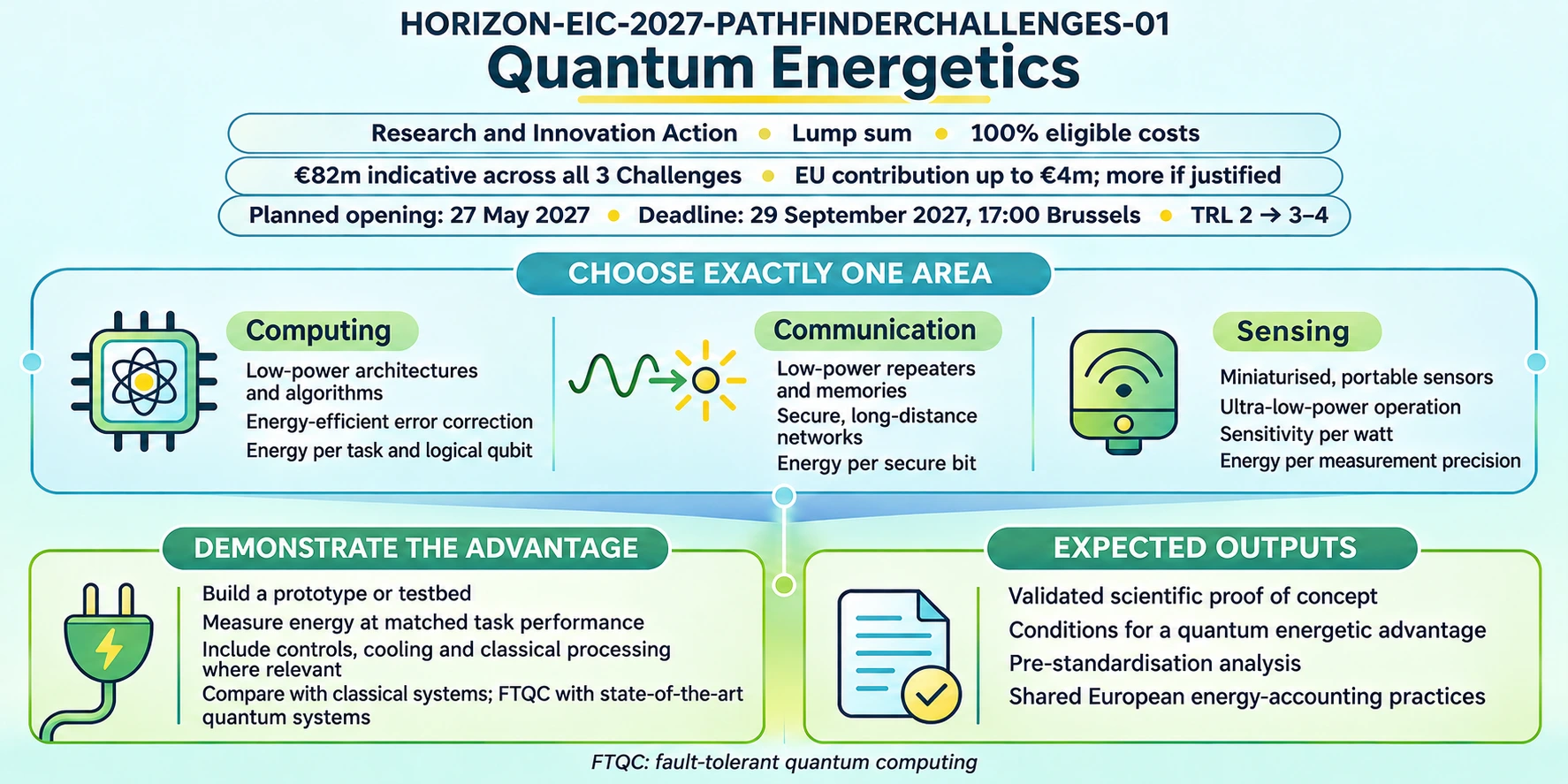
HORIZON-EIC-2027-PATHFINDERCHALLENGES-01 is the shared EIC Pathfinder Challenges 2027 call identifier. Quantum Energetics is Challenge 3 2027, described in section II.2.3 of the EIC Work Programme 2027.
- Schedule: planned opening on 27 May 2027; deadline on 29 September 2027 at 17:00 Brussels local time. The work programme permits an opening shift of up to one month and a deadline delay of up to two months.
- Action and funding: Research and Innovation Action, with lump-sum funding covering 100% of eligible costs. An EU contribution of up to €4 million is considered appropriate; a larger request may be justified.
- Budget: €82 million indicative for the entire call, expected to be allocated approximately equally across the three Challenges. This is not a dedicated Quantum Energetics allocation.
- Technology readiness level (TRL): start at TRL 2 and reach TRL 3–4, supported by a prototype or testbed and empirical evidence of the required energetic advantage.
- Application: one submission deadline, followed by individual assessment and portfolio selection. Sections 1–3 of Part B have a 30-page limit. Proposals are submitted through the Funding & Tenders Portal.
Who can apply to EIC Pathfinder challenge 3 2027 ?
A single eligible entity in an EU Member State or Associated Country can apply, except a mid-cap or larger company. A two-entity consortium needs independent entities in two different Member States or Associated Countries. A consortium of three or more needs at least three independent beneficiaries in different countries: one in a Member State and two others in Member States or Associated Countries.
The EIC work programme’s Annex 2 governs the remaining eligibility and funding conditions. Additional restrictions apply where a proposal concerns the evolution of European communication networks. The relevant Challenge Guide provides further technical and portfolio guidance.
Choose one scientific area and define its useful output
An EIC Pathfinder challenge 3 2027 proposal must focus on one, and only one, of three areas. The shared objective is an experimentally supported energy advantage arising from the quantum technology, with the conditions of that advantage made explicit.
- Full-stack quantum computing: develop low-power architectures, compilers, algorithms and energy-efficient error correction. Define energy per task and performance targets, include classical post-processing, derive fundamental energy bounds, and account for qubits, control, readout, cooling and classical co-processing. Assess energy per logical qubit and fault-tolerance overhead.
- Quantum communication: develop energy-efficient technologies, such as low-power repeaters and photonic memories, for secure long-distance networks. Energy per secure bit is one relevant metric; the comparison must address the classical encryption overhead specified by the call.
- Quantum sensing: develop miniaturised, portable, ultra-low-power sensors with improved precision and sensitivity. Establish sensitivity-per-watt and energy-per-measurement-precision benchmarks.
The comparator matters. Quantum computing, communication and sensing prototypes must show lower energy use than relevant classical counterparts for the targeted use case. For fault-tolerant quantum computing (FTQC), the required comparison is with state-of-the-art quantum solutions. These are distinct validation routes, not interchangeable claims.
Design the experiment around a fair comparison
In EIC Pathfinder challenge 3 2027, a useful validation plan fixes the task and acceptance criteria before selecting the preferred architecture. Specify the result quality, operating conditions and reference implementation. This prevents an apparent energy reduction obtained by delivering a less useful result.
- Define the accounting boundary. Identify each included subsystem and its measurement point. Integrate electrical power over the task duration and include applicable classical processing and infrastructure loads.
- Separate prediction from measurement. Use models to choose experiments, then report which quantities the prototype actually measures. State the assumptions behind extrapolation to larger systems.
- Make the comparison reproducible. Retain workload definitions, configuration files, calibration information, repeated measurements and uncertainty estimates alongside the energy result.
Communication research illustrates why component selection needs a system-level check. Yehia and colleagues’ modelling found regimes where a less efficient photon detector reduced total energy consumption while extending execution time. Their preprint also examines how classical processing changes comparisons between protocols. These results depend on the modelled hardware and network conditions. [2]
Connect the expertise needed to deliver the testbed
For EIC Pathfinder challenge 3 2027, organise the team around the selected area and the interfaces that determine its energy cost. This is a design recommendation, not an additional consortium-size rule.
- Quantum specialists establish the physical mechanism, performance target and conditions under which the proposed advantage can occur.
- Hardware and software engineers implement the relevant control, readout, compilation, decoding or optical functions and expose their resource costs.
- Measurement specialists and application users help define comparable operating conditions, uncertainty and a task that has practical value.
Allocate responsibility for the reference system as clearly as for the new prototype. Agree who supplies benchmark workloads, who measures each subsystem and who checks whether the outputs meet the same acceptance criteria. Explain how access to the required testbeds will support the work plan.
Plan publications, intellectual-property protection and exploitation around the scientific result and its intended use. The common Pathfinder conditions also call for assessment of relevant regulatory, certification and standardisation issues. These activities should follow the chosen technology and its maturity.
Turn the proof of concept into reusable evidence
The endpoint of EIC Pathfinder challenge 3 2027 is a validated scientific breakthrough with a clear account of when its energetic advantage holds. A useful evidence package combines the prototype or testbed, benchmark protocol, measured energy and performance data, uncertainty analysis, and limits of the demonstrated operating range.
Portable sensing shows why those limits matter. Deguchi and colleagues reported a diamond nitrogen-vacancy sensor module consuming 3 W from a laptop’s USB supply. The figure describes the module, not the laptop’s total consumption, and does not by itself demonstrate an advantage over a classical sensor. [3]
All projects are expected to contribute to pre-standardisation, including analysis of relevant terminology, use cases and benchmarking practices. Projects should also collaborate across the Challenge portfolio on a common framework for quantum energy accounting. A measurement protocol that another team can apply is therefore a useful output alongside the prototype.
The work programme advises a dedicated portfolio-activities work package with at least 10 person-months. This is a planning recommendation. Portfolio cooperation connects the separate computing, communication and sensing projects; it does not require one proposal to cover all three areas.
The MIC already brings its expertise in microfluidics to Horizon Europe:
H2020-NMBP-TR-IND-2020

Microfluidic platform to study the interaction of cancer cells with lymphatic tissue
H2020-LC-GD-2020-3

Toxicology assessment of pharmaceutical products on a placenta-on-chip model

About the author

Céleste Chidiac, PhD
Scientific writer and digital marketing specialist
Céleste Chidiac holds a doctorate in neuroscience and molecular biology from the University of Strasbourg. Since joining the Microfluidics Innovation Center in 2023, she has combined scientific writing with website management. For MIC’s Horizon Europe topic pages, she draws on her research background to explain scientific challenges and clarify funding priorities. Her writing helps prospective applicants understand each topic’s scope, expected outcomes and research directions.
FAQ – EIC Pathfinder challenge 3 2027: Interpreting quantum energy measurements
These questions address technical choices that can change the meaning of an energy-efficiency result, from error correction to sensor readout.
Is lower electrical power enough to prove lower energy consumption?
No. Power is the rate of energy use; energy also depends on duration. A device drawing less power can consume more energy if it takes longer to deliver the required result. Compare integrated energy for an equivalent task, and state the task’s quality criterion.
Why distinguish physical qubits from logical qubits?
A logical qubit encodes protected information using physical qubits and error-correction operations. Reporting only physical-qubit energy can miss the resources needed for reliable computation. The relationship between noise, encoding and hardware consumption is central to full-stack resource modelling. [1]
Does cooling a quantum processor further always improve energy efficiency?
No. Lower temperature can reduce errors while increasing refrigeration costs. In an idealised superconducting model, the most energy-efficient operating point depended on hardware and error-correction assumptions; some regimes favoured warmer qubits with more correction. This is a model-specific trade-off. [1]
Is the most efficient photon detector necessarily the lowest-energy choice?
No. Detection efficiency and system energy efficiency measure different things. Modelling of quantum key distribution found conditions where avoiding cryogenic detection saved energy despite a longer run. The preferred detector depended on transmission distance and the amount of secret key required. [2]
How should security assumptions affect a communication benchmark?
State them explicitly. Quantum key distribution and classical encryption can provide different security properties, so a joules-per-bit comparison alone does not establish equivalent service. Define the key-generation task, security assumptions and classical processing included in each result. [2]
Should an energy measurement include starting the equipment?
Report start-up separately and explain its allocation to the task. Cooling a detector can impose an initial energy cost that matters greatly for short or infrequent runs. Longer continuous operation changes its contribution per delivered secret bit. [2]
Does a room-temperature quantum sensor avoid auxiliary power consumption?
No. Room-temperature operation can avoid cryogenic cooling, but optical excitation, microwave control and readout still need power. The portable diamond sensor reported by Deguchi and colleagues reduced optical and microwave requirements while retaining these functions. [3]
How should sensor sensitivity be compared across instruments?
Match bandwidth, measurement duration and operating conditions. The diamond-module report derived sensitivity from fluorescence noise and measurement rate for a specified field orientation. Those conditions matter when comparing instruments. Compare energy for a defined precision rather than treating a sensitivity value alone as an energy metric. [3]
Does an operational energy advantage establish a lower environmental footprint?
No. A claim about electrical energy during use has a narrower boundary than an environmental assessment. Manufacturing, replacement, operating lifetime and the electricity supply may change that assessment. State the demonstrated energy result precisely and assess broader impacts separately.
What if the measured energy difference is smaller than its uncertainty?
Treat the ranking as unresolved under those conditions. Report the uncertainty and investigate which measurement, operating variation or accounting assumption dominates it. Better precision, additional repeat runs or a revised experiment may be needed before claiming a reproducible advantage.
References
[1] Fellous-Asiani, M., Chai, J. H., Thonnart, Y., Ng, H. K., Whitney, R. S. and Auffèves, A. Optimizing Resource Efficiencies for Scalable Full-Stack Quantum Computers. PRX Quantum. 2023;4(4):040319. https://doi.org/10.1103/PRXQuantum.4.040319
[2] Yehia, R., Piétri, Y., Pascual-García, C., Lefebvre, P. and Centrone, F. Energetic Analysis of Emerging Quantum Communication Protocols. arXiv:2410.10661v3 [quant-ph]. Preprint, 2024; revised 9 September 2026. https://arxiv.org/abs/2410.10661v3
[3] Deguchi, H., Hayashi, T., Nishibayashi, Y., Teramoto, M., Fujiwara, M., Morishita, H., Mizuochi, N. and Tatsumi, N. Compact and Portable Quantum Sensor Module Using Diamond NV Centers. Sumitomo Electric Technical Review. 2024;98:118–124. Original device report. https://sumitomoelectric.com/sites/default/files/2024-04/download_documents/E98-24.pdf