
EIC Pathfinder Open 2027: designing the experiment behind a breakthrough
Opening
25 November 2026
Deadline
Keywords
EIC Pathfinder Open
Scientific breakthrough
High-risk research
POC
Laboratory validation
Interdisciplinary research
Deep technology
Your microfluidic SME partner for Horizon Europe
We take care of microfluidic engineering, work on valorization and optimize the proposal with you
HORIZON-EIC-2027-PATHFINDEROPEN-01: EIC Pathfinder Open
How can a high-risk project test whether its central scientific idea is wrong?
By stating a falsifiable hypothesis and designing an experiment in which competing explanations predict different outcomes. If an observed effect could come from background noise, a familiar mechanism or a measurement artefact, the experiment needs controls that distinguish those possibilities. This makes uncertainty something the project can investigate.
For HORIZON-EIC-2027-PATHFINDEROPEN-01, that reasoning connects a radical technological vision to an achievable experimental endpoint. The proposed research should explain which scientific uncertainty blocks the technology, how the team will test it, and what the resulting evidence would enable. Pathfinder Open supports this early breakthrough research across disciplines, with an expected output of at least an experimental proof of concept or laboratory validation.
Download the MIC Horizon Europe 2026/2027 Calls Calendar:
Discover more!
Call facts and the new two-stage process
Which call is it, and when does it open?
Topic: HORIZON-EIC-2027-PATHFINDEROPEN-01 — EIC Pathfinder Open. Official topic page
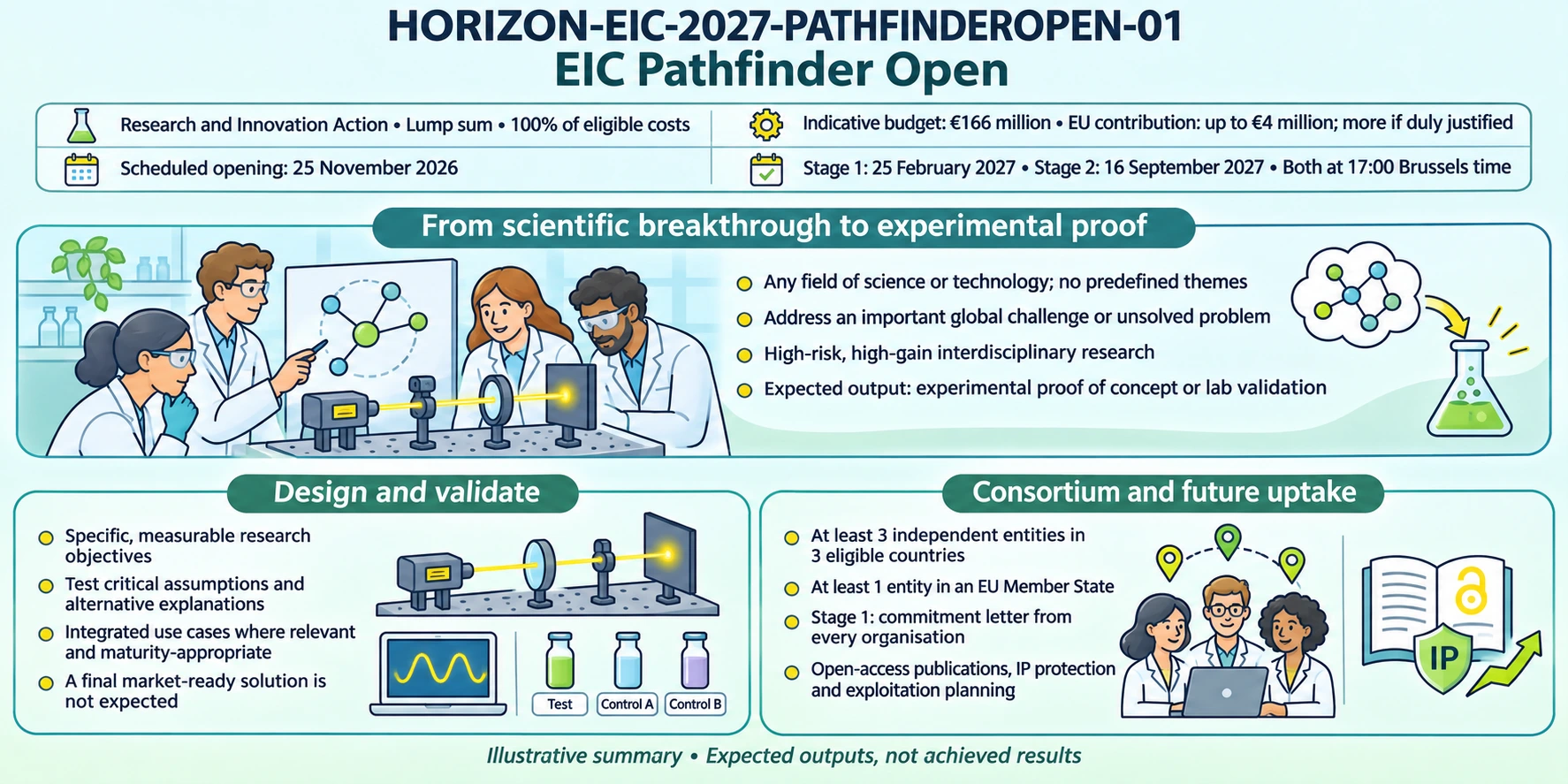
The call has no predefined thematic priorities. The EIC Work Programme 2027 schedules its opening for 25 November 2026.
- Action and funding: Research and Innovation Action, with lump-sum funding at 100% of eligible costs.
- Indicative call budget: €166 million. Requested EU contributions of up to €4 million are considered appropriate; larger requests remain possible when duly justified.
- Stage 1: 25 February 2027, 17:00 Brussels local time. Part B sections 1–2, covering Excellence and Impact, are limited to 10 A4 pages.
- Stage 2, by invitation: 16 September 2027, 17:00 Brussels local time. Part B sections 1–3, covering all three award criteria, are limited to 23 A4 pages.
Letters of commitment are mandatory at Stage 1. Each organisation proposed for the consortium must confirm awareness of its participation and willingness to take part if selected. Missing required letters make the proposal incomplete and ineligible. The letters are submitted separately and are not disclosed to evaluators.
The consortium must include at least three independent legal entities in three different countries: at least one established in an EU Member State and at least two others established in different Member States or Associated Countries. The coordinator submits on their behalf. The EIC programme’s Annex 2 governs additional admissibility, eligibility and country conditions. Pathfinder retains an exclusive focus on civil applications; nuclear-energy research within Euratom’s scope belongs under the relevant Euratom calls.
Stage 1 weights Excellence at 60% and Impact at 40%, with a threshold of 4/5 for each. Stage 2 weights Excellence, Impact and Implementation at 50%, 30% and 20%, with respective thresholds of 4/5, 4/5 and 3/5. Stage 2 proposals initially above the thresholds are invited to an interview, which informs the final assessment. Passing thresholds alone does not secure funding.
The programme permits adjustments to the scheduled opening and deadlines. Use the current submission forms and instructions when preparing either stage.
Define the breakthrough and the problem it could solve
The HORIZON-EIC-2027-PATHFINDEROPEN-01 proposal must connect four essential elements: a radically new technological vision, a concrete scientific breakthrough, a credible high-risk/high-gain interdisciplinary approach, and an important global challenge or unsolved economic, societal or environmental problem.
Explain the obstacle in scientific terms. What remains unknown, which established approach reaches its limit, and why could the proposed principle change that limit? Describe the advance against the relevant state of the art. An incremental improvement, or implementation of a technology already validated in the laboratory, does not meet this call’s purpose.
The expected research endpoint is at least experimental proof of concept or laboratory validation of the central technology. Integrated use cases are required where relevant and appropriate to its maturity. A complete market-ready solution is not expected, and the programme does not require a prototype as an output.
Make the distinction between a result and its demonstrated scope concrete. Boiko and colleagues connected language-model planning with robotic chemical experiments and used analytical measurements to confirm reaction products. Their demonstration still involved manual plate movement. [1] This illustrates why a proposal should specify exactly which function the integrated experiment proves. It is an example of research design, not a prescribed technology for Pathfinder Open.
Design experiments that resolve the decisive uncertainty
A useful planning approach is to organise the work around the most consequential uncertain claim. State the hypothesis, competing explanation, measured quantity and interpretation before listing equipment or tasks. Choose conditions that let the experiment distinguish these explanations.
- Set a meaningful comparator. Explain whether the comparison concerns an existing technology, a control without the proposed mechanism, or a theoretical limit.
- Separate signal from artefact. Plan calibration, blanks or negative controls as appropriate, and identify the conditions that could create a misleading positive result.
- Define an interpretable endpoint. Specify the operating conditions, repeat measurements and acceptance criteria that would support the feasibility claim.
- Plan the response to failure. Identify which result would trigger a revised mechanism, a different experiment or termination of a particular research route.
These are design recommendations, not additional call conditions. High scientific risk can coexist with a clear method: the outcome remains uncertain while the experiment and decision process remain credible.
Keep simulations, calculations and measurements distinct. A model can identify informative experiments and reveal sensitivity to assumptions. The work plan still needs to reach the experimental or laboratory endpoint expected by the call. Define how an integrated test will connect the new principle to the problem it is intended to address.
Build the consortium around scientific interfaces
For the HORIZON-EIC-2027-PATHFINDEROPEN-01 topic, choose partners by the knowledge needed to test the breakthrough and interpret the result. The team should combine the originating scientific insight, experimental implementation, independent assessment and understanding of the intended future application. Which disciplines are necessary depends on the technology; no particular sector is prescribed.
For each interface, define what one partner supplies and what another must be able to use: a material specification, model prediction, experimental protocol, dataset or assessment of application constraints. Agree units, sample identity, data formats and responsibility for interpreting unexpected results. Interdisciplinarity should change how the research is performed.
The programme encourages the involvement and empowerment of excellent early-career researchers and promising high-tech small and medium-sized enterprises, including startups. It also particularly encourages female researchers and gender balance among work-package leaders. These encouragements do not establish an SME quota.
Plan Stage 1 participation carefully. The Stage 2 consortium is expected to match the commitment letters; changes must remain exceptional, duly justified and must not substantially alter the proposal assessed at Stage 1. Match responsibilities and resources to the actual work.
Prepare the results for future use
The expected outputs include high-quality scientific publications in open access and measures that allow the main results to be taken further. The programme expects suitable intellectual-property protection, a thought-through exploitation plan, and consideration of relevant regulation, certification and standardisation.
Connect that planning to the particular result: identify who might use it, what evidence they would need next, and which technical dependencies remain. A laboratory demonstration can establish feasibility without demonstrating manufacturability, regulatory acceptance or performance in routine use.
As a practical recommendation, maintain a result-level record of contributions, ownership questions, experimental conditions and remaining limitations. Coordinate publication and protection decisions early. Define future validation steps without presenting later development, commercial uptake or follow-on funding as guaranteed.
The proposal should make the link between today’s scientific experiment and the longer-term problem understandable. The official EIC Pathfinder guidance clarifies that the envisioned solution can depend on combining the new technology with other technologies. The immediate project should demonstrate a credible step towards that vision.
The MIC already brings its expertise in microfluidics to Horizon Europe:
H2020-NMBP-TR-IND-2020

Microfluidic platform to study the interaction of cancer cells with lymphatic tissue
H2020-LC-GD-2020-3

Toxicology assessment of pharmaceutical products on a placenta-on-chip model

About the author

Céleste Chidiac, PhD
Scientific writer and digital marketing specialist
Céleste Chidiac holds a doctorate in neuroscience and molecular biology from the University of Strasbourg. Since joining the Microfluidics Innovation Center in 2023, she has combined scientific writing with website management. For MIC’s Horizon Europe topic pages, she draws on her research background to explain scientific challenges and clarify funding priorities. Her writing helps prospective applicants understand each topic’s scope, expected outcomes and research directions.
FAQ — Scientific choices for EIC Pathfinder Open
These questions address experimental reasoning, interdisciplinary research and the limits of early technological evidence.
What is the difference between scientific uncertainty and an implementation risk?
Scientific uncertainty concerns whether the proposed principle works or explains the observation. An implementation risk concerns whether the team can carry out the planned work, for example because equipment arrives late. Explain both, but show why resolving the scientific uncertainty could enable a significant technological advance.
How does a falsifiable hypothesis improve a proposal?
A falsifiable hypothesis states what observable result would count against the proposed explanation. It helps a team choose controls and interpret an unsuccessful experiment. For proposal planning, connect the hypothesis to a measurable quantity and define the conditions under which the result would be informative.
What makes a negative result useful?
A negative result is useful when a well-controlled experiment rules out a mechanism, parameter range or technical route. Record the sensitivity of the measurement and whether the experiment could have detected the predicted effect. Failure caused by an unverified setup cannot establish that the scientific principle is wrong.
Should every experimental variable be optimised before testing the concept?
No. First establish which variables could change the interpretation of the central hypothesis. Control or measure those variables, then separate feasibility testing from later optimisation. A narrowly defined experiment can be informative if its limits are explicit; changing many uncontrolled conditions makes the result harder to interpret.
Can an artificial-intelligence prediction establish experimental feasibility?
A prediction alone does not demonstrate an experimental result. Define an independent measurement that tests the predicted function. In the Coscientist study, generated experimental plans were followed by chemical experiments and analytical confirmation of products. [1] That evidence supports the demonstrated tasks, rather than every possible use of the system.
How should a project choose a benchmark when no equivalent technology exists?
Compare the proposed function with the closest relevant scientific or technological reference and explain the mismatch. A control experiment, a physical limit or a competing mechanism may be more informative than an unrelated commercial product. State which part of the claimed advance the comparison can establish.
How is interdisciplinary research different from several disciplines working in parallel?
Interdisciplinary research makes one discipline’s methods or findings change another’s research decisions. For example, a model may determine which experiment is informative, while measurements revise the model. Define these exchanges and their consequences in the work plan, rather than relying on a list of partner disciplines.
Does an integrated use case require a finished product?
No. An integrated use case can test how the emerging technology performs a relevant function within a research setting. The EIC Work Programme 2027 requires such validation where relevant and appropriate to maturity. It does not expect the project to deliver the final solution or a market-ready product.
How can a consortium demonstrate relevance to an unsolved problem at an early stage?
Identify the technical bottleneck that prevents an existing solution from meeting a meaningful need. Explain how the new principle could address that bottleneck and which later advances would still be necessary. Keep the scale of the demonstrated result distinct from the scale of the anticipated societal or economic benefit.
What should be recorded so another researcher can interpret a proof of concept?
Record the configuration, input materials or data, operating conditions, controls, analysis method and observed variability. Identify any manual steps and excluded operating ranges. This gives another researcher a basis for assessing what was demonstrated, reproducing the test and deciding what further validation is needed.
References
[1] Boiko, D. A., MacKnight, R., Kline, B. and Gomes, G. Autonomous chemical research with large language models. Nature. 2023;624(7992):570–578. doi:10.1038/s41586-023-06792-0