
Participatory foresight for adaptable neighbourhoods
Opening
5 May 2027
Deadline
Keywords
Participatory foresight
Neighbourhood futures
Long-term stewardship
Intergenerational fairness
Scenario validation
Transdisciplinary research
Your microfluidic SME partner for Horizon Europe
We take care of microfluidic engineering, work on valorization and optimize the proposal with you
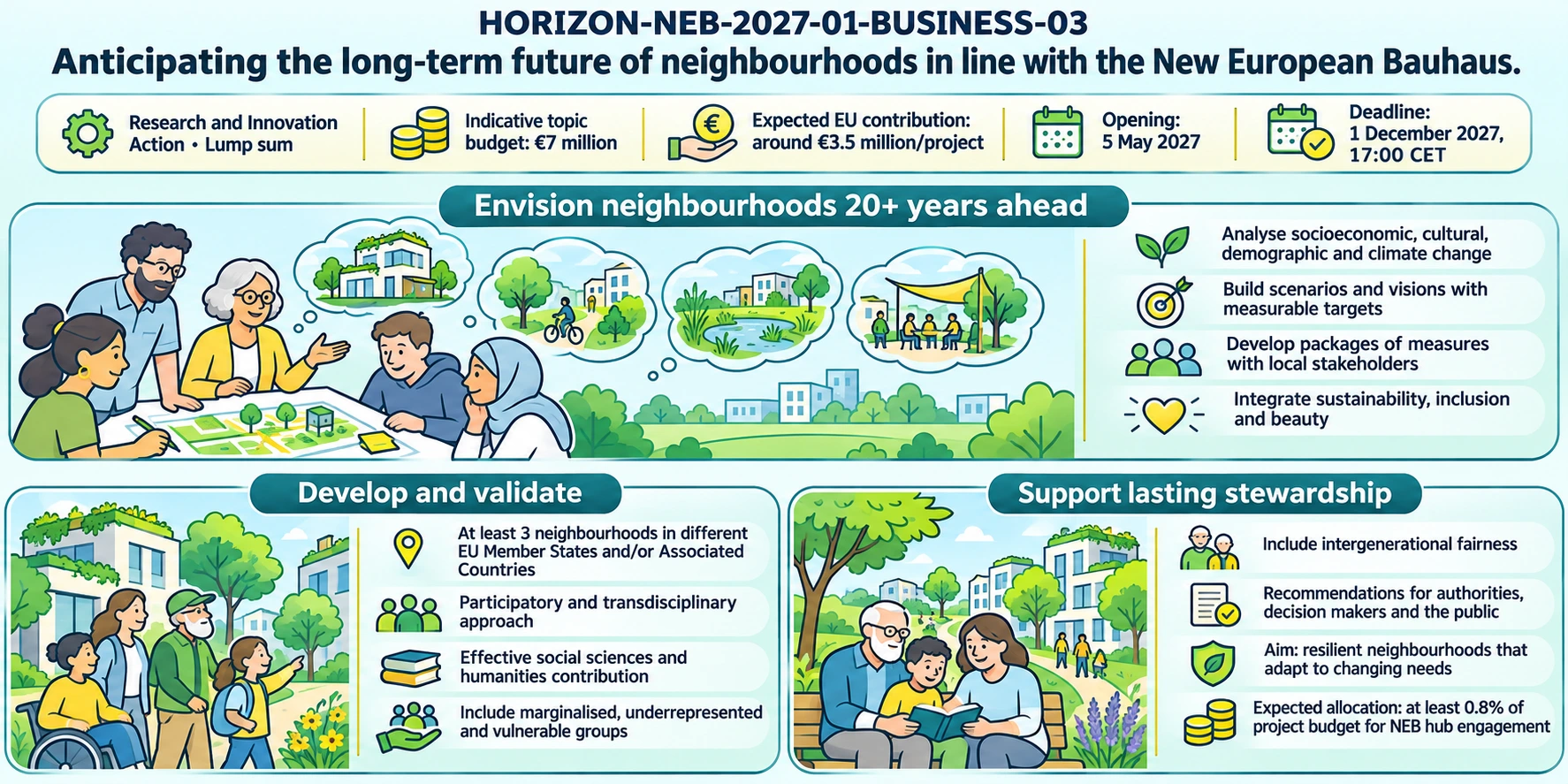
HORIZON-NEB-2027-01-BUSINESS-03: Anticipating the long-term future of neighbourhoods in line with the New European Bauhaus
How can a neighbourhood plan remain useful when its assumptions change?
A neighbourhood plan can build in decisions about when and how to revise its course. Residents and planners can identify assumptions about housing, climate or public services, explore how those assumptions might change, and agree which developments should trigger reconsideration. This makes the future a continuing subject of inquiry. For HORIZON-NEB-2027-01-BUSINESS-03, participatory foresight connects this capacity to revise decisions with a shared vision extending at least twenty years ahead.
Download the MIC Horizon Europe 2026/2027 Calls Calendar:
Discover more!
Call conditions and funding
Topic HORIZON-NEB-2027-01-BUSINESS-03 belongs to the destination Innovative funding and new business models for the transformation of neighbourhoods. The call is “Innovative models for neighbourhoods that integrate beauty, inclusiveness and sustainability”. Official topic page.
- Action and funding model. Research and Innovation Action (RIA); lump sum
- Call status. Upcoming
- Opening. 5 May 2027
- Deadline. 1 December 2027, 17:00 CET (Brussels time); single-stage
- Indicative topic budget. €7 million
- Expected EU contribution per project. Around €3.5 million; proposals requesting different amounts may be submitted and selected
- Indicative projects to be funded. 2
- Target technology readiness level (TRL). No topic-specific target stated
The General Annexes provide the standard consortium minimum: three independent beneficiary legal entities in three different countries, including at least one in an EU Member State and two others in different Member States or Associated Countries. Country-specific participation and funding conditions also apply. This eligibility minimum is separate from the requirement to validate the approach in three neighbourhoods.
The standard RIA funding rate is up to 100% of eligible costs; for this lump-sum action, it is applied when establishing the grant amount. The standard full-proposal limit is 45 pages for a lump-sum RIA, subject to the applicable submission template. The NEB work programme gives the indicative schedule and permits adjustments to opening and deadline dates.
What the foresight approach must achieve
The HORIZON-NEB-2027-01-BUSINESS-03 topic seeks long-term stewardship by local stakeholders and neighbourhoods that can adapt to changing conditions. “Long term” means 20 years or more. The research concerns existing neighbourhoods and must integrate the New European Bauhaus (NEB) values of sustainability, inclusion and beauty.
Proposals are expected to develop and validate an approach covering:
- Conditions and drivers: socioeconomic, cultural, demographic and climate trends, including changing population composition, migration, and social and aesthetic acceptance.
- Scenarios and visions: potential futures with objectives, measurable targets and packages of measures, including intergenerational fairness.
- Co-creation: participation by diverse local stakeholders, including marginalised or underrepresented groups and people in vulnerable situations.
The approach must be developed and validated in at least three neighbourhoods in different Member States and/or Associated Countries. Recommendations should help local authorities, decision makers and the public apply it. Climate analysis should incorporate relevant evidence, including the European State of the Climate 2024 identified in the topic.
Petzold and colleagues developed three narratives for Mumbai to 2050 using global Shared Socioeconomic Pathways and local stakeholder input. These scenarios explored adaptation challenges in that setting; they did not predict future outcomes. [1]
Design a method that can be tested during the project
A useful research design separates scenario plausibility, participation quality and practical use. A scenario can be internally coherent while overlooking a group’s needs; a well-attended workshop can still produce recommendations that planners cannot apply. Each dimension therefore needs its own evaluation questions.
For this topic, a consortium could use a common assessment framework across the neighbourhoods:
- Traceable assumptions: connect each major scenario choice to observations, projections or explicitly recorded stakeholder judgments.
- Meaningful participation: examine who contributes, whose suggestions alter the scenarios, and which unresolved disagreements remain.
- Usable measures: ask local teams to apply the approach to an actual planning decision and record difficulties, revisions and resource needs.
- Capacity to revise: introduce a changed assumption during a follow-up exercise and assess whether participants can update the proposed measures consistently.
These are proposed validation choices. They make the approach assessable within a research project without claiming to observe twenty years of resilience. Indicators could track the clarity of decision responsibilities, the treatment of conflicting objectives and the usefulness of recommendations to their intended users.
Keep a common method while allowing local priorities and evidence to differ. Transferable outputs could include facilitation materials, an assumptions register, scenario templates and guidance for updating targets. Local authorities should be able to identify what they can reuse and what requires a fresh local investigation.
Connect residents, planning practice and research
The HORIZON-NEB-2027-01-BUSINESS-03 topic requires an effective contribution from social sciences and humanities (SSH), together with a participatory and transdisciplinary approach. Foresight researchers, social researchers, local authorities and community organisations would connect the method to everyday decisions. Relevant built-environment professionals, such as architects, urban planners and landscape designers, must participate in interventions concerning the built environment.
Partner interfaces deserve explicit planning. Community organisations could help identify barriers to participation; SSH researchers could design and evaluate co-creation; planners could test the proposed measures against local decision processes; environmental specialists could interpret relevant ecological evidence. The coordinator would retain responsibility for consortium leadership, with MIC contributing as a partner where a defined technical task is justified.
International cooperation is encouraged. The topic also encourages synergies with HORIZON-NEB-2027-01-PARTICIPATION-02 and HORIZON-CL2-2025-01-TRANSFO-10, particularly around intergenerational fairness. These are opportunities for collaboration, not additional mandatory demonstration sites.
Proposals are expected to allocate at least 0.8% of their budget to engagement with the Horizon Europe-funded New European Bauhaus hub for results and impact, including sharing intermediate and final findings and contributing to impact assessment.
The MIC already brings its expertise in microfluidics to Horizon Europe:
H2020-NMBP-TR-IND-2020

Microfluidic platform to study the interaction of cancer cells with lymphatic tissue
H2020-LC-GD-2020-3
Toxicology assessment of pharmaceutical products on a placenta-on-chip model
About the author

Céleste Chidiac, PhD
Scientific writer and digital marketing specialist
Céleste Chidiac holds a doctorate in neuroscience and molecular biology from the University of Strasbourg. Since joining the Microfluidics Innovation Center in 2023, she has combined scientific writing with website management. For MIC’s Horizon Europe topic pages, she draws on her research background to explain scientific challenges and clarify funding priorities. Her writing helps prospective applicants understand each topic’s scope, expected outcomes and research directions.
FAQ - Participatory foresight and environmental evidence
These questions explore how to interpret scenarios, assess participation and connect environmental evidence to neighbourhood decisions.
Is a participatory scenario a forecast?
No. Participatory scenarios explore plausible futures. In Mumbai, stakeholders reviewed narrative plausibility and consistency without assigning probabilities to the resulting scenarios. [1]
How is a shared vision different from an exploratory scenario?
A vision expresses the future participants want to pursue; an exploratory scenario examines conditions they may have to navigate. Keeping them distinct makes it possible to assess whether a preferred package of measures remains useful under several plausible futures. The topic’s scope calls for both scenarios and visions.
How can people who do not attend workshops influence the research?
The participation design could combine interviews, small group sessions, accessible materials and trusted local intermediaries. Researchers should document which perspectives remain absent and how that affects interpretation. Offering several ways to contribute is a design choice; attendance alone does not establish representativeness.
Can disagreement between generations be a useful result?
Yes. Disagreement can reveal different time horizons, priorities or distributions of benefit. A consortium could preserve those differences in alternative measures and assess their consequences, rather than treating consensus as the only successful workshop outcome. No single age group should automatically be treated as speaking for future generations.
How can beauty be assessed without imposing one aesthetic preference?
Participants could describe what they value in a place, compare visual alternatives and explain how heritage, sensory experience and belonging shape their judgments. The NEB framework treats beauty as part of neighbourhood transformation; the evaluation should make the selected criteria and contrasting interpretations visible.
What does an environmental measurement add to a future scenario?
It can constrain a specific assumption about present conditions or a tested intervention. The scenario must still explain how that evidence is used over time. Recording the sampling date, location, method and interpretation prevents a local measurement from being presented as a prediction of future conditions.
What is the difference between a measurable target and an indicator?
A target describes the result a neighbourhood wants to achieve; an indicator defines what will be observed to assess progress. For example, a project could agree a desired level of access to a public service, then specify the population, distance measure and observation period used to assess it.
Can the same indicator be compared across different neighbourhoods?
Only after checking that its definitions and measurement conditions are comparable. A consortium could agree a shared data dictionary covering units, denominators, geographical boundaries and observation periods. Where local definitions differ, the comparison should explain those differences rather than combine the values into a single ranking.
References
[1] Petzold J, Garschagen M, Deshpande S, Dhiman R, Doshi D, Katzschner A, Pereira Santos A, Parthasarathy D. Identifying future challenges for climate change adaptation through insights from participatory scenario-downscaling in Mumbai. npj Climate Action. 2024;3:111. doi:10.1038/s44168-024-00197-z