
Tips & Tricks for a successful HORIZON-WIDERA-2027-01-WIDENING-01 proposal
Opening
05 May 2027
Deadline
Keywords
EIC Pre-accelerator
Widening countries
maturation
deep tech startups
SME
TRL 4-6
mono-beneficiary
technological readiness
lump sum grant
CSA
Your microfluidic SME partner for Horizon Europe
We take care of microfluidic engineering, work on valorization and optimize the proposal with you
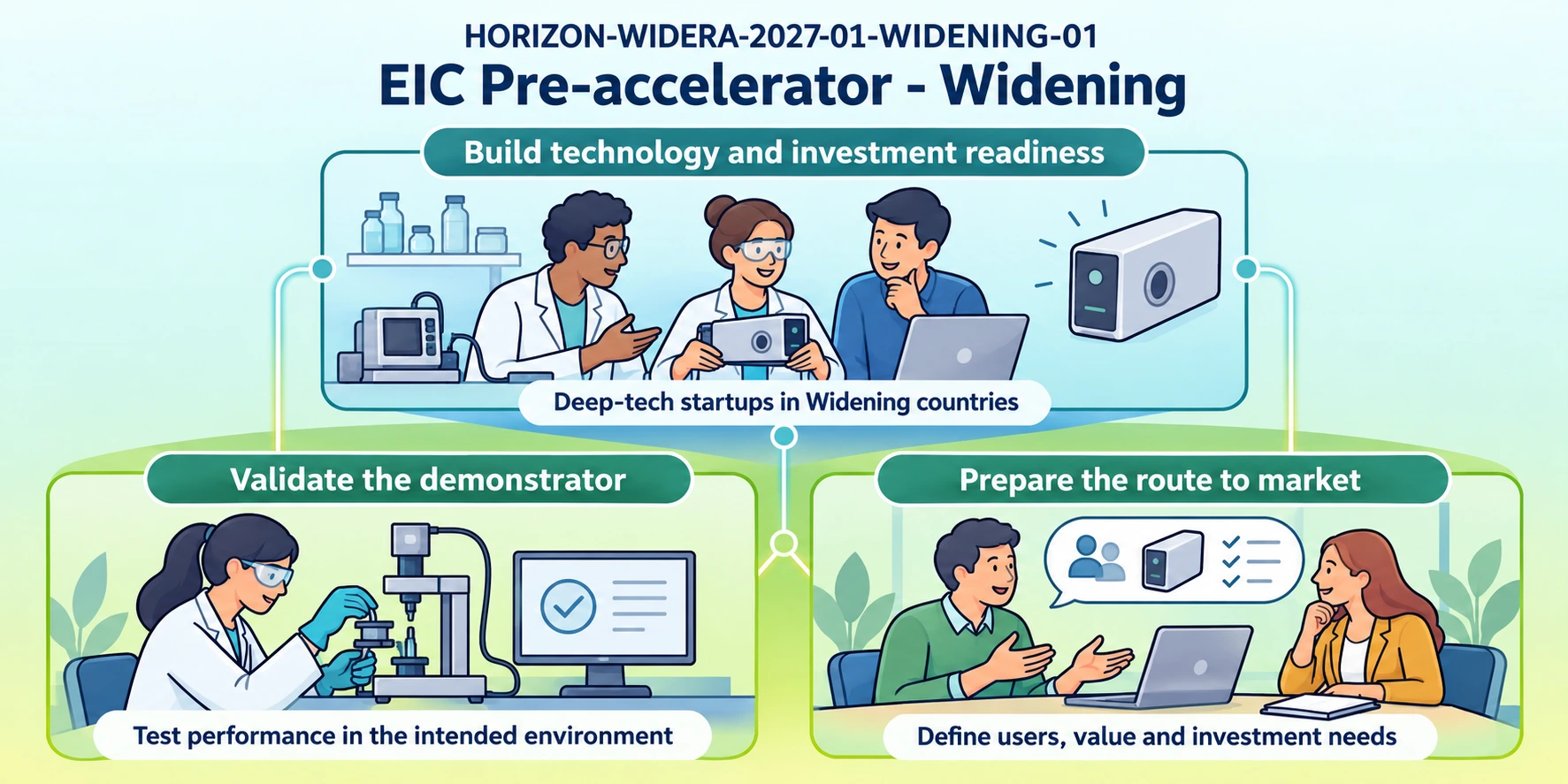
HORIZON-WIDERA-2027-01-WIDENING-01: EIC Pre-accelerator - Widening
What must remain reproducible when a deep-tech prototype leaves the developer’s laboratory?
Its critical function must remain measurable when the operator, samples or operating conditions change. A useful transfer test asks whether another user can follow the protocol and obtain a result within predefined acceptance limits. This connects the technology maturation sought by HORIZON-WIDERA-2027-01-WIDENING-01 to a practical business question: can the intended customer use the demonstrator reliably?
The Microfluidics Innovation Center (MIC) develops project-specific microfluidic instruments and supports their transfer to research laboratories. Its Minipump prototype was developed for medium recirculation in the completed Horizon Europe BioProS project, where a small footprint was an integration requirement. For a startup whose demonstrator depends on liquid handling, this illustrates why integration constraints should be included in validation planning.
Download the MIC Horizon Europe 2026/2027 Calls Calendar:
Discover more!
Administrative facts: what do we know about the HORIZON-WIDERA-2027-01-WIDENING-01 call?
Which call is it, and when is the opening and the deadline?
- Call name: EIC Pre-accelerator – Widening
- Call identifier: HORIZON-WIDERA-2027-01
- Destination: Widening participation and spreading excellence
- Topic: HORIZON-WIDERA-2027-01-WIDENING-01
- Opening: 05 May 2027
- Deadline: 18 November 2027, 17:00 Brussels time
- Type of action: Coordination and Support Action (CSA)
What about the budget and estimated size of the project?
- Overall indicative topic budget: EUR 40.00 million
- Indicative number of projects funded: 60
- EU contribution per project (call overview): EUR 0.50 to 1.00 million
- Lump sum (topic text): EUR 500 000 to a maximum of EUR 1 000 000, up to 2 years
- Funding rate: 70%, the remaining 30% on the beneficiary
What are the key eligibility and evaluation conditions?
- Mono-beneficiary. One legal entity applies
- The beneficiary must be an SME established in a Horizon Europe Widening country
- At submission: technology validated in the lab (min TRL 4), IP rights held with freedom to operate
- 3 independent evaluators, EIC Transition Open first step criteria (EIC Work Programme 2027)
- Thresholds: Excellence 4/5, Impact 4/5, Quality and efficiency of the implementation 3/5
- Ex aequo proposals prioritised on geographical diversity
- Seals of Excellence for applications exceeding all evaluation thresholds that cannot be funded because the call budget is insufficient
- Successful applicants and Seal holders receive free access to EIC Business Acceleration Services. Access to the EIC Accelerator Fast Track follows a project review in the second half of the project; it is not an automatic Accelerator grant
Scientific range: what does the Commission expect from the HORIZON-WIDERA-2027-01-WIDENING-01 grant?
What outcomes are expected?
By the end, the technology must have been validated in a relevant environment, with all aspects of TRL 5 completed. The company should be ready to apply for the EIC Accelerator, seek other investment or funding, or pursue licensing and other routes to market. Follow-on funding is an objective, not a guaranteed outcome.
What is within scope?
- Maturation and validation beyond proof of concept, from TRL 4 up to TRL 6
- Investor and market readiness: market research, value proposition, business case, competitor analysis
- IP protection
- Regulation, certification and standardisation where relevant
One boundary. High tech alone does not qualify, and the work programme says plainly that deep tech is not the same as R&D intensity.
What are the specifically proposed research directions?
The call is open to all fields. The following planning advice should be distinguished from the formal eligibility conditions:
- Focus the development roadmap on a clearly justified initial use case. This is a scoping recommendation, not a rule limiting applicants to one product or one market
- A dated route to market, with KPIs an evaluator can actually verify
Scientific strategy: how should you design validation for HORIZON-WIDERA-2027-01-WIDENING-01?
What scientific choices matter most?
- Substantiate the starting TRL 4 with experimental evidence and identify what remains to validate.
- Define the relevant environment early: intended users, sample types, operating conditions and measurable acceptance criteria.
- Benchmark against an appropriate existing method under comparable conditions, with uncertainty and limitations reported.
- Identify technical, market and financial risks, and connect mitigation measures to dated milestones.
- Explain why the timing is appropriate for the technology and intended market. The award criteria explicitly assess timing, feasibility and technological readiness.
SME team & proposal-writing plan: what works best with this single-beneficiary call?
- The topic is mono-beneficiary: one eligible SME submits the application and remains responsible for the project.
- Identify any expertise or facilities needed beyond the company’s own capacity. External organisations do not automatically become subcontractors; any arrangement must comply with the applicable call and grant rules.
- Keep the team description short but concrete: identify who leads technical development, business development and exploitation, with evidence of the relevant experience.
- Explain how validation capacity will be secured and budgeted, with credible access to samples, equipment and intended users.
- Connect the experimental workplan to measurable technical and business milestones. Describe the evidence needed for each decision.
How would microfluidics contribute to this topic?
TRL 5 means technology validated in a relevant environment. For a demonstrator involving liquids, microfluidics may support controlled sample handling and repeatable test protocols. The validation must still establish performance with representative samples and operating conditions.
- Automated test benches can execute defined sequences and record operating conditions. Their value depends on calibration, controls and predefined acceptance criteria; automation alone does not establish a TRL.
- If a device has only been tested in buffer, plan a comparison with the intended sample matrix, using appropriate controls and a justified number of samples. Throughput and sample consumption must be measured for the actual workflow.
- Chips, pumps, connectors and housings should be assessed as an integrated system. A change in material or manufacturing process requires checks of the resulting geometry, interfaces and application performance.
- MIC’s project-specific flow-control developments illustrate relevant instrumentation experience. This single-beneficiary topic does not establish a consortium role for MIC, and no MIC subcontracting arrangement is assumed.
The practical question is whether a microfluidic approach can meet the demonstrator’s requirements within the available resources. Compare its performance, operating demands and cost with the existing workflow before choosing it.
The MIC already brings its expertise in microfluidics to Horizon Europe:
H2020-NMBP-TR-IND-2020

Microfluidic platform to study the interaction of cancer cells with lymphatic tissue
H2020-LC-GD-2020-3

Toxicology assessment of pharmaceutical products on a placenta-on-chip model
About the author
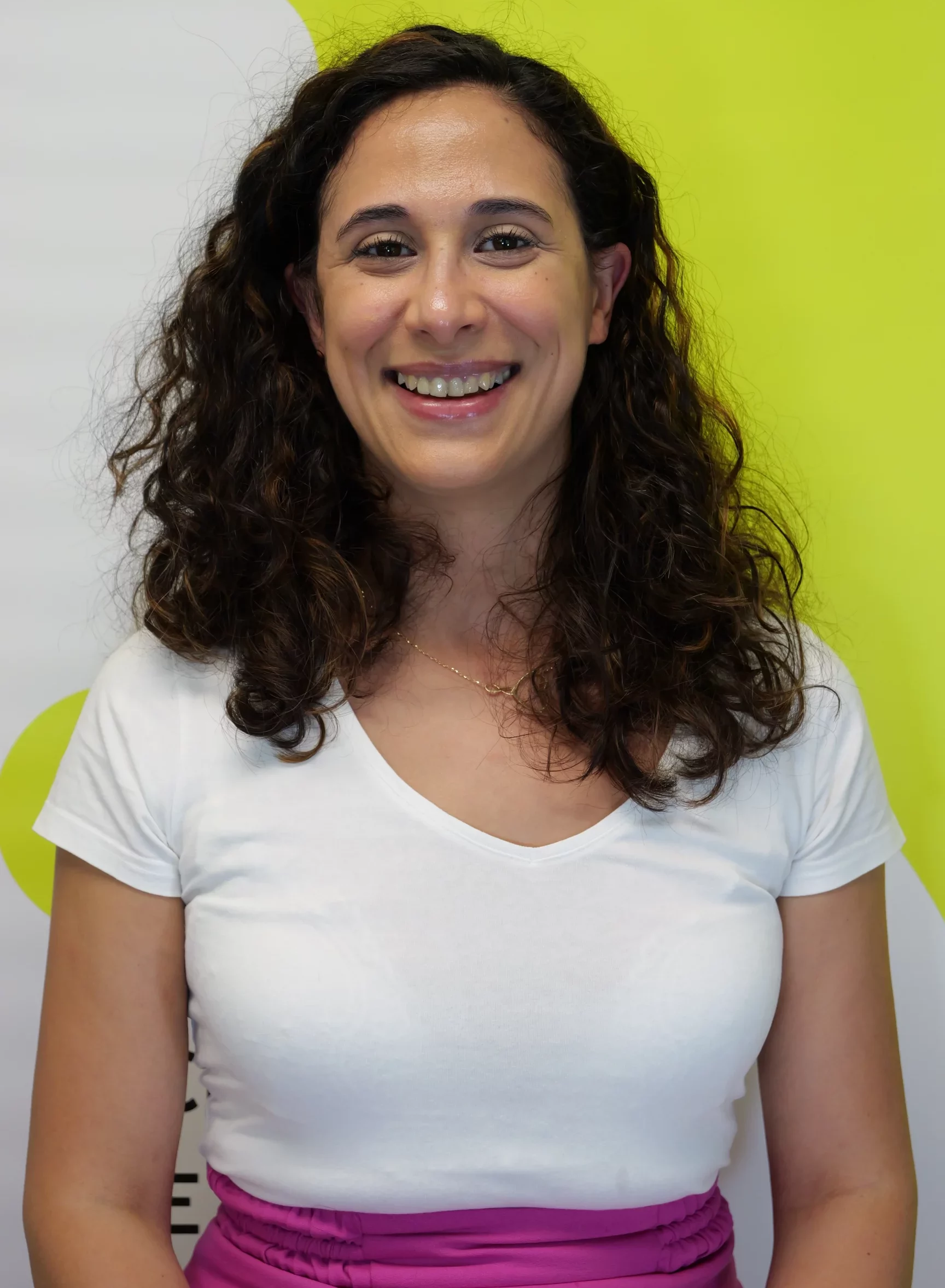
Céleste Chidiac, PhD
Scientific writer and digital marketing specialist
Céleste Chidiac holds a doctorate in neuroscience and molecular biology from the University of Strasbourg. Since joining the Microfluidics Innovation Center in 2023, she has combined scientific writing with website management. For MIC’s Horizon Europe topic pages, she draws on her research background to explain scientific challenges and clarify funding priorities. Her writing helps prospective applicants understand each topic’s scope, expected outcomes and research directions.
FAQ - HORIZON-WIDERA-2027-01-WIDENING-01
What is the difference between instrument validation and application validation?
Instrument validation checks whether the equipment meets its defined specifications. Application validation asks whether the complete workflow produces a useful result with the intended samples and operating conditions. A flow-control check cannot establish an assay’s specificity or a biological model’s relevance. Plan separate acceptance criteria for the instrument and the application.
What makes a comparison with an existing method meaningful?
Compare the methods using matched sample types, a defined reference procedure and the same intended decision. Specify performance measures and acceptance limits before collecting data. Report failed runs and measurement uncertainty alongside successful results. A proposed comparison should distinguish analytical performance from handling time, sample consumption and operator effort.
Why is a pump setting insufficient to verify flow through a chip?
The setting is a command; validation needs a measurement of delivered flow. EURAMET Technical Guide No. 4 describes flow-measurement methods and associated uncertainty. Check the assembled circuit under its intended conditions, allowing it to stabilise. Record the liquid, temperature and reference method so the result can be interpreted and compared.
What should be checked when changing chip material or manufacturing process?
Use a comparison plan covering channel dimensions, connections, leak integrity and the application’s measured output. For an analytical workflow, include recovery checks with representative compounds and controls. Define acceptable differences before testing. A successful result with one material, sample or fabrication batch should not be treated as validation of every variant.
How can carryover between sequential samples be assessed?
Run a blank after a representative challenge sample and measure residual analyte through the proposed wash sequence. Set an application-specific acceptance limit before comparing cleaning procedures. Include the full wetted path in the test: reservoirs, tubing, valves and chip. Treat this as a proposed validation experiment, with cleaning conditions justified for the intended assay.
What should an automated validation run record?
Retain enough information to reconstruct the run: device and software versions, sample identifiers, timestamps, command values, measurements, alarms and operator interventions. Define how interrupted or out-of-range runs will be classified before analysing results. A completed automated sequence should only count as valid when its acceptance criteria are met.
How can the intended user shape a technical milestone?
Ask which result would change a practical decision, then translate that need into a measurable test. A proposed milestone could require a trained external operator to complete a defined workflow within agreed performance limits. Keep usability feedback and technical measurements distinguishable: both inform whether the demonstrator fits its intended use.
What should accompany a prototype transferred to another laboratory?
A useful handover package includes the device configuration, installation and calibration instructions, operating protocol, controls, acceptance limits and troubleshooting guidance. Agree a comparison run between sites. MIC’s prototype-transfer and instrument-support experience illustrates this engineering interface; the receiving laboratory remains responsible for its application-specific methods and user feedback.
Which MIC experience is relevant to liquid-handling demonstrators?
MIC develops microfluidic flow-control prototypes for specific research needs. Its Minipump development for BioProS addressed compact medium recirculation, illustrating how an integration requirement can guide instrument design. This is an example of technical experience, not a commitment to supply equipment or participate in an EIC Pre-accelerator project.
How should technical evidence connect to a route-to-market decision?
Link each proposed test to a customer question: whether the workflow fits, whether its performance is useful and whether operating demands are acceptable. Keep measured results separate from assumptions about production cost, demand or willingness to pay. A working demonstrator supports a business case, but market demand and investment readiness require their own evidence.