
Eve-Line Bancel, PhD
Publication Date
Keywords
R&D engineer
microfluidic instrumentation
user need
pressure driven pumps
technical specifications
end products
multidimensional spectroscopy
Your microfluidic SME partner for Horizon Europe
We take care of microfluidic engineering, work on valorization and optimize the proposal with you
R&D engineer in microfluidic instrumentation
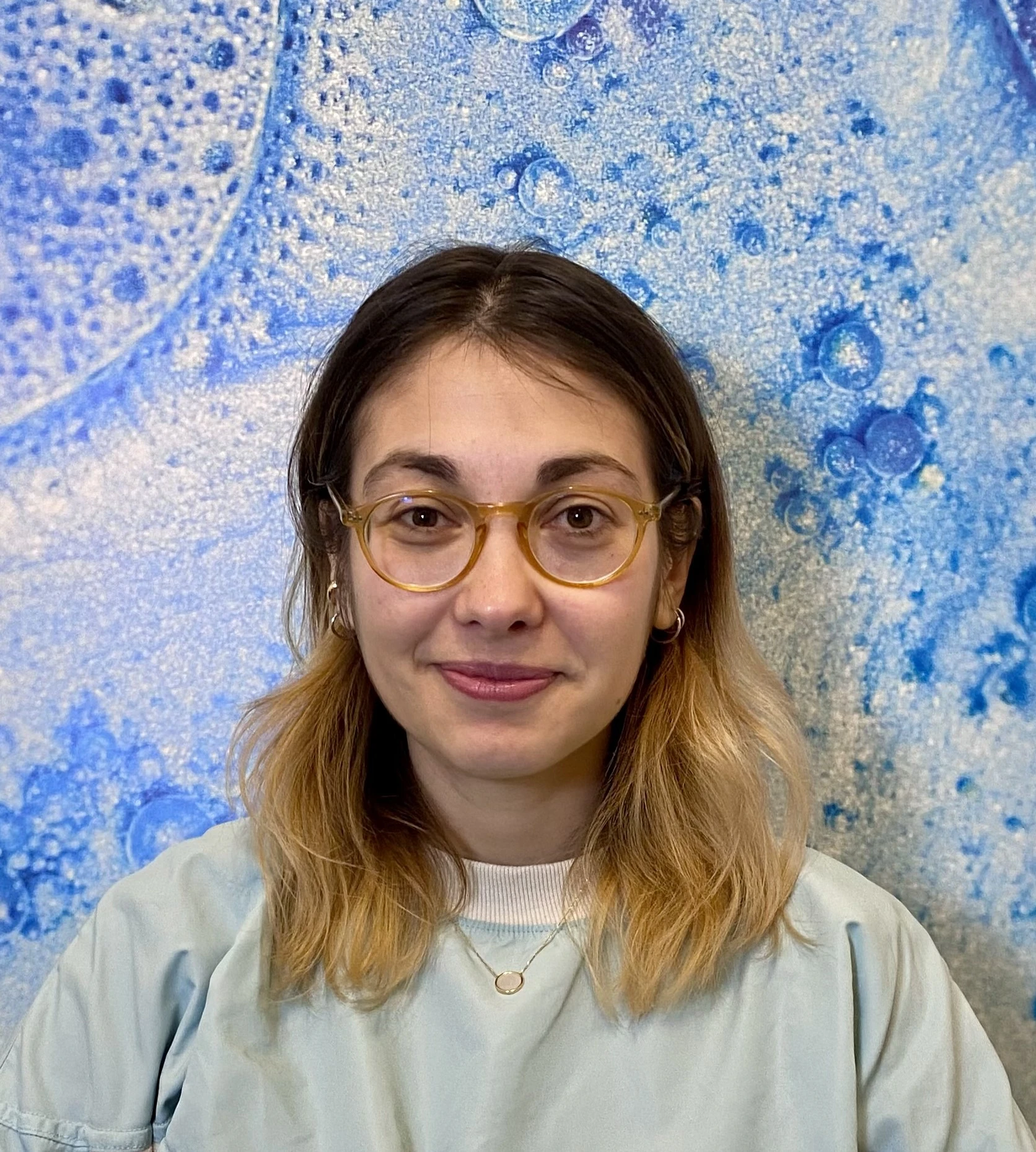
Eve-Line Bancel holds a PhD in physics from ONERA and the PhLAM laboratory (University of Lille). Her research focused on developing a fibre laser source for precision spectroscopy. Since joining the Microfluidics Innovation Center in 2024, she has applied this experimental background to the development of microfluidic-based solutions, including the Perfusion Pump for Incubator and the Pressure Pump for Microfluidics, as well as their use for the culture of organisms under flow.
What did you investigate during your PhD?
At ONERA and PhLAM, I built an optical setup that turns one monochromatic laser into three coherent broadband sources, using a homemade multicore nonlinear fibre. Think of turning a single tube of red paint into three full palettes of colours that blend easily together. This makes it possible to perform multidimensional spectroscopy, an advanced high-resolution experimental technique.
“Building an experimental bench from scratch taught me to question every component that can affect the end product.”
How did your work expand into microfluidics?
When I joined MIC in 2024, I moved from optics to fluidics, but the approach stayed the same. My work starts with the needs of users, often biologists working on interdisciplinary topics. I translate these needs into technical specifications before designing, building and validating a system.
What do you work on at MIC?
I build solutions that answer the technical needs of our partners. For example, I worked on the development of two pressure-driven pumps for cell culture. The Perfusion Pump for Incubator is a compact, self-contained unit that works without any compressed air source. The Pressure Pump for Microfluidics keeps the gas composition of the medium unchanged, making it possible to perfuse cells outside the traditional CO₂ incubator.
What subjects do you explore at MIC?
An instrument is only useful if its performance is measured and understood, so characterisation and testing are part of every development. These tests answer concrete scientific questions, such as how to control a microenvironment with a pressure pump. They also put us in the position of end users. For both pumps, we ran real cell-culture experiments, including an 8-day perfusion of U-251 MG cells, and published the protocols and results as an application note and a quick tip that users can follow.
“An instrument is only useful if its performance is measured and understood.”
What do you find most rewarding in your work?
Seeing a prototype leave the lab and help with the experimental work at a partner’s laboratory, and using their feedback to improve the next version.
Publications
- How to maintain a stable pH under flow conditions? (Quick tips)
- Workshop – Microfluidics for bioremediation (Fun fluidics)
- CO2 incubator-friendly microfluidic perfusion system for cell culture (Application Note)