Tips & Tricks for a successful HORIZON-CL5-2027-07-D3-28 proposal
Opening
04 August 2027
Deadline
Keywords
Cluster 5 energy
data-driven decision-making
CSA
electricity grids
open-source tools
digital twins
BRIDGE initiative
competitive energy supply
Your microfluidic SME partner for Horizon Europe
We take care of microfluidic engineering, work on valorization and optimize the proposal with you
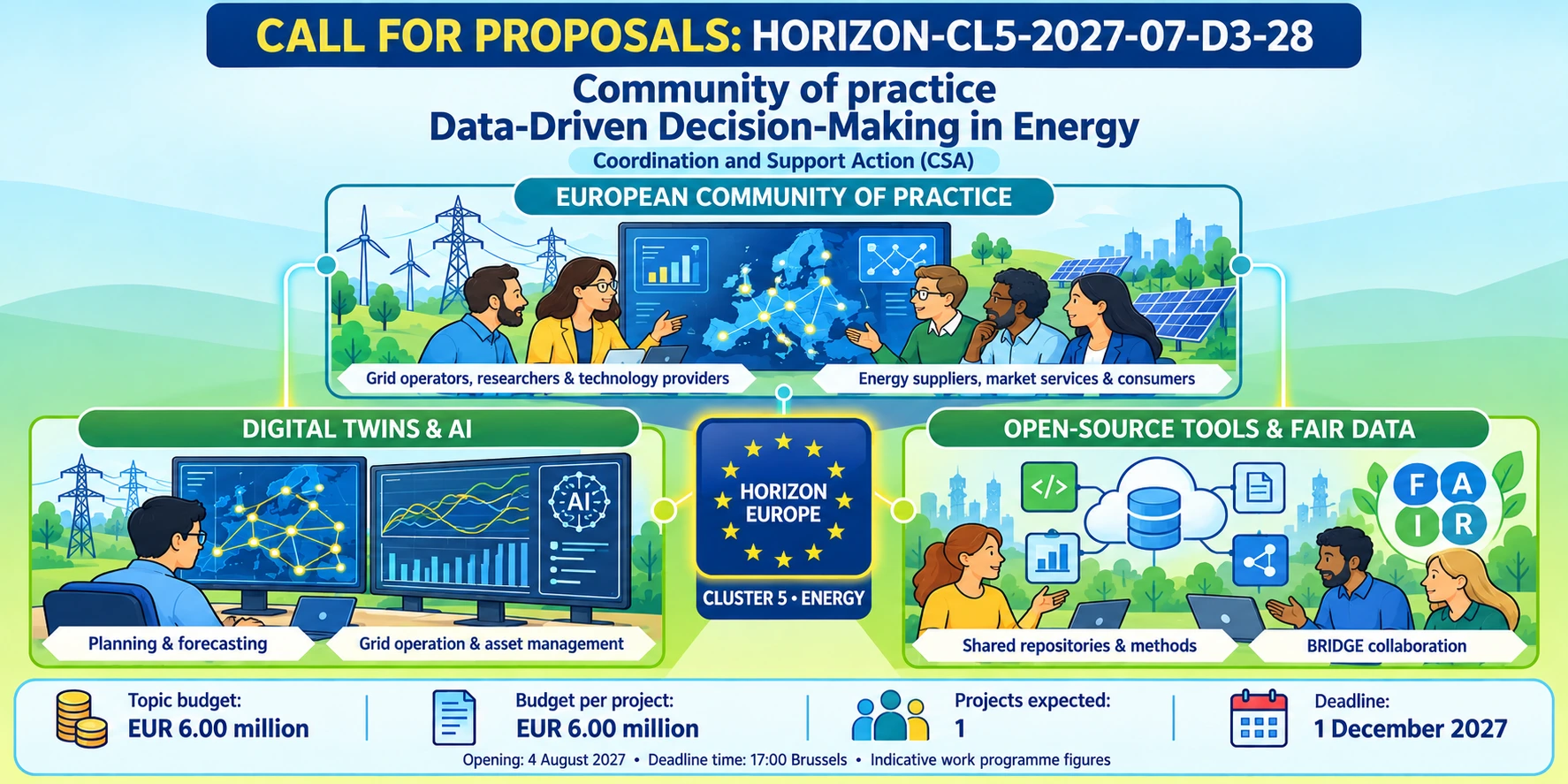
HORIZON-CL5-2027-07-D3-28: Community of practice - Data-Driven Decision-Making in Energy
Grid operators sit on more data than they know what to do with. This topic is the Commission’s answer to that. One Coordination and Support Action, funded once, tasked with building a European community of practice around data and analytics for electricity grids. Open-source tools, shared methods, digital twins, AI. No hardware, no demonstrators.
Download the MIC Horizon Europe 2026/2027 Calls Calendar:
Discover more!
Administrative facts: what do we know about the HORIZON-CL5-2027-07-D3-28 call?
Which call is it, and when is the opening and the deadline?
- Call name: ENERGY
- Call identifier: HORIZON-CL5-2027-07
- Destination: Sustainable, secure and competitive energy supply (Destination 3)
- Topic: HORIZON-CL5-2027-07-D3-28, Community of practice – Data-Driven Decision-Making in Energy
- Opening: 04 August 2027
- Deadline: 01 December 2027, 17.00 Brussels time
- Type of action: Coordination and Support Action (CSA)
What about the budget and estimated size of the project?
- Topic budget: EUR 6.00 million
- Indicative number of projects: 1
- Budget per project: EUR 6.00 million
- Overall budget of the ENERGY call: EUR 179.00 million
What are the key eligibility and evaluation conditions?
- General Annexes A to G apply. No topic-specific derogation on award criteria. Standard thresholds apply: 3 per criterion, 10 overall.
- Costs take the form of a lump sum (Decision of 7 July 2021).
- If satellite earth observation, positioning, navigation or timing data are used, Copernicus and/or Galileo/EGNOS must be used.
- Subject to restrictions for the protection of European communication networks.
- Contribution to the BRIDGE initiative, with active participation in its activities.
- No JRC participation and no clustering obligation stated for this topic.
Scientific range: what does the Commission expect from the HORIZON-CL5-2027-07-D3-28 grant?
What outcomes are expected?
At the end of the grant there should be a working community, not a mailing list. The Commission wants shared repositories of open-source solutions, planning and simulation tools that operators and academics can actually pick up, and research results that stay FAIR long after the project that produced them has closed. A tidy final report on coordination activities is not what they are after.
What is within scope?
- Coordination between grid operators, research and academia, technology providers, energy suppliers, market service providers, and consumer representatives.
- Tools and technologies for planning, operating and maintaining European electricity grids while managing high shares of renewables.
- A European ecosystem of innovation hubs, giving stakeholders a space for experimentation and agile innovation on digitalisation.
- Synergies with major European and international initiatives already active in the field.
This is a CSA. Technology development, pilots and infrastructure investment fall outside the boundary.
What are the specifically proposed research directions?
- Blueprints, methodologies and repositories of open-source solutions for simulation, observation, forecasting and infrastructure asset management. The yardstick given is the overall cost of system operation.
- Digital twins and AI-enabled systems for decision-making.
- Targeted showcases of grid operator and academia cooperation on specific projects or programmes. Pick real ones.
- FAIR research results that survive the end of a project and accommodate technology evolution.
- Open-source practice pushed across the value chain so that shared methods and standards get industrialised by the energy industry itself.
The wording on that last one is loose, which gives you room to frame it your way.
Scientific strategy: how can you enhance your chances of being funded through HORIZON-CL5-2027-07-D3-28?
What scientific choices matter most?
- Name the tools you will maintain. “A platform will be developed” gets punished in CSAs.
- Come with a community that already half exists. Evaluators want evidence that people will show up, and from what we’ve seen, letters of intent from twenty organisations who have never worked together read as exactly that.
- Say who pays for the repository after month 48. Sustainability is probably the most scrutinised part of this proposal.
- Put TSOs and DSOs in the consortium, not in the annex.
- Don’t oversell AI. The call mentions AI-powered tools, but the reviewers on this destination are grid people.
- Build the BRIDGE contribution into a work package with named effort.
Consortium & proposal-writing plan: what works best with this type of call?
- Somewhere between twelve and twenty partners, maybe a few more if you are covering several grid regions. Community-building CSAs need mass.
- Mix public labs, universities, system operators, and at least one innovative SME. Small companies are usually the ones actually maintaining open-source energy tooling.
- Geographic spread matters here more than in an IA. A community of practice that covers four countries is not European.
- Lump sum means your work package descriptions are the budget. Write them as if a financial officer will read them, because one will.
- If you are coordinating for the first time, don’t. Find someone who has run a CSA before.
How would microfluidics contribute to this topic?
Straight answer first: not much, and we would rather say so. This topic is about grid data, not fluids. Microfluidics is a laboratory technology, and there is no chip in an electricity substation.
- Where it touches, indirectly, is the hardware end of the energy chain. Electrolysers, redox flow batteries, fuel cells. Those are fluidic systems and they generate exactly the kind of experimental data the community of practice says it wants to keep FAIR.
- If your proposal builds a use case around energy storage or hydrogen data, a lab that produces that data can be a useful contributor.
So no, don’t put a microfluidics partner in this consortium for the sake of it. If your community of practice extends beyond the grid itself into storage and conversion hardware, then it starts to make sense.
The MIC already brings its expertise in microfluidics to Horizon Europe:
H2020-NMBP-TR-IND-2020

Microfluidic platform to study the interaction of cancer cells with lymphatic tissue
H2020-LC-GD-2020-3
Toxicology assessment of pharmaceutical products on a placenta-on-chip model
FAQ - HORIZON-CL5-2027-07-D3-28
What is HORIZON-CL5-2027-07-D3-28 actually about?
It funds a community of practice on data and analytics for European electricity grids. Coordination, shared tools, open-source repositories. Not research on grid hardware.
How much money is available, and for how many projects?
The topic budget is EUR 6.00 million for one project. So the expected EU contribution per project is EUR 6.00 million. The whole ENERGY call carries EUR 179.00 million.
When does the call open and when is the deadline?
Opening on 04 August 2027, deadline 01 December 2027 at 17.00 Brussels time. Single stage. The Director-General may shift the opening by a month or delay the deadline by up to two months.
What does the lump sum funding change for us?
Quite a lot. Your work packages become the budget lines, so vague tasks cost you money at negotiation. Describe deliverables that a financial officer can tick off.
Which outcomes will evaluators check first?
Knowledge sharing across the EU on grid data and analytics. Coordinated processes producing open-source modules. Support for keeping research results FAIR beyond project end. And better EU-wide coordination on data-driven solutions, including AI-powered tools.
What falls outside the scope of this topic?
This is a CSA. Technology development, demonstrators, pilots and infrastructure investment do not belong here. If your idea needs a testbed built, you are on the wrong topic.
How big should the consortium be?
Somewhere between twelve and twenty partners, a few more if you cover several grid regions. Community actions need mass and geographic spread.
Check the Funding and Tenders Portal for more information.
Who really has to be in the consortium?
Transmission and distribution system operators. Research organisations and universities. At least one innovative SME, because small companies often maintain the open-source tooling the call talks about.
What role does the BRIDGE initiative play?
Selected projects are expected to contribute to BRIDGE and take part in its activities. Budget effort for it rather than mentioning it once in the impact section.
Does microfluidics have a place in this proposal?
Only indirectly. Storage and conversion hardware such as electrolysers or flow batteries produce fluidic experimental data that a community of practice may want to keep FAIR. Our reading of the wider Horizon Europe work programme 2026-2027 puts stronger microfluidic opportunities elsewhere in Cluster 5.