Tips & Tricks on how to get Korea-EU Horizon Europe funding
Status
Associated country
Since
1 January 2025
Keywords
Horizon Europe
Korea
Pillar II
associated country
EU partner
consortium
Korea-EU
Cluster 4
Korean researchers
European partner
Korea eligibility
Your microfluidic SME partner for Horizon Europe
We take care of microfluidic engineering, work on valorization and optimize the proposal with you
Horizon Europe Pillar II, open to Korea as an associated country since 2025
Since 2025, a Korean lab or company can be funded by Horizon Europe like a European one, at least for a large part of the programme. That opens the door to the world’s biggest research funding scheme, around 95 billion euros over 2021 to 2027. Yet most Korean teams never file a proposal. The reason is rarely eligibility. It’s knowing where to start, which calls to target, and how to build the European consortium the rules ask for. This page walks you through it, from Seoul’s point of view, including how to find the right international partner.
Download the MIC Horizon Europe 2026/2027 Calls Calendar:
Discover more!
Eligibilty for Korea-EU Horizon Europe funding
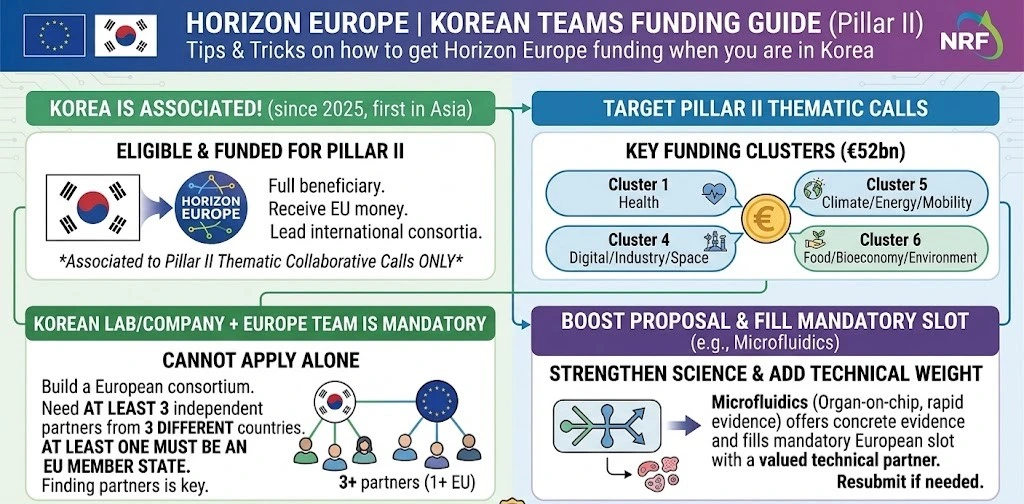
The Republic of Korea became an associated country to Horizon Europe on 1 January 2025, with the formal agreement signed in July 2025. Korea was the first country in Asia to join. In practice, Korean universities, research institutes, SMEs and large firms can be full beneficiaries, receive EU money, and lead international consortia.
One catch, and it matters. Korea is associated to Pillar II only. Pillar II is the “Global Challenges” part of the programme, the biggest slice, worth around 52 billion euros. Your association covers the thematic collaborative calls. It does not cover the European Research Council, the EIC Accelerator, or the Marie Skłodowska-Curie Actions in the same way. The official line says Korean researchers stay eligible for those too. True enough, but eligible to take part is not the same as funded like a member. For anything outside Pillar II, read the call text before you assume the money is there.
Which Horizon Europe calls can a Korean team actually get funded in?
The money and the eligibility line up inside the six Pillar II clusters. These are the calls to look at first.
- Cluster 1, Health. Cancer, infectious disease, medical devices, diagnostics.
- Cluster 4, Digital, Industry and Space. A huge cluster, and it covers a lot of Korean strengths in electronics, materials and manufacturing.
- Cluster 5, Climate, Energy and Mobility. Batteries, hydrogen, clean transport.
- Cluster 6, Food, Bioeconomy, Natural Resources, Agriculture and Environment.
- Clusters 2 and 3, on inclusive society and civil security. Smaller, but real.
Most of these run as RIA or IA. Research actions reimburse 100% of eligible costs. Innovation actions pay 70% for companies and 100% for non-profits. Project size usually sits somewhere between 4 and 15 million euros, shared across the consortium, over three to four years.
Do you still need European partners if Korea is associated?
You do. This is the part people miss. Even as an associated country, a Korean team can’t apply alone. Standard collaborative calls need at least three independent partners from three different countries, and at least one of them has to sit in an EU Member State. Association lets you count as a full partner and get paid. It does not remove the need to build a European team around you.
So the real work isn’t the paperwork. From what we’ve seen, a promising Korean idea usually stalls right here, at the consortium.
How do you find the right Korea-EU Horizon Europe partner from Korea?
A few routes work better than others.
- Start with the official help. Korea’s National Research Foundation runs National Contact Points, and the Korea-EU Research Centre in Brussels exists precisely to connect Korean teams to European ones. Use them.
- Use the partner search on the EU Funding & Tenders portal, and look at who won past projects on your topic. Those consortia are your shortlist.
- Target the gap, not the name. Pick partners who bring the one thing your proposal lacks, a clinical site, a demonstrator, a specific measurement platform. A well-chosen innovative SME with a niche technology often does more for your score than another big-name university (worth checking twice before you default to the famous lab).
- Go to brokerage events, even the online ones. Most winning consortia started with a real conversation, not a cold email.
What makes a Korea-involving proposal win?
- Make the international dimension mean something. Evaluators can smell a token partner. Your Korean contribution has to be a reason the project works.
- Divide the work cleanly. Who does what, and why them.
- Put impact and exploitation up front. Above all, show what happens after the grant ends.
- Start early. Building trust with European partners takes months, not weeks. If a call closes in six weeks and you have no consortium, you’re probably already too late for that one.
Where does microfluidics fit for a Korean consortium?
Here’s a concrete case. Many Pillar II health and diagnostics calls ask you to prove a biological effect or a device actually works, not just describe it. Standard lab methods are slow, burn through sample, and often hand you a different answer each time you run them. That’s a weak spot in a lot of proposals.
Microfluidics, chips that move tiny volumes of fluid through tiny channels, is one way to close that gap. What it buys you.
- Organ-on-chip models. Say you want to show your compound protects human lung or gut tissue, not just cells in a dish. A chip lets you run that experiment in a setup that behaves more like a real organ.
- Less sample, faster answers. You test more conditions with the material you have, and you tend to get the same result twice.
- A demonstrator reviewers can picture. A working chip platform is the kind of tangible outcome Pillar II calls reward.
For a Korean coordinator, an EU-based microfluidics partner does two jobs at once. It strengthens the science, and it fills that mandatory European slot with a group that carries real technical weight. If your idea touches health, diagnostics, bioproduction or environmental monitoring, it’s worth a conversation early, while the consortium is still taking shape.
How do you write a winning Horizon Europe proposal?
Beyond the Korea angle, a few rules hold for almost every European project.
- Answer the call, don’t bend it to your project. Evaluators score you against the topic text, not against how clever your idea looks on its own. If the topic names three expected outcomes, address all three, in its own words.
- Write to the three scored criteria: Excellence, Impact, and Quality and efficiency of the implementation. A strong idea with a vague work plan still fails.
- Make the work plan concrete. Real tasks, real deliverables, one partner clearly responsible for each, and no passengers in the consortium.
- Keep it readable. The evaluator reading you is tired and going through many proposals in a row. Short sentences. Clear figures. Use their vocabulary, not yours.
- Be ambitious, but stay believable (reviewers reward reach only when the plan behind it holds up).
One lever matters more than the rest, fit with the exact call topic. That’s why we publish a dedicated page for individual Horizon Europe topics, breaking down what each one really asks for and how to aim a proposal at it. Before you commit weeks of work, check our pages.
The MIC was present at the Korea-EU Horizon Europe Researchers Consulting Forum on Cluster 4, that took place in Brussels, on September 15-16, 2026.
The MIC already brings its expertise in microfluidics to Horizon Europe:
H2020-NMBP-TR-IND-2020
Microfluidic platform to study the interaction of cancer cells with lymphatic tissue
H2020-LC-GD-2020-3
Toxicology assessment of pharmaceutical products on a placenta-on-chip model
FAQ - Korea-EU Horizon Europe funding
Is Korea eligible for Horizon Europe funding?
Yes. The Republic of Korea is an associated country to Horizon Europe since 1 January 2025, with the formal agreement signed in July 2025. Korean universities, research institutes, SMEs and firms can be full beneficiaries and receive EU money.
What does "associated to Pillar II only" mean for a Korean team?
Korea’s association covers Pillar II, the Global Challenges collaborative calls, worth around 52 billion euros. The European Research Council, the EIC Accelerator and the Marie Skłodowska-Curie Actions are not covered the same way. For anything outside Pillar II, read the call text before assuming the funding is there.
Can a Korean team apply to Horizon Europe alone?
No. Standard collaborative calls need at least three independent partners from three different countries, and at least one has to sit in an EU Member State. Association lets Korea count as a full, funded partner. It does not remove the need for a European consortium.
Which Horizon Europe clusters can a Korean team get funded in?
The six Pillar II clusters. Cluster 1 Health, Cluster 4 Digital, Industry and Space, Cluster 5 Climate, Energy and Mobility, Cluster 6 Food, Bioeconomy, Natural Resources, Agriculture and Environment, plus Clusters 2 and 3 on inclusive society and civil security.
How much funding, and how big are the projects?
Most calls run as RIA or IA. Research actions reimburse 100% of eligible costs. Innovation actions pay 70% for companies and 100% for non-profits. Project size usually sits between 4 and 15 million euros, shared across the consortium, over three to four years.
How does a Korean team find European partners?
Start with the National Research Foundation National Contact Points and the Korea-EU Research Centre in Brussels. Use the partner search on the EU Funding & Tenders portal, look at who won past projects on your topic, and go to brokerage events. Pick partners who fill the one gap your proposal has.
Does Korea get real EU funding, or just participation?
Real funding, for Pillar II, on the same terms as EU members. That is what changed with the association in 2025.
Can a Korean institution coordinate a Horizon Europe project?
Yes, in Pillar II calls, as long as the consortium includes EU-based partners and meets the minimum three-partner rule.
What makes a Korea-involving proposal win?
The international dimension has to be a reason the project works, not a token partner. Divide the work cleanly, put impact and exploitation up front, and start building the consortium months ahead. Rejected before? Read the Evaluation Summary Report and resubmit.
How can microfluidics strengthen a Korean proposal?
An EU-based microfluidics partner does two jobs. It fills the mandatory European slot with real technical weight, and it strengthens the science through organ-on-chip demonstrators, smaller samples and consistent results. Useful for health, diagnostics, bioproduction or environmental monitoring calls.