Tips & Tricks for a successful HORIZON-MISS-2027-04-CIT-05 proposal
Opening
09 February 2027
Deadline
Keywords
Pre-Commercial Procurement
climate-neutral cities
open strategic autonomy
greenhouse gas reduction
urban air quality
buyers group
sustainability
Your microfluidic SME partner for Horizon Europe
We take care of microfluidic engineering, work on valorization and optimize the proposal with you
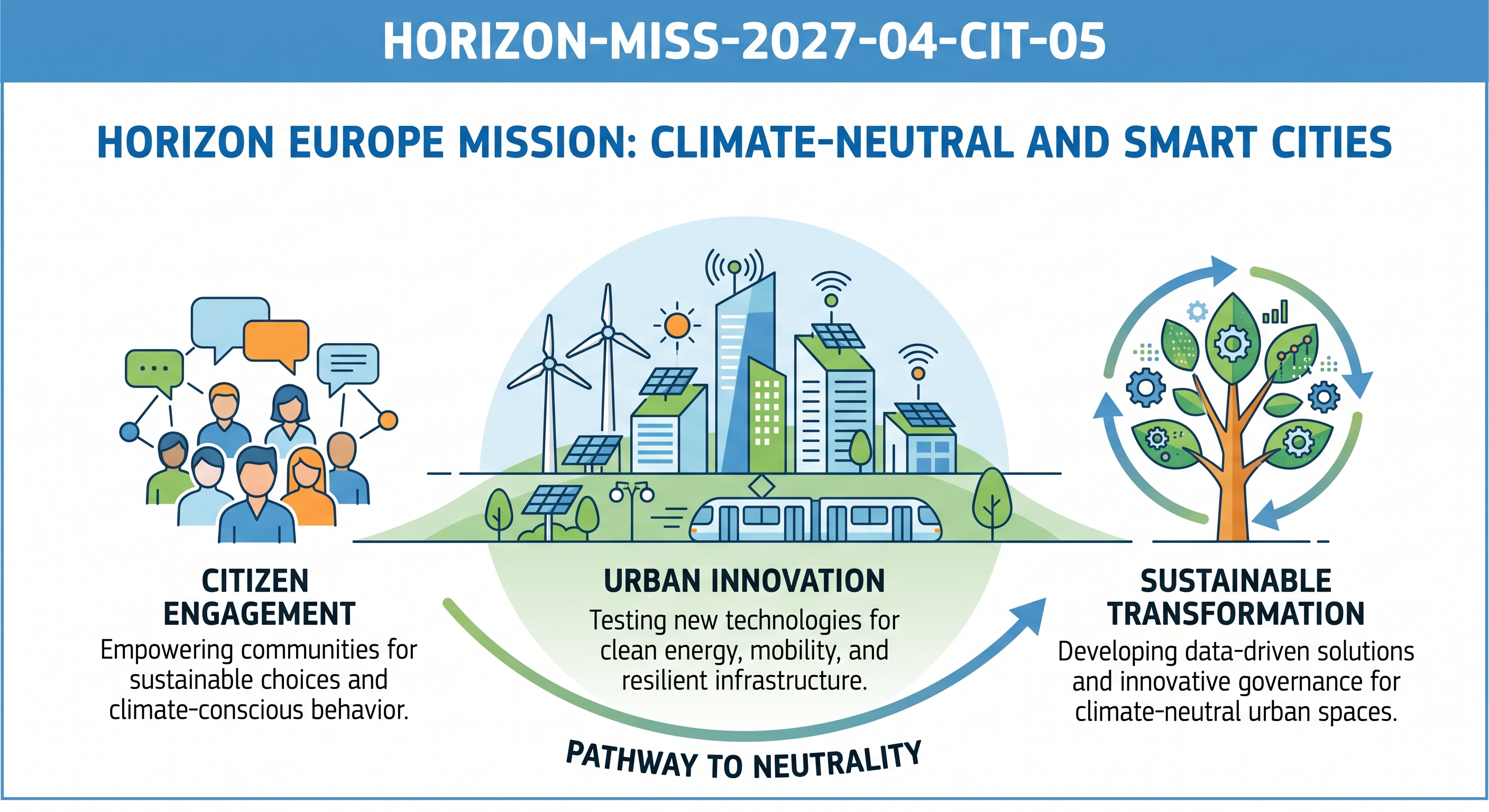
HORIZON-MISS-2027-04-CIT-05: Boosting the transformation towards climate-neutral cities, the net-zero economy and open strategic autonomy through Pre-Commercial Procurement (PCP)
The Commission wants cities to buy their way into climate neutrality. Not with off-the-shelf products, but with solutions that don’t exist yet. This is a Pre-Commercial Procurement action, so a group of public buyers pays suppliers to develop and test new answers to cutting greenhouse gas and air pollutant emissions. Open strategic autonomy sits right next to the climate goal here, which tells you a lot about who the Commission wants building these solutions.
Download the MIC Horizon Europe 2026/2027 Calls Calendar:
Discover more!
Administrative facts: what do we know about the HORIZON-MISS-2027-04-CIT-05 call?
Which call is it, and when is the opening and the deadline?
- Call name: Supporting the implementation of the Climate-Neutral and Smart Cities Mission
- Identifier: HORIZON-MISS-2027-04
- Destination: 100 Climate-Neutral and Smart Cities by 2030
- Topic: HORIZON-MISS-2027-04-CIT-05
- Opening: 09 February 2027
- Deadline: 07 October 2027, 17.00 Brussels time
- Type of action: PCP (Pre-Commercial Procurement)
What about the budget and estimated size of the project?
- Overall topic budget: EUR 26.82 million
- Projects expected: 3
- Budget per project: EUR 8.94 million on a simple split, though the Commission sets a range of EUR 7.00 to 12.00 million per project
What are the key eligibility and evaluation conditions?
- Standard admissibility, eligibility and award criteria from General Annexes A to G apply
- At least three of the 112 Mission cities must sit in the buyers group, and the lead procurer must be one of them
- PCP rules and minimum requirements follow General Annex H
- PCP/PPI procurement costs are eligible
- Financial support to third parties is capped at EUR 200,000, only to incentivise end-users to adopt solutions
- Collaboration with the Cities Mission Platform is mandatory, plus clustering with the other funded projects
- No JRC involvement is foreseen for this topic
Scientific range: what does the Commission expect from the HORIZON-MISS-2027-04-CIT-05 grant?
What outcomes are expected?
By the end, the buyers group should have pushed real suppliers to develop market-ready solutions that cut emissions in the participating cities. Publication series are not what the Commission is after. It wants tested prototypes, a credible path to deployment, and a numbered forecast of the greenhouse gas reduction expected by 2030 and 2050 against a baseline.
What is within scope?
- Energy efficiency in buildings
- Production and use of renewable energy
- Sustainable and smart mobility
- Digitalisation that supports emission cuts
- Air pollutant reduction alongside greenhouse gases
One boundary matters. This topic does not fund developers, industry or research organisations to do the R&D. They respond to the tenders. The money goes to the procurers.
What are the specifically proposed research directions?
- Challenge-based tenders where several suppliers develop competing prototypes in parallel
- An open market consultation before the tender, promoted widely across Europe
- A named deployment commitment from each procurer (buy, follow-up procurement, adopt, or incentivise)
- Fast-track PCP where a procurer commits early to buying or deploying
- Cooperation with follower cities to speed wider uptake
The work programme leaves the exact technologies open. Our reading: pick a challenge narrow enough that three suppliers can realistically compete on it.
Scientific strategy: how can you enhance your chances of being funded through HORIZON-MISS-2027-04-CIT-05?
What scientific choices matter most?
- Frame a sharp challenge. Vague smart city ambitions read badly. Reviewers want one problem the market hasn’t solved.
- Show the demand is real. Letters and budget commitments from the procurers carry more weight than promises.
- Prove open strategic autonomy. This is not just on paper. Show how European suppliers benefit and where the supply chain sits.
- Baseline your emissions properly. That 2030 and 2050 forecast has to rest on numbers, not aspiration.
- Plan the deployment before you plan the R&D.
Consortium & proposal-writing plan: what works best with this type of call?
Here the beneficiaries are the procurers, not technology firms, and that trips up first-time PCP applicants. Build a buyers group of at least three Mission cities, ideally somewhere around five or six so the demand looks convincing. Add a partner who has run a PCP before. If you have never handled the Annex H tender process, that experience is worth more than another city.
- Bring in a procurement coordination partner to run the legal and tender machinery
- Add follower cities early, even informally
- An innovative SME with technical and procurement know-how can sharpen the requirements and de-risk the tender
- Write the deployment strategy first, then reverse-engineer the phases
On the writing, keep the challenge statement short and let the market analysis carry the ambition.
How would microfluidics contribute to this topic?
Worth being straight here. In a PCP the technology provider usually sits on the supply side, answering the tender, not inside the buyers group.
Say your challenge is urban air quality. You want to know, street by street, what people actually breathe. Microfluidic sensors do this at a size and cost that fixed monitoring stations can’t match.
- Compact air and water quality sensors for dense city monitoring
- Lab-on-chip tools to verify emission cuts on the ground
- Microfluidic test rigs for fuel cells and flow batteries in the energy strand
If your buyers group frames a challenge around sensing, verification or new energy hardware, microfluidics is one of the technologies your future tenderers might bring. MIC can design and prototype these sensors, and can help you scope the challenge so it stays open to real innovation.
The MIC already brings its expertise in microfluidics to Horizon Europe:
H2020-NMBP-TR-IND-2020

Microfluidic platform to study the interaction of cancer cells with lymphatic tissue
H2020-LC-GD-2020-3

Toxicology assessment of pharmaceutical products on a placenta-on-chip model

FAQ - HORIZON-MISS-2027-04-CIT-05
What is HORIZON-MISS-2027-04-CIT-05 actually about?
It funds groups of cities to run a Pre-Commercial Procurement. Suppliers are paid to develop and test new solutions that cut greenhouse gas and air pollutant emissions in urban areas.
What is a Pre-Commercial Procurement, in plain terms?
Public buyers jointly buy R&D services. Several suppliers develop competing prototypes in phases. The buyers do not fund their own R&D. They challenge the market and keep the results non-exclusive.
Who can be a beneficiary of this topic?
The procurers. At least three of the 112 Mission cities must be in the buyers group, and the lead procurer must be one of them. Technology firms are not beneficiaries here.
How much funding is available and for how many projects?
The topic budget is EUR 26.82 million, with three projects expected. The Commission foresees EUR 7.00 to 12.00 million per project.
When does the call open and close?
Opening is 09 February 2027. The deadline is 07 October 2027 at 17.00 Brussels time.
What is a fast-track PCP?
A shorter version of the process. If a procurer commits early to buying or deploying the solution, the PCP can drop a phase. It rewards buyers who are serious about deployment.
Where does an innovative SME fit in a PCP?
Mostly on the supply side, answering the tender. An innovative SME with technical and procurement experience can also support the buyers group in setting requirements and running the Annex H process.
Check the Funding and Tenders Portal for more information.
What must the deployment commitment look like?
Each procurer declares whether it will buy the solution, launch a follow-up procurement, adopt it (for example open source), or incentivise others to adopt it. That declaration shapes the whole plan.
What role does the Cities Mission Platform play?
Collaboration is mandatory. The Cities Mission Platform supports preparation, upscaling, replication and impact monitoring. Budget for this must sit in your work plan.
How do we contribute microfluidics if we are not a city?
Through the tender. If a challenge targets emissions sensing, air or water monitoring, or new energy hardware, microfluidic solutions can compete as supplier offerings.