Tips & Tricks for a successful HORIZON-MISS-2027-04-CIT-01 proposal
Opening
09 February 2027
Deadline
Keywords
Missions
LVDC microgrids
Climate-Neutral Cities
renewable energy
energy efficiency
DC fault safety
digital twins
Innovative microgrids
green spaces
Your microfluidic SME partner for Horizon Europe
We take care of microfluidic engineering, work on valorization and optimize the proposal with you
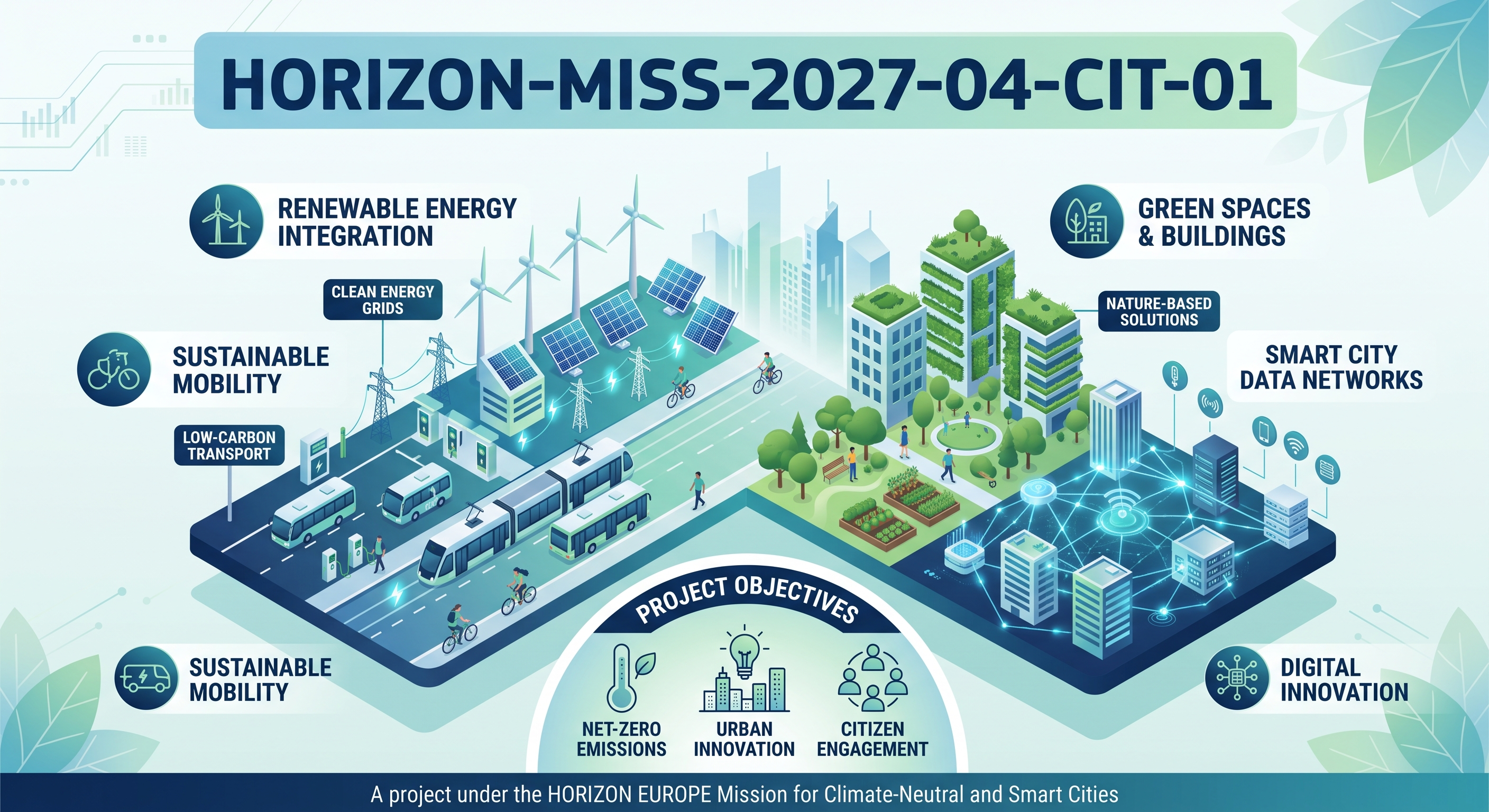
HORIZON-MISS-2027-04-CIT-01: Innovative microgrids for improved energy system integration and efficiency in urban contexts
The Commission wants Low Voltage Direct Current (LVDC) microgrids out of the lab and into real buildings and streets. Most appliances already run on DC, so the AC/DC conversion back and forth is a waste the EU wants to cut. This topic is about proving LVDC works, safely and at affordable cost, in actual cities. The Green Deal, the Clean Industrial Deal and the Solar Strategy sit behind it.
Download the MIC Horizon Europe 2026/2027 Calls Calendar:
Discover more!
Administrative facts: what do we know about the HORIZON-MISS-2027-04-CIT-01 call?
Which call is it, and when is the opening and the deadline?
- Call name: Supporting the implementation of the Climate-Neutral and Smart Cities Mission
- Identifier: HORIZON-MISS-2027-04
- Destination: 100 Climate-Neutral and Smart Cities by 2030
- Topic: HORIZON-MISS-2027-04-CIT-01, Innovative microgrids for improved energy system integration and efficiency in urban contexts
- Opening: 09 February 2027
- Deadline: 07 October 2027, 17.00 Brussels time
- Type of action: Innovation Action
What about the budget and estimated size of the project?
- Overall topic budget: EUR 20.00 million
- Number of projects expected to be funded: 3
- Budget per project: roughly EUR 6.7 million (the Commission estimates around EUR 7 million each)
What are the key eligibility and evaluation conditions?
- At least three cities, each from a different Member State or Associated Country, as beneficiaries, represented by a local authority or an entity with its explicit consent
- At least one of those cities must be among the 112 EU Mission cities
- TRL 7 to 8 expected by the end of the project
- SSH disciplines and experts must be involved
- Funding is a lump sum, linked to HORIZON-MISS-2021-CIT-02-03
- A Memorandum of Understanding with the Cities Mission Platform is required, plus clustering with other Mission projects
Scientific range: what does the Commission expect from the HORIZON-MISS-2027-04-CIT-01 grant?
What outcomes are expected?
By the end, at least one LVDC microgrid should be running in a real building or neighbourhood, safety and cost case made. Publication series are not what the Commission is after. It wants technical guidelines, regulatory recommendations and standardisation input other cities can pick up and reuse.
What is within scope?
- LVDC microgrid design methods and tools, including grid monitoring, control and safe handling of DC faults
- Life-cycle cost and benefit assessment against traditional AC, from technical to social
- One real demonstration connecting all electrical applications in a building or a neighbourhood
- Virtual demonstrations with digital twins in other building types, including one under renovation, in different cities (at least 3 real and virtual combined)
- Integration of PV, batteries, EV charging, heat pumps, LED and IT equipment
Heating through hydrogen is a separate topic (CIT-02). Keep this one electrical.
What are the specifically proposed research directions?
- Affordable DC fault protection and monitoring. This is the safety story reviewers will look for
- Regulatory feasibility work, including a review of local grid codes and, where needed, an innovation sandbox
- Contribution to CEN-CENELEC and IEC standardisation via concrete use cases
- Energy-community sharing at street level, running in parallel to an existing AC grid
Build on Shift2DC, plus HYPERRIDE, TIGON, HYNET and THEUS. The call expects it.
Scientific strategy: how can you enhance your chances of being funded through HORIZON-MISS-2027-04-CIT-01?
What scientific choices matter most?
- Lead with a real building. The virtual demonstrations support the case, they don’t replace it.
- Make the safety argument early. DC faults worry people.
- Get the regulator in the room. A pre-agreed sandbox beats a promise to sort it out later.
- Cost, in detail. Life-cycle numbers against AC, including the effect on vulnerable consumers’ bills.
- Take SSH seriously. It shapes acceptance and uptake.
Consortium & proposal-writing plan: what works best with this type of call?
Mission Innovation Actions reward a real mix. You need cities that will host, not just endorse.
- Around eight to twelve partners, a couple more if you carry three cities plus their distribution operators
- At least three cities, one of them a Mission city, each from a different country
- Distribution system operators, power-electronics and DC hardware makers, plus an innovative SME to sharpen the converter or monitoring side
- Academia and research partners for training and life-cycle work
- An SSH institution for acceptance and social impact
Pair a hosting city with its DSO from day one and demonstration risk drops fast. Write the work plan around the MoU and clustering duties, reviewers check for them.
How would microfluidics contribute to this topic?
Here is the honest link. This is an electrical grid call, so microfluidics sits at component level, not centre stage. But it earns a place wherever heat becomes the problem.
DC/DC converters and battery storage both run hot, and heat drags down efficiency and, worse, sets off faults.
- Microchannel liquid cooling for the power electronics. Say your converter runs hot under peak shaving. A microfluidic cold plate pulls that heat out in a smaller footprint than air cooling, and it stays efficient and safe.
- Battery thermal management. Stationary storage in a microgrid needs even temperatures to avoid thermal runaway. Microfluidic cooling channels keep the pack inside its safe window.
- Flow-cell storage. Redox flow batteries work on microfluidic principles, and they suit neighbourhood-scale storage.
Point is, thermal control feeds straight into the outcomes the call names, safety, efficiency and resilience. Your consortium wouldn’t build the microgrid around microfluidics. But if your demonstration carries serious storage or hard-working converters, a partner like MIC earns its keep.
The MIC already brings its expertise in microfluidics to Horizon Europe:
H2020-NMBP-TR-IND-2020

Microfluidic platform to study the interaction of cancer cells with lymphatic tissue
H2020-LC-GD-2020-3
Toxicology assessment of pharmaceutical products on a placenta-on-chip model

FAQ - HORIZON-MISS-2027-04-CIT-01
What is the HORIZON-MISS-2027-04-CIT-01 call actually about?
It funds real-world demonstrations of LVDC microgrids in urban buildings and neighbourhoods. The aim is to cut the AC/DC conversion losses that pile up when DC appliances run off an AC grid, and to support the Climate-Neutral and Smart Cities Mission.
When does the call open and close?
Opening is 09 February 2027. The deadline is 07 October 2027 at 17.00 Brussels time. Both dates can shift slightly at the Commission’s discretion.
How much money is on the table, and for how many projects?
The topic budget is EUR 20 million, and three projects are expected. That puts each grant at roughly EUR 7 million.
What type of action is it, and which TRL is expected?
It is an Innovation Action, funded as a lump sum. Projects should reach TRL 7 to 8 by the end.
Who has to be in the consortium?
At least three cities, each from a different Member State or Associated Country, must be beneficiaries. One of them has to be among the 112 EU Mission cities. Each city is represented by its local authority or an entity acting with the authority’s consent.
Check the Funding and Tenders Portal for more information.
What exactly must the project demonstrate?
One real LVDC microgrid connecting all electrical applications in a building or neighbourhood, plus virtual demonstrations using digital twins in other settings. The total of real and virtual demonstrations must be at least three.
Is hydrogen for heating in scope here?
No. Hydrogen cities are handled under a separate topic, HORIZON-MISS-2027-04-CIT-02. This one stays electrical.
Are social sciences and humanities really required?
Yes. SSH disciplines and experts must be involved, especially around acceptance, dissemination and the training materials. Treat it as core, not decoration.
What obligations come with the Cities Mission?
A Memorandum of Understanding with the Cities Mission Platform, signed soon after the project starts, plus clustering with other Mission projects. Budget the time and resources for it in the work plan.
Where does microfluidics fit in an electrical grid call?
Mostly in thermal management. Microchannel cooling keeps DC/DC converters and battery storage in a safe, efficient window, and redox flow batteries run on microfluidic principles. It is a component-level contribution, but it maps onto the safety and efficiency outcomes the call cares about.