Tips & Tricks for a successful HORIZON-MISS-2027-05-SOIL-06-two-stage proposal
Opening
04 February 2027
Deadline
Keywords
Mission Soil
soil degradation
sediment specialists
palaeo-environmental records
ancient eDNA
pollution
soil health projections
soil erosion
resilience
Your microfluidic SME partner for Horizon Europe
We take care of microfluidic engineering, work on valorization and optimize the proposal with you
HORIZON-MISS-2027-05-SOIL-06-two-stage: Long-term drivers and consequences of soil degradation: learning from the past to improve future soil health
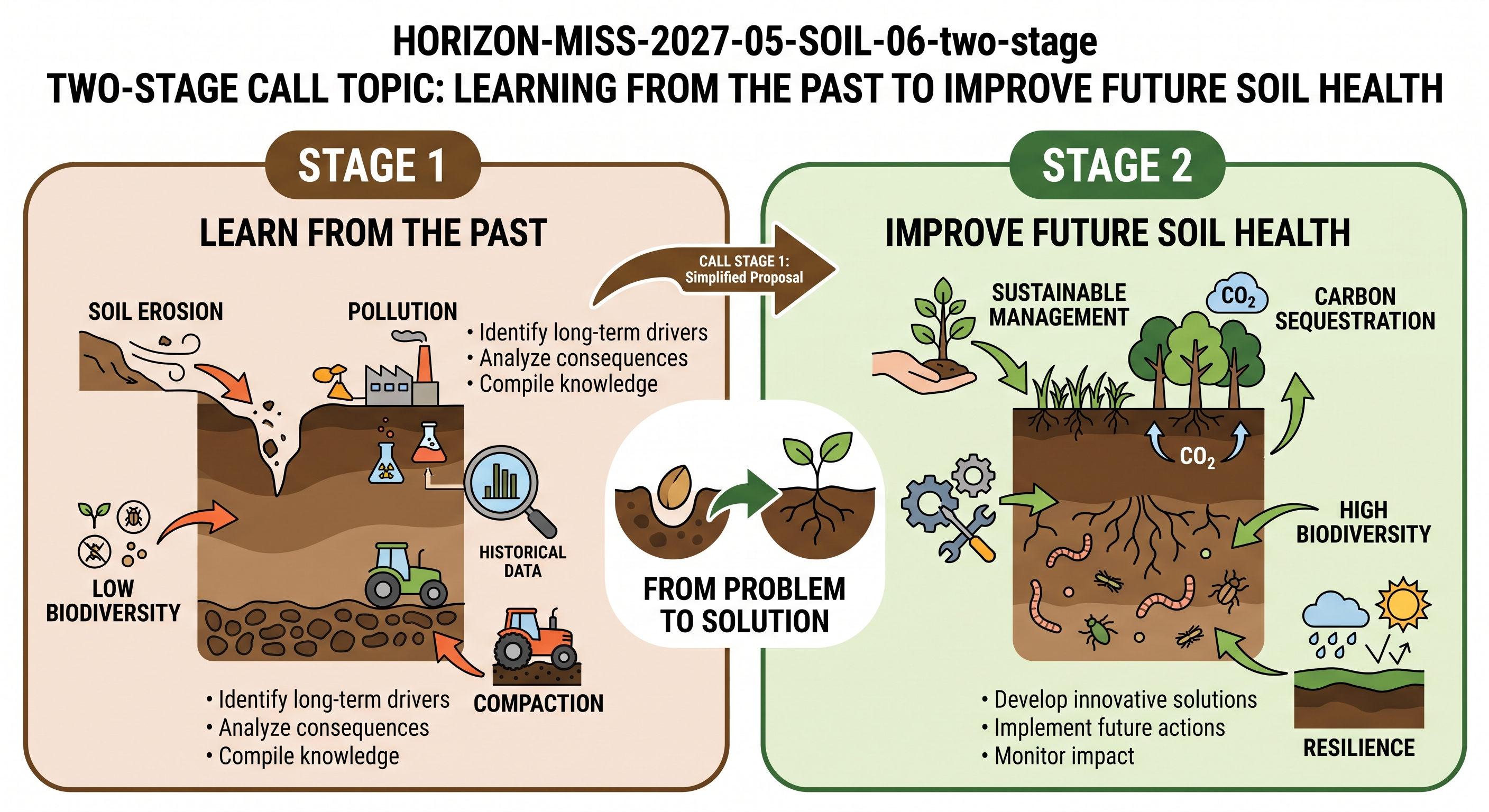
Soil data in Europe barely goes back three decades. The Commission wants to push that window back centuries, even millennia, and use what comes out to project soil health forward. Expect archaeologists, sediment specialists and soil scientists sitting at the same table. One project only, so the bar is high.
Download the MIC Horizon Europe 2026/2027 Calls Calendar:
Discover more!
Administrative facts: what do we know about the HORIZON-MISS-2027-05-SOIL-06-two-stage call?
Which call is it, and when is the opening and the deadline?
- Call name: Supporting the implementation of the Soil Deal for Europe Mission
- Call identifier: HORIZON-MISS-2027-05-two-stage
- Destination: A Soil Deal for Europe, supporting the implementation of Mission Soil
- Topic: HORIZON-MISS-2027-05-SOIL-06-two-stage
- Opening: 04 February 2027
- Deadline first stage: 08 April 2027
- Deadline second stage: 14 September 2027
- Type of action: Research and Innovation Action, lump sum grant
What about the budget and estimated size of the project?
- Overall indicative call budget: EUR 94.80 million
- Topic budget: EUR 7.00 million
- Number of projects expected: 1
- EU contribution per project: around EUR 7.00 million
What are the key eligibility and evaluation conditions?
- General Annex B applies: at least three independent legal entities from three different Member States or Associated Countries, one of them established in a Member State
- Award criteria under General Annex D. At first stage only Excellence and Impact are scored, threshold 4 each, cumulative 8. Second stage: 3 per criterion, cumulative 10
- Development of specific technologies above TRL 4 is out of scope
- Collaboration required with the EU Soil Observatory and the SoilWise project
- Proposals must build on results of HORIZON-MISS-2025-05-SOIL-02
- International cooperation encouraged, China in particular under the EU-China FAB flagship
Scientific range: what does the Commission expect from the HORIZON-MISS-2027-05-SOIL-06-two-stage grant?
What outcomes are expected?
Policymakers and land managers should end up with quantitative data on how soils degraded over centuries to millennia across pedo-climatic regions, plus projections under different scenarios. The Commission also wants the social and cultural side, why societies degraded their soils and what it cost them. Publication series are not what it is after here.
What is within scope?
- Past degradation processes, erosion, compaction, loss of soil organic carbon, and their natural, socio-economic and cultural drivers
- Evidence from historical documents, archaeological data, sediment archives, buried fossil soils, archived soil and plant samples
- Methods for reconstructing past soil health: ancient eDNA, pollen, spores, environmental radionuclides, other proxy indicators
- Numerical models and digital tools to rebuild past patterns and predict future trends
- Citizen science, with genuine participation in data collection and data analysis
Building technology beyond TRL 4 is not funded here.
What are the specifically proposed research directions?
- A multi-scalar approach integrating proxy data at the scale of pedo-climatic regions
- Separating long-term drivers from short-term ones. The work programme explicitly asks for similarities and differences
- Long-term consequences for climate and biodiversity systems, and for water and nutrient cycles
- Socio-economic consequences, including EU agricultural competitiveness
- Trajectories for sustainable soil management, not just reconstruction
Scientific strategy: how can you enhance your chances of being funded through HORIZON-MISS-2027-05-SOIL-06-two-stage?
What scientific choices matter most?
- Pick your regions early. Contrasting pedo-climatic regions, and justify each one.
- Do not let the humanities be decoration. History, archaeology, sociology and social geography are named in the text, and evaluators will check they hold real tasks and real budget.
- Cross-validate your proxies. One line of evidence per site is thin.
- Say what your model does with uncertainty.
- Plan the data flow to EUSO and SoilWise from month one, not as a task in the final year.
- The call says citizen science. What evaluators respond to, in our experience, is named communities and a data quality protocol (this one trips people up). More on how we read Horizon Europe calls for microfluidic relevance.
Consortium & proposal-writing plan: what works best with this type of call?
- Single project, RIA, seven million. Somewhere between ten and fifteen partners, maybe a couple more if regional coverage demands it. Our take on what an RIA consortium really needs may help you size it.
- Soil and environmental scientists, archaeologists, historians, modellers. Sociologists too.
- Bring in an innovative SME. Analytical platforms, sensing, data tools: an SME usually moves faster than a university lab, and it strengthens the impact story. That is exactly the role we play as a microfluidic Horizon Europe partner.
- Lump sum grant, so your work package structure is your budget. Get it right at second stage.
- If you have a partner sitting on Chinese sediment or soil archives, use them.
- Stage one stays short. Excellence and Impact only.
How would microfluidics contribute to this topic?
Ancient soil and sediment archives come in small quantities, with degraded molecules inside. Bench extraction and standard PCR burn material and blur weak signals. Microfluidic systems work at nanolitre scale, which is what you want when your sample is a few grams of buried fossil soil.
- Digital PCR on chip counts DNA copies one by one. For ancient eDNA from a core, you can quantify a faint signal instead of arguing about it. We covered the underlying methods in our review of droplet microfluidics in action.
- Say you want to know how a compacted soil loses its water pathways. Soil micromodels, transparent chips with engineered pore networks, let you watch it happen. You see the clogging, not just the endpoint. Full background in our soil-on-chip review.
- Same protocol, two partners, same answer twice.
- Portable units for field campaigns run with citizens, along the lines of what we described for other Mission Soil calls.
Keep it in proportion. Your proposal is about centuries of soil, not about devices. Microfluidics belongs in the methods work package, as the way you squeeze more evidence out of scarce archives.
The MIC already brings its expertise in microfluidics to Horizon Europe:
H2020-NMBP-TR-IND-2020

Microfluidic platform to study the interaction of cancer cells with lymphatic tissue
H2020-LC-GD-2020-3

Toxicology assessment of pharmaceutical products on a placenta-on-chip model

FAQ - HORIZON-MISS-2027-05-SOIL-06-two-stage
What is HORIZON-MISS-2027-05-SOIL-06-two-stage about?
The topic funds research that reconstructs how soils degraded over centuries to millennia, and uses that record to project future soil health. It sits under the Mission A Soil Deal for Europe.
When does the call open and when are the two deadlines?
The call opens on 04 February 2027. First stage proposals are due 08 April 2027 and second stage proposals on 14 September 2027, both at 17:00 Brussels time.
How much funding is available and how many projects will be selected?
The topic budget is EUR 7.00 million and one project is expected to be funded, with an EU contribution of around EUR 7.00 million. The whole call carries an indicative budget of EUR 94.80 million.
What type of action is it, and what does the lump sum mean?
It is a Research and Innovation Action. Eligible costs take the form of a lump sum, so your work package structure and its costing are the budget itself. Build them carefully before the second stage.
Check the Funding and Tenders Portal for more information.
What does the two-stage procedure change for applicants?
At first stage you submit a short proposal and only Excellence and Impact are evaluated. Implementation comes in at second stage. Plan the writing effort accordingly.
Which disciplines should be present in the consortium?
Soil sciences and environmental sciences, combined with social sciences and humanities. The work programme names history, archaeology, sociology and social geography. They need real tasks, not a symbolic presence.
What is explicitly out of scope?
Development of specific technologies above TRL 4. This topic funds knowledge, methods and models, not device engineering beyond a research prototype stage.
Which projects and platforms must we connect to?
Proposals are expected to build on results from HORIZON-MISS-2025-05-SOIL-02 and to work closely with the EU Soil Observatory and the SoilWise project for open access, longevity and interoperability of outputs.
Is international cooperation required?
It is strongly encouraged rather than mandatory, in particular with China under the EU-China Food, Agriculture and Biosolutions flagship initiative. A partner with access to non-European archives can strengthen the reconstruction.
Where can microfluidics realistically contribute?
Mostly in the methods work package. Digital PCR on chip for quantifying ancient environmental DNA, soil micromodels for pore scale processes, and portable analysis units for citizen science campaigns. It supports the science, it is not the subject of the topic.