Tips & Tricks for a successful HORIZON-CL4-2027-01-MAT-PROD-16 proposal
Opening
22 September 2026
Deadline
Keywords
Cluster 4
critical raw materials
Innovative processing
mineral processing
mining waste recovery
circularity
pilot scale demonstration
high-value products
Your microfluidic SME partner for Horizon Europe
We take care of microfluidic engineering, work on valorization and optimize the proposal with you
HORIZON-CL4-2027-01-MAT-PROD-16: Technologies for innovative processing of raw materials (IA)
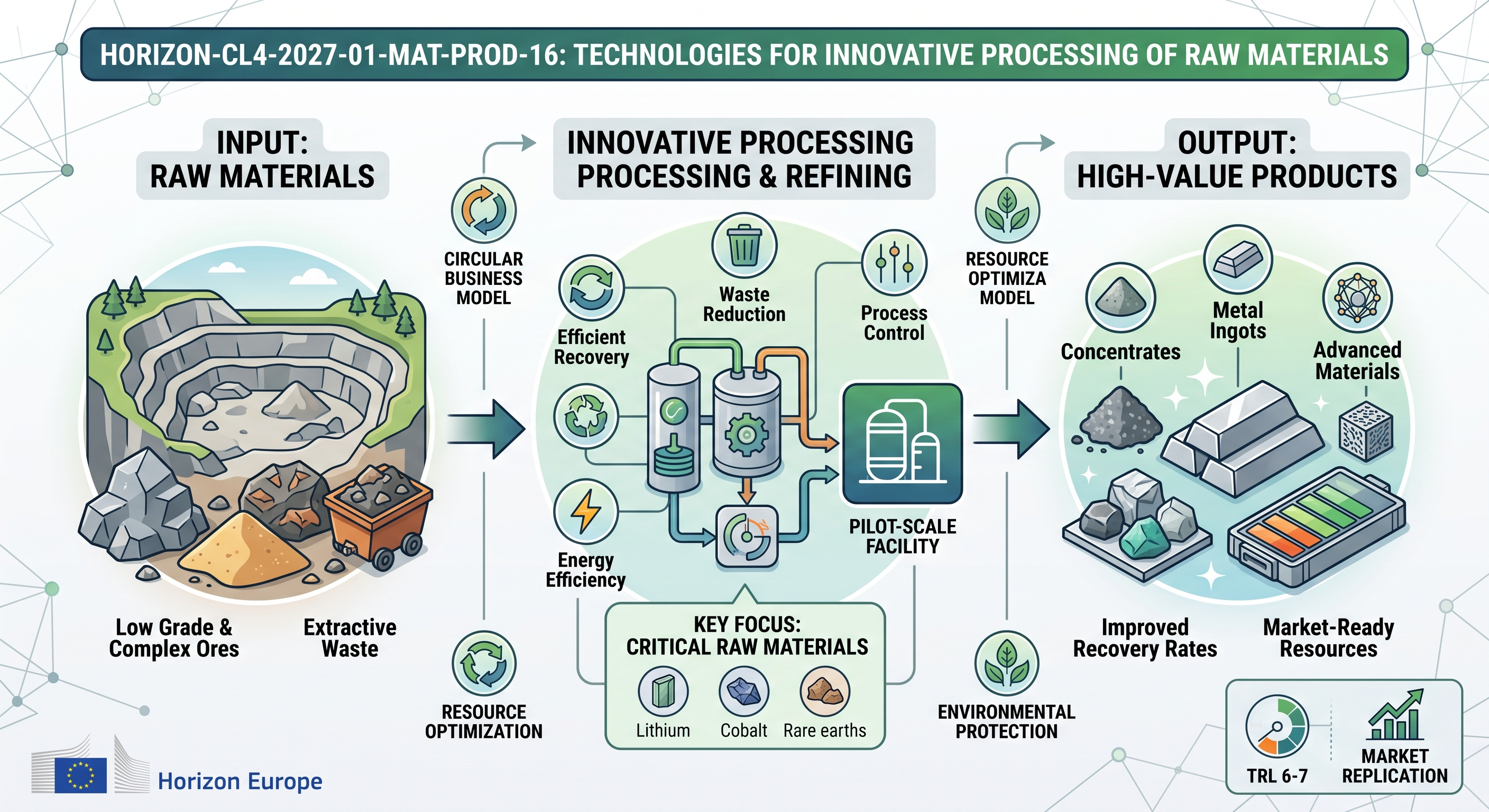
The Commission wants a pilot plant in Europe that pulls critical raw materials out of ore nobody currently bothers with. Low grade, complex, or sitting in an old waste heap. TRL 7 by the end, not a bench demo. And with less water and energy than industry uses today.
Download the MIC Horizon Europe 2026/2027 Calls Calendar:
Discover more!
Administrative facts: what do we know about the HORIZON-CL4-2027-01-MAT-PROD-16 call?
Which call is it, and when is the opening and the deadline?
- Call name: INDUSTRY
- Call identifier: HORIZON-CL4-2027-01
- Destination: Leadership in materials and production for Europe, Raw Materials area
- Topic: MAT-PROD-16, Technologies for innovative processing of raw materials
- Opening date: 22 September 2026
- Deadline: 2 February 2027, 17:00 Brussels time
- Type of action: Innovation Action
What about the budget and estimated size of the project?
- Topic budget: EUR 49 million
- Number of projects expected: 4
- EU contribution per project: EUR 10 to 12.50 million. Straight 49 divided by four gives 12.25 million
What are the key eligibility and evaluation conditions?
- TRL: activities start at 5 and reach 7
- Participation limited to Member States, associated and OECD countries, African Union, MERCOSUR, CARIFORUM, Andean Community, and EU raw materials partner countries
- Entities in an eligible country but controlled by a non-eligible country cannot take part
- Part B page limit extended by 3 pages for the business case
- Clustering with other selected projects, through a dedicated work package or task
- Granting authority may object to transfer of ownership or exclusive licensing of results for 4 years after the action
- Award criteria and thresholds: General Annex D, no topic-specific exception
Scientific range: what does the Commission expect from the HORIZON-CL4-2027-01-MAT-PROD-16 grant?
What outcomes are expected?
A working pilot facility on EU soil, recovering more metal from ore that current plants reject. The Commission wants numbers. Recovery rates up, water and energy down, waste and air emissions down. A publication series is not what they are after here.
What is within scope?
Recycling of end-of-life products is explicitly out.
- Pilot scale facility in the EU integrating processing and refining technologies
- Low grade and complex ores, plus extractive waste and old tailings
- Minerals and metals, critical raw materials above all
- Cutting toxic elements in the output, including safe handling of what gets removed
- Process control that copes with feed changing grade week to week
- Reducing land and sea use change, habitat loss and fragmentation
What are the specifically proposed research directions?
- Intelligent production systems that lose less material during waste rock separation
- Energy efficient separation, water use kept to a minimum
- Flexible flowsheets, because ore grade and waste streams vary
- Standardisation, plus analysis of the financial opportunities behind the circular business model
The wording stays broad on technology. Our reading: they want hydrometallurgy and beneficiation industry can actually buy, not one clever unit operation in isolation.
Scientific strategy: how can you enhance your chances of being funded through HORIZON-CL4-2027-01-MAT-PROD-16?
What scientific choices matter most?
- Pick a real ore body or a real waste heap. Named site, characterised feed. Generic complex ore proposals get marked down.
- Quantify everything. Recovery rate, water per tonne, kWh per tonne, emissions. Baseline and target.
- Build process control in from the start, not as work package six.
- Show what happens to the toxic fraction you remove. This one catches people off guard.
- Do not oversell TRL 7. Evaluators know what a pilot looks like.
Consortium and proposal-writing plan: what works best with this type of call?
- Somewhere between ten and fifteen partners, maybe a couple more if you need several ore sites.
- A mining or metallurgy company in the lead, or close to it. The work programme is explicit: EU industry and users of recovered materials should be prominent, with resources to match.
- Equipment suppliers, a research institute or two, one university for the fundamentals.
- An innovative SME often brings the instrumentation or the process step the large players do not have in house.
- Use the three extra pages. Business case, market size, who commits what afterwards.
- Ukraine and other partner countries encouraged. Check every partner’s eligibility early.
- If your consortium is academia heavy, rebalance now.
How would microfluidics contribute to this topic?
Testing a new lixiviant or assaying a leach solution usually means bench columns, litres of reagent and days of waiting. Microfluidic devices run the same chemistry in channels narrower than a hair. Contact time and mixing stay under control, and you get an answer in minutes.
- Solvent extraction of metals on a chip. Two phases flow side by side, the metal partitions, you read the split. Useful when screening extractants for a mixed critical raw material stream.
- Say your feed grade jumps twice a week. An inline microfluidic analyser on the pregnant leach solution tells the control system what changed, so the plant reacts instead of drifting.
- Droplet screening of leaching agents. Thousands of tiny reactors, each with a different acid, ligand or bacterial culture. You find the useful combination without burning through a drum of reagent, and you do it in days rather than months.
- Continuous monitoring of toxic elements in process water and effluent, at low concentration. Same condition twice, same answer twice.
Microfluidics will not replace your pilot line. It feeds it. Faster screening upstream, better sensing during operation, and hard data behind the environmental claims in your business case. At TRL 7 you have to prove numbers.
The MIC already brings its expertise in microfluidics to Horizon Europe:
H2020-NMBP-TR-IND-2020

Microfluidic platform to study the interaction of cancer cells with lymphatic tissue
H2020-LC-GD-2020-3

Toxicology assessment of pharmaceutical products on a placenta-on-chip model

FAQ - HORIZON-CL4-2027-01-MAT-PROD-16
What is HORIZON-CL4-2027-01-MAT-PROD-16 about?
It funds a pilot scale facility located in the EU that recovers minerals and metals, above all critical raw materials, from low grade or complex ores and from extractive waste. The work programme asks for higher recovery rates, less waste, less water and air pollution, better energy efficiency, and less pressure on land and habitats.
When does the call open and when is the deadline?
The INDUSTRY call HORIZON-CL4-2027-01 opens on 22 September 2026. The single deadline is 2 February 2027 at 17:00 Brussels time. The Director-General responsible may open the call up to one month earlier or later, and may delay the deadline by up to two months.
How much funding is available and how many projects will be funded?
The indicative topic budget is EUR 49 million. The Commission expects to fund 4 projects, with an EU contribution of EUR 10.00 to 12.50 million each. Asking for a different amount does not disqualify a proposal, but you would need a solid reason.
Which countries can take part in this topic?
Participation is limited to legal entities established in Member States, associated countries, OECD countries, African Union Member States, MERCOSUR, CARIFORUM, the Andean Community, and countries with EU strategic partnerships or trade agreements covering raw materials. Proposals including entities outside that list are ineligible. Entities inside the list but directly or indirectly controlled by a non-eligible country cannot participate either.
Check the Funding and Tenders Portal for more information.
What technology readiness level is expected?
Activities are expected to start at TRL 5 and reach TRL 7 by the end of the project. For TRL 6 to 7, the Commission also wants a credible route to full-scale deployment in the EU, with stated commitments from the leading partners after the project ends.
Is recycling of end-of-life products in scope?
No. The work programme excludes recycling of end-of-life products from this topic. The focus stays on primary ores, low grade and complex feeds, and extractive waste such as tailings. If your idea sits on the recycling side, look at the other Cluster 4 raw materials topics instead.
What has to go into the business case?
Target markets, estimated market size in the EU and globally, user and customer needs, evidence that the solution meets those needs cost-effectively, plus the expected market position and competitive advantage. The exploitation strategy should name the obstacles to reaching higher TRLs. Part B gets 3 extra pages for this, so use them.
What does the clustering requirement mean in practice?
Selected projects have to work with other relevant projects: joint activities on cross-cutting issues, shared results, common meetings and communication events. Budget it properly. A dedicated work package or task with named effort is what evaluators expect to see.
How should the consortium be built?
Industry and users of recovered secondary raw materials should be prominent, with resources to match. In practice that means a mining or metallurgy company close to the lead, equipment suppliers, research institutes, and at least one innovative SME to carry the instrumentation and valorisation work. Ten to fifteen partners is a reasonable range for a project this size.
Where does microfluidics fit in a raw materials processing project?
Microfluidics is a support technology here, not the core of the pilot. It earns its place in screening and sensing: liquid-phase extraction on chip for selecting extractants, droplet reactors for testing leaching agents, and inline analysers that feed the process control loop. Small volumes, fast answers, and numbers you can put in the impact section. More context on our Horizon Europe calls for proposals pages.