
Tips & Tricks for a successful HORIZON-CL5-2027-02-D3-31 proposal
Opening
03 December 2026
Deadline
Keywords
CO2 transport
CO2 storage
CCUS
CSA
EU policy
infrastructure repurposing
renewable gases
CO2 quality
climate neutrality
cross-border transport
Your microfluidic SME partner for Horizon Europe
We take care of microfluidic engineering, work on valorization and optimize the proposal with you
HORIZON-CL5-2027-02-D3-31: Support to the implementation of an EU policy framework for CO2 transport and storage infrastructure
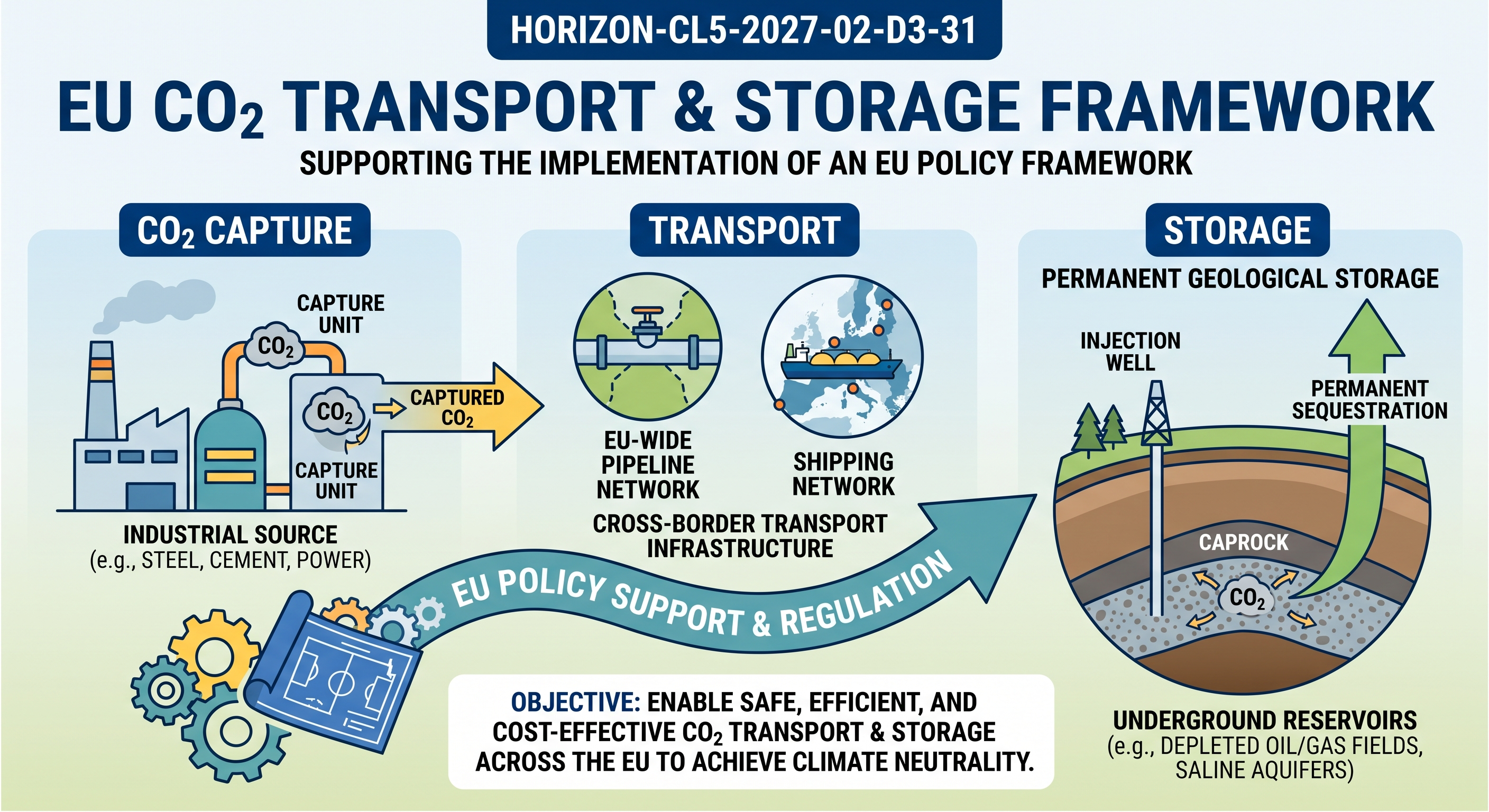
Europe is about to regulate CO2 transport and storage as a network industry. The Commission wants the people who will live with that framework to be ready before it lands. This topic funds no pilot plant and no new capture technology. It funds the homework: rules, tariffs, liability, and the question of whether old gas pipes can carry CO2.
Download the MIC Horizon Europe 2026/2027 Calls Calendar:
Discover more!
Administrative facts: what do we know about the HORIZON-CL5-2027-02-D3-31 call?
Which call is it, and when is the opening and the deadline?
- Call name: BATTERIES and ENERGY
- Call identifier: HORIZON-CL5-2027-02
- Destination: Sustainable, secure and competitive energy supply, under the Carbon Capture, Utilisation and Storage (CCUS) heading
- Topic: HORIZON-CL5-2027-02-D3-31
- Opening date: 03 December 2026
- Deadline: 31 March 2027, 17:00:00 Brussels time
- Type of action: Coordination and Support Action (CSA)
What about the budget and estimated size of the project?
- Overall indicative topic budget: EUR 5.00 million
- Number of projects expected to be funded: 1
- Budget per project: around EUR 5.00 million
What are the key eligibility and evaluation conditions?
- Eligibility per General Annex B, award criteria per General Annex D. No topic-specific threshold exception.
- Eligible costs take the form of a lump sum.
- If the project uses satellite earth observation, positioning or navigation data, Copernicus and/or Galileo/EGNOS must be used.
- No JRC participation clause and no clustering obligation attached to this topic.
Scientific range: what does the Commission expect from the HORIZON-CL5-2027-02-D3-31 grant?
What outcomes are expected?
One outcome, stated plainly: stakeholders in the CO2 infrastructure network must be in a position to implement the upcoming legislative framework. What the Commission is after is operational readiness, not a literature review. Guidance people can pick up and use.
What is within scope?
- Market and cost structure of CO2 transport and storage
- Cross-border integration, interoperability and planning
- Technical harmonisation, plus investment incentives for new infrastructure
- Third-party access, along-chain liability, competent regulatory authorities, tariff regulation
- Ownership and contractual models
- A baseline of the state of play of current legislation across the value chain
New capture or storage technology is not in scope here.
What are the specifically proposed research directions?
- Review and report on repurposing existing infrastructure for CO2, taking in the needs of renewable gases
- Technical feasibility and costs of that repurposing
- Synergies between new multimodal CO2 infrastructure and existing systems
- Regulatory barriers to integrating CO2 infrastructure with industrial clusters
- CO2 quality, flexibility, robustness, and interconnections between CO2 and energy infrastructures
The repurposing question is where the text gets most specific. We’d read that as the real priority.
Scientific strategy: how can you enhance your chances of being funded through HORIZON-CL5-2027-02-D3-31?
What scientific choices matter most?
- Anchor everything to the legislative timeline. The framework is described as upcoming, so your outputs have to land usable and on time.
- Build the legislative baseline first. Everything else depends on it.
- Treat CO2 quality as a regulatory variable, not a chemistry footnote. Impurity limits decide who is allowed to inject into a shared pipeline, which makes them a market access question.
- Get real cost data from operators.
- Cover at least two cross-border corridors. One country is not a European framework.
- The call text stays vague on method. That gives you room to frame it your way, and we’d use it.
Consortium & proposal-writing plan: what works best with this type of call?
- CSAs of this size usually run somewhere between eight and fourteen partners, maybe a couple more if you need wide country coverage.
- If you have no regulator or ministry inside the consortium, put them on an advisory board. Without that, the readiness claim is thin.
- Pipeline operators and storage developers. Non-negotiable.
- Mix legal and economic expertise with engineering. A consortium that is all law firms will lose points on Excellence.
- Bringing in one innovative SME with measurement or modelling capability is usually worth doing. It keeps the technical chapters credible and gives your dissemination work a commercial reader.
- Name the people who will use each deliverable, and say when.
- Lump sum funding means your work package breakdown is the budget. Get it right first time.
How would microfluidics contribute to this topic?
Let’s be straight about this one. It’s a policy support action, and microfluidics won’t carry a work package here. Still, part of the scope is technical. Conventional core-flooding and pipeline loop tests are slow and costly, and they eat budget a CSA doesn’t have. Chip-scale experiments give you numbers faster, on millilitres instead of barrels.
- Say you need to defend an impurity limit for a shared pipeline. Water and oxygen in the stream, maybe some SOx. A microfluidic cell lets you watch phase behaviour and the first signs of corrosion at pressure, in weeks.
- Reservoir-on-a-chip work shows how CO2 actually moves through pore space and where it gets trapped. That matters once the liability discussion starts.
- Small volumes, so you repeat the test cheaply. You get the same answer twice.
- Renewable gas blends. Same question, different mixture.
None of this replaces the legal and economic core of your proposal. It does something narrower: it puts measured evidence behind the technical claims your regulatory chapters rest on, thanks to precise microfluidic flow control. Evaluators notice when a CSA can back its numbers instead of citing someone else’s.
The MIC already brings its expertise in microfluidics to Horizon Europe:
H2020-NMBP-TR-IND-2020

Microfluidic platform to study the interaction of cancer cells with lymphatic tissue
H2020-LC-GD-2020-3

Toxicology assessment of pharmaceutical products on a placenta-on-chip model

FAQ - HORIZON-CL5-2027-02-D3-31
What is HORIZON-CL5-2027-02-D3-31 actually about?
It is a Coordination and Support Action that helps stakeholders in the CO2 infrastructure network get ready for the upcoming EU legislative framework on CO2 transport and storage. The work is regulatory, economic and legal rather than experimental. Think tariffs, third-party access, liability along the chain, ownership models, and a baseline of what current legislation already says.
Which call does this topic sit under, and when is the deadline?
The topic belongs to the BATTERIES and ENERGY call, identifier HORIZON-CL5-2027-02, inside Cluster 5. The call opens on 03 December 2026 and closes on 31 March 2027 at 17:00:00 Brussels time. Keep in mind that the Director-General may shift the opening by one month and delay the deadline by up to two months.
How much money is on the table, and for how many projects?
The total indicative budget for the topic is EUR 5.00 million, and the work programme expects a single project to be funded. So the expected EU contribution per project is around EUR 5.00 million. That does not stop you from requesting a different amount, but with one project funded the competition is unforgiving.
What does lump sum funding change for applicants?
Eligible costs take the form of a lump sum. In practice, your work package structure becomes the payment structure, and each work package has to be a defensible unit of work with a clear completion test. Reallocating effort later is much harder than under actual cost reporting. Build the breakdown carefully before submission.
Check the Funding and Tenders Portal for more information.
Is this topic about developing new capture or storage technology?
No. The scope is the policy and market framework around CO2 infrastructure, not the technology that fills it. Technology-facing topics sit elsewhere in the CCUS section, for instance the Direct Air Capture topic or the aquifer storage appraisal topic. A proposal that reads like an Innovation Action will be marked down on scope.
What is the upcoming legislative framework the topic refers to?
The work programme calls it the upcoming legislative framework for CO2 infrastructure without naming a specific legal act. We would not guess at the exact instrument in a proposal. Instead, track what the Commission publishes between now and the deadline, and build your work plan so it adapts to whatever text lands.
Which stakeholders should be inside the consortium?
Pipeline operators, storage developers, and industrial emitters who will actually be regulated. Add legal and regulatory economics expertise, plus at least a couple of national regulators or ministries, on the consortium or on an advisory board. An innovative SME bringing measurement or modelling capability keeps the technical chapters honest.
Why does repurposing existing infrastructure get so much attention here?
Because it is the cheapest path to a European CO2 network, and nobody has settled the rules for it. The work programme asks for a review and report on the challenges of repurposing existing infrastructure, including the needs of renewable gases. Technical feasibility, costs, regulatory barriers and CO2 quality all come up in the same paragraph. That concentration is a signal.
Can microfluidics play any role in a policy support action?
In a limited but real way. Microfluidics will not be a work package, yet several scope items rest on physical evidence: CO2 quality limits, corrosion in repurposed pipes, how CO2 behaves in pore space. Chip-scale experiments produce that evidence faster and cheaper than core floods or full loop tests. Use it to support the regulatory chapters, not to replace them.
What usually sinks a CSA proposal of this kind?
Vagueness about who uses the output. A CSA is judged on whether real stakeholders can act on what you produce, so name them and say when. The other classic failure is a consortium with no regulator and no operator, which makes the readiness claim impossible to believe. And do not underestimate the lump sum work package design.