
Tips & Tricks for a successful HORIZON-NEB-2026-01-REGEN-02 proposal
Opening
05 May 2026
Deadline
Keywords
New European Bauhaus
predictive maintenance
existing buildings
prospective LCA
heritage buildings
social & affordable housing
IA
REGEN approach
Your microfluidic SME partner for Horizon Europe
We take care of microfluidic engineering, work on valorization and optimize the proposal with you
HORIZON-NEB-2026-01-REGEN-02: Advancing sustainable maintenance and repair measures for existing buildings
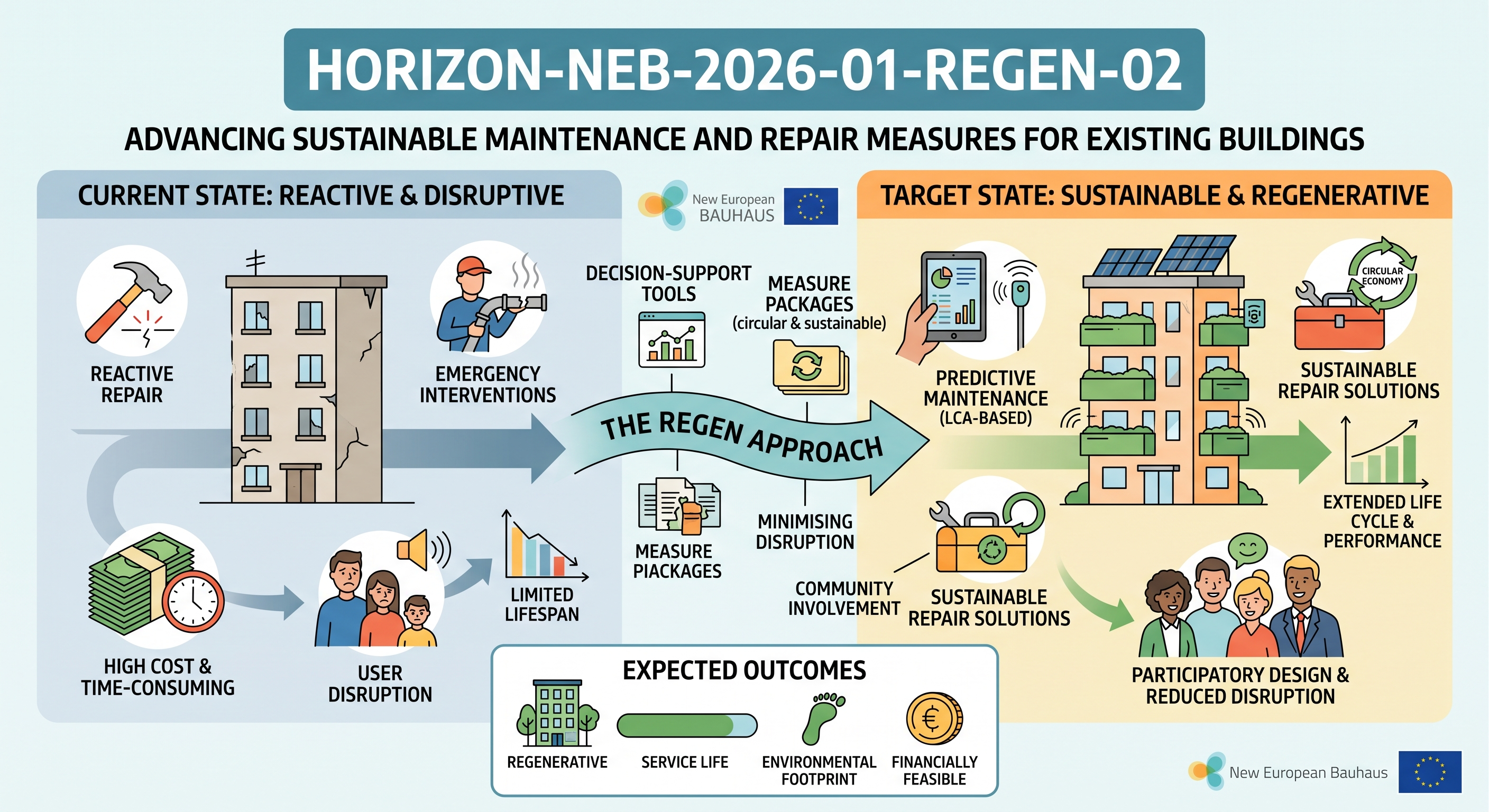
Most repair work on buildings happens after something has already broken. The Commission wants that logic flipped. This topic asks for predictive maintenance packages and decision support tools that extend the service life of existing buildings, then proves them on real sites. Heritage buildings and social housing are explicitly part of the deal.
Download the MIC Horizon Europe 2026/2027 Calls Calendar:
Discover more!
Administrative facts: what do we know about the HORIZON-NEB-2026-01-REGEN-02 call?
Which call is it, and when is the opening and the deadline?
- Call name: Beautiful, inclusive and sustainable neighbourhoods for communities
- Call identifier: HORIZON-NEB-2026-01
- Destination: Circular and regenerative approaches for the built environment
- Topic: HORIZON-NEB-2026-01-REGEN-02
- Opening: 05 May 2026
- Deadline: 01 December 2026, 17.00 Brussels time
- Type of action: Innovation Action
What about the budget and estimated size of the project?
- Topic budget: EUR 10.00 million
- Number of projects expected: 2
- EU contribution per project: around EUR 5.00 million
- Overall call budget: EUR 101.10 million
What are the key eligibility and evaluation conditions?
- TRL 6 to 8 by the end of the project. Activities may start at any TRL.
- Lump sum funding.
- Demonstration on three buildings in three different Member States or Associated Countries.
- At least one heritage building and at least one social and affordable housing project.
- Effective contribution of social sciences and humanities required.
- At least 0.8% of the budget allocated to the New European Bauhaus hub for results and impact.
- Admissibility, eligibility and award criteria as per General Annexes A, B and D.
Scientific range: what does the Commission expect from the HORIZON-NEB-2026-01-REGEN-02 grant?
What outcomes are expected?
Two things by the end: existing buildings that last longer with lower life cycle impacts, and predictive maintenance that is easy enough that people actually use it. A pilot nobody adopts is not what the Commission is after.
What is within scope?
- Prospective LCA based decision support tools for predictive maintenance and repair
- Packages of measures that extend the estimated service life of existing buildings
- Circularity, environmental sustainability and financial feasibility over the remaining life cycle
- Involving inhabitants, users and owners in the design and implementation of the works
- Compliance with European and national rules, the recast EPBD above all
- Solutions that cut noise and shorten works for people who stay in the building
New construction is not the subject here. Existing stock only.
What are the specifically proposed research directions?
- One decision support tool at minimum, built on prospective LCA. Prospective is the operative word: forecast, not footprint report.
- One package of maintenance and repair measures, demonstrated across three countries
- A barrier analysis on why predictive maintenance stays rare in existing buildings, with proposed fixes
- Participatory and transdisciplinary work, SSH inside the technical tasks rather than beside them
The work programme says little about how building condition should be measured. That vagueness gives you room to define the diagnostic layer your way.
Scientific strategy: how can you enhance your chances of being funded through HORIZON-NEB-2026-01-REGEN-02?
What scientific choices matter most?
- Make the tool genuinely prospective. An LCA that predicts degradation and the right moment to intervene beats a retrospective carbon calculation, and evaluators can tell the difference in about two pages.
- Name your three buildings early. Real owners, signed commitments.
- Show the data pipeline. Predictive maintenance without a defensible sensing layer is a spreadsheet with ambitions.
- Quantify disruption. Days of works, decibels, rooms out of service.
- Treat heritage constraints as a design input, not an annex.
- Do not park SSH in the dissemination work package. We see this a lot, and it costs points.
Consortium & proposal-writing plan: what works best with this type of call?
- Somewhere between eight and twelve partners, maybe a couple more if the three demo sites need local coverage
- Building owners and social housing operators as full partners, not letters of support
- A workable mix: contractors, a heritage conservation body, LCA specialists, sensing and materials SMEs, plus a university team carrying the SSH side
- An innovative SME on the diagnostics side usually strengthens the exploitation story
- Lump sum means your work package breakdown is the budget. Write it once, carefully. Then check the totals again.
- If you have run a live demonstration building before, say so in the first page of the impact section
How would microfluidics contribute to this topic?
Sampling a wall usually means drilling it, bagging the powder, and waiting a week for the lab. Slow, slightly destructive, and on a heritage facade you only get so many attempts. Microfluidic sensing shrinks that loop to minutes, on site, from a droplet of liquid.
- Salts and moisture are what kill old masonry. A small chip reads chloride, sulfate and nitrate from a tiny extract, right there on the scaffold. Numbers the same morning, not next Thursday.
- Say your tool predicts a render will fail in six years. Microfluidic corrosion and pH sensors left in the wall let you check whether that prediction holds, then feed the answer back into the model. That is how a decision support tool earns trust.
- Water systems in occupied buildings: portable microfluidic assays for microbial contamination, no lab trip.
- Droplet generation lets you encapsulate healing agents at a controlled size for self repairing mortars. Same agent, wrong capsule, no repair.
- Air and dust screening during works, so you can prove the disruption limits you promised.
For your consortium the point is evidence. Predictive maintenance stands or falls on whether the prediction can be checked, cheaply and often. Microfluidics is one of the few ways to do that without cutting into the building every time.
The MIC already brings its expertise in microfluidics to Horizon Europe:
H2020-NMBP-TR-IND-2020

Microfluidic platform to study the interaction of cancer cells with lymphatic tissue
H2020-LC-GD-2020-3

Toxicology assessment of pharmaceutical products on a placenta-on-chip model

FAQ - HORIZON-NEB-2026-01-REGEN-02
What is HORIZON-NEB-2026-01-REGEN-02 actually about?
It is a New European Bauhaus Facility topic on maintenance and repair of buildings that already exist. The Commission wants intervention to become predictive instead of reactive, so that buildings stay usable longer and fewer new ones need to be built. Two elements are required: a decision support tool based on prospective LCA, and a package of maintenance and repair measures. Both have to be demonstrated on real buildings.
When does the call open and when is the deadline?
The call HORIZON-NEB-2026-01 opens on 05 May 2026 and closes on 01 December 2026 at 17.00 Brussels time. The work programme notes that the Director-General may open the call up to one month earlier or later, and may delay the deadline by up to two months. Check the Funding and Tenders Portal before you fix your internal planning.
How much money is on the table, and for how many projects?
The topic budget is EUR 10.00 million. Two projects are expected, each with an EU contribution of around EUR 5.00 million. Requesting a different amount is allowed, but with only two grants available the margin for an unusual budget is thin. The whole call carries EUR 101.10 million across nine topics.
What does lump sum funding change for the proposal?
Quite a lot in practice. Under a lump sum, the detailed budget table you submit becomes the payment schedule, and payment follows completed work packages rather than reported costs. So work package design, deliverable definition and the split of effort all have to be right at submission. Vague work packages get expensive later.
Check the Funding and Tenders Portal for more information.
Which buildings can be used for the demonstration?
Three buildings, in three different Member States or Associated Countries. At least one has to be a heritage building and at least one a social and affordable housing project. The work programme also counts social care homes, elderly houses and other inclusive housing with a welfare function as social and affordable housing.
What does the Commission mean by prospective LCA here?
A life cycle assessment used to look forward rather than backward. Instead of reporting the footprint of what has been done, the tool should estimate how a building will degrade, what interventions will be needed, when they should happen, and what each option costs in environmental and financial terms. That forward-looking element is the part evaluators will test hardest.
Is social sciences and humanities involvement really mandatory?
Yes. The topic explicitly requires an effective contribution from SSH disciplines and the involvement of SSH experts and institutions. Occupants, owners and managers have to be part of designing the measures, and that is not a technical question. Putting SSH partners only in communication tasks is a common and expensive mistake.
What are the classic weak points in proposals for this kind of topic?
Demonstration sites named late or not named at all. Decision support tools with no credible data feeding them. Disruption reduction promised in words but never measured. Consortia strong on construction and empty on heritage expertise. And budgets built as if the grant were cost-based rather than lump sum.
Where does microfluidics fit into a building maintenance project?
In the measurement layer. Predictive models need condition data, and condition data on masonry, mortar, water systems and indoor air is usually slow and partly destructive to collect. Microfluidic chips can run those analyses on site from very small samples. Encapsulation work also feeds directly into self repairing materials.
What role can the Microfluidics Innovation Center play in the consortium?
MIC is a French SME that has taken part in more than fifty European projects since 2011. In a consortium of this type it would typically take the sensing and diagnostics work package: chip design, prototyping, on-site validation, and integration with the data pipeline feeding the decision support tool. More on our Horizon Europe work.