Tips & Tricks for a successful HORIZON-MISS-2027-05-SOIL-01-TWO-STAGE proposal
Opening
04 February 2027
Deadline
Keywords
Mission Soil
Living labs
Soil health
Soil monitoring
Biogeographical regions
Multi-actor approach
Your microfluidic SME partner for Horizon Europe
We take care of microfluidic engineering, work on valorization and optimize the proposal with you
HORIZON-MISS-2027-05-SOIL-01-two-stage: Living labs to enhance soil health in Continental, Black Sea, Pannonian and Steppic biogeographical regions
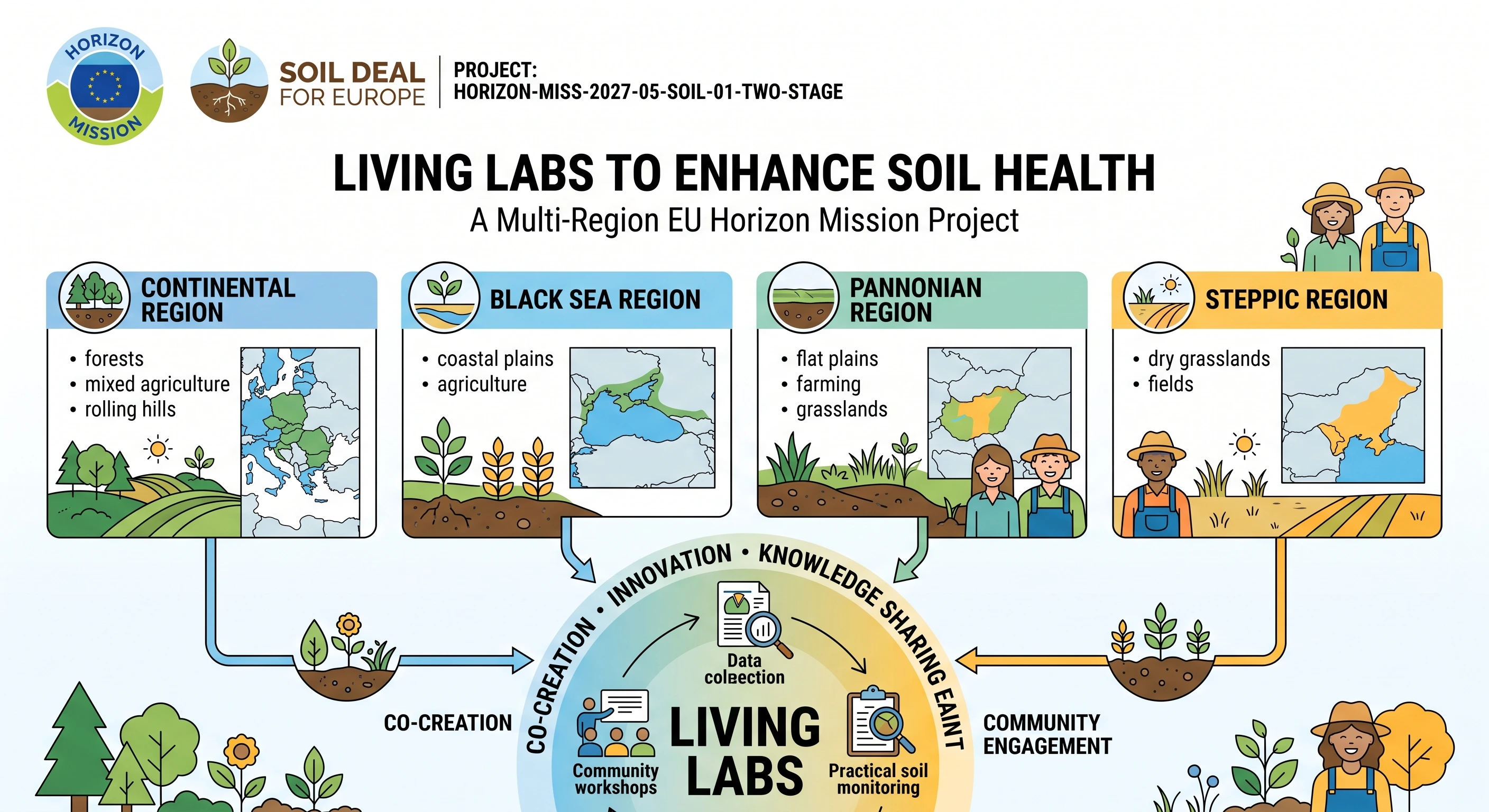
The Commission wants living labs on the ground, not another round of desk studies. It is building towards 100 living labs and lighthouses by 2030, and this topic adds four to five more in specific regions. The focus sits on the Continental soils, or on the Black Sea, Pannonian and Steppic regions. Real sites, real actors, measurable change in soil health.
Download the MIC Horizon Europe 2026/2027 Calls Calendar:
Discover more!
Administrative facts: what do we know about the HORIZON-MISS-2027-05-SOIL-01 call?
Which call is it, and when is the opening and the deadline?
- Call name: Supporting the implementation of the Soil Deal for Europe Mission
- Call identifier: HORIZON-MISS-2027-05-two-stage
- Destination: A Soil Deal for Europe, supporting the implementation of Mission Soil
- Topic: HORIZON-MISS-2027-05-SOIL-01-two-stage
- Opening: 04 February 2027
- Deadlines: 08 April 2027 (first stage), 14 September 2027 (second stage)
- Type of action: Research and Innovation Action (RIA)
What about the budget and estimated size of the project?
- Overall topic budget: EUR 24.00 million
- Number of projects expected: 2
- Budget per project: around EUR 12.00 million (24 divided by 2)
What are the key eligibility and evaluation conditions?
- Second stage overall threshold: 12, with a minimum of 4 on Excellence
- Multi-actor approach is mandatory
- Focus on Continental, or on one or more of Black Sea, Pannonian, Steppic
- Living labs in at least three Member States or Associated Countries
- Financial support to third parties allowed, capped at EUR 60 000 per party
Scientific range: what does the Commission expect from the HORIZON-MISS-2027-05-SOIL-01 grant?
What outcomes are expected?
By the end, the Commission wants working living labs that produce standardised, high quality soil data and practice-ready knowledge that land managers actually adopt. Publication series are not what they are after. Policymakers should come away better informed about local soil needs.
What is within scope?
- Four to five living labs, each with roughly 10 to 20 sites
- Agricultural, urban, peri-urban, post-industrial, forest and semi-natural land uses
- Co-designed soil health solutions, adapted to local context
- Baseline soil conditions plus monitoring against the Soil Monitoring and Resilience indicators
- Lighthouse sites for demonstration and training
One boundary: proposals where all living labs tackle eutrophication in a river catchment belong under SOIL-02, not here.
What are the specifically proposed research directions?
- Common soil health challenges shared within and across the living labs of one project
- Baselines and long-term monitoring of soil health and ecosystem services
- Technical, social, economic and environmental viability of solutions, plus scalability
- Business models and funding mixes so the labs survive past Horizon money
- Data flowing into EUSO through collaboration with SoilWise, kept FAIR
The wording leaves room on which soil challenge you pick. That is deliberate, so frame it around your regions.
Scientific strategy: how can you enhance your chances of being funded through HORIZON-MISS-2027-05-SOIL-01?
What scientific choices matter most?
- Pick your biogeographical focus early: The whole proposal reads better when the region drives the science.
- Build a real baseline: Reviewers check whether you can actually measure change, not just claim it.
- Use the Directive soil indicators as your backbone, then add your own where the challenge demands.
- Show cause and effect between practice and soil response.
- Plan for the SOILL collaboration from day one: Budget it.
- Do not skimp on social sciences and the arts: The call names SSHA explicitly.
Consortium & proposal-writing plan: what works best with this type of call?
Living labs need people, not just labs. Aim for somewhere between eight and twelve partners, maybe more if your regions are spread wide. Mix universities, research institutes, land managers, local authorities and civil society. For instance farmers and NGOs count through third party support, so use it. An innovative SME on board helps a lot for the monitoring and data side (this one often gets overlooked). If you cover Black Sea, Pannonian or Steppic, your ranking odds improve, since the Commission reserves grants for the best there. Write the multi-actor story concretely. Who does what, at which site.
How would microfluidics contribute to this topic?
Conventional soil and water testing means sending samples to a central lab and waiting. That slows down a living lab that needs answers on site. Microfluidic sensors change the tempo. You measure in the field.
- Say you want to track nitrate or phosphate leaching after a change in practice. A small lab-on-chip device gives you a reading in the field, same day, no courier.
- Portable microfluidic tools help standardise how sites collect data, which matters when you compare results across four or five living labs.
- Soil biota and microbial activity: your consortium can screen samples cheaply and get the same answer twice.
- Water quality at the edge of a catchment. Same chip, different site, quick check.
For a topic built on measurable change across many sites, microfluidics gives you consistent numbers without the lab bottleneck. That is exactly what a living lab needs to prove its soil health solutions work.
The MIC already brings its expertise in microfluidics to Horizon Europe:
H2020-NMBP-TR-IND-2020

Microfluidic platform to study the interaction of cancer cells with lymphatic tissue
H2020-LC-GD-2020-3

Toxicology assessment of pharmaceutical products on a placenta-on-chip model

FAQ - HORIZON-MISS-2027-05-SOIL-01-TWO-STAGE
What is the SOIL-01 call really asking for?
It funds living labs that co-create and test soil health solutions on real sites, then turn results into practice-ready knowledge for land managers and policymakers.
Who should apply and how big is the budget?
Two projects are expected, at around EUR 12.00 million each, out of a EUR 24.00 million topic budget. The action type is RIA.
Which biogeographical regions are in scope?
Each proposal must focus either on the Continental region, or on one or more of Black Sea, Pannonian and Steppic. The majority of living labs must sit in that focus.
How many living labs must a proposal set up?
Four to five living labs, spread across at least three Member States or Associated Countries. Each living lab usually covers 10 to 20 sites.
What is the multi-actor approach, in practice?
You involve researchers, land managers, SMEs, public bodies and civil society as active partners, not just informants. It is mandatory for this topic.
Check the Funding and Tenders Portal for more information.
What is financial support to third parties here?
Beneficiaries can pass grants to smaller actors such as farmers, SMEs or civil society, capped at EUR 60 000 per third party. This keeps small players in the living labs.
How is the two-stage evaluation scored?
At the second stage the overall threshold is 12, with a minimum of 4 on the Excellence criterion. Grants also protect the best-ranked proposals in Black Sea, Pannonian and Steppic.
What separates SOIL-01 from SOIL-02?
If every living lab targets eutrophication within a river catchment, the proposal belongs under SOIL-02, not SOIL-01.
Which data and platforms must we connect to?
Proposals connect to SOILL, feed data into EUSO via SoilWise, and keep outputs FAIR. Clustering with other Mission Soil projects is expected.
Where does microfluidics fit in a soil project?
It gives you fast, field-side soil and water readings, standardised across sites. Handy for baselines, nitrate or phosphate monitoring, and comparing living labs.