Tips & Tricks for a successful HORIZON-MISS-2027-05-SOIL-05-two-stage proposal
Opening
04 February 2027
Deadline
Keywords
soil microbiome
bioremediation
bio-based fertilizers
microbial inoculants
PFAS remediation
soil health
Your microfluidic SME partner for Horizon Europe
We take care of microfluidic engineering, work on valorization and optimize the proposal with you
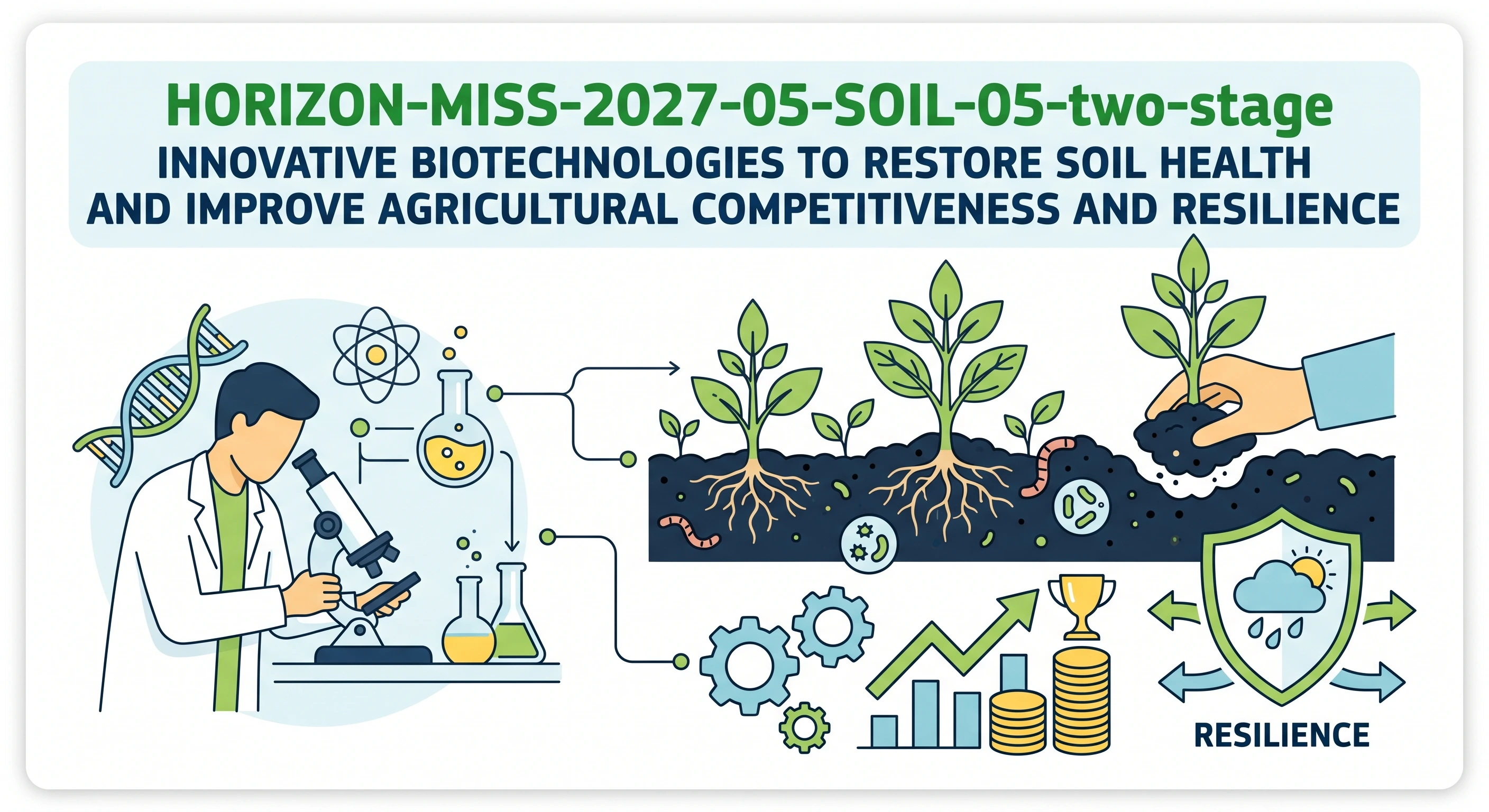
HORIZON-MISS-2027-05-SOIL-05-two-stage: Innovative biotechnologies to restore soil health and improve agricultural competitiveness and resilience
The Commission wants biotech that actually reaches the field, not another set of promising lab results. The focus sits on soil microbiome solutions, bio-based fertilizers, microbial inoculants and bioremediation that can be scaled and sold. Degraded and polluted soils are the problem to solve, across very different European conditions. In short, working products that cut chemical dependency and lift crop productivity.
Download the MIC Horizon Europe 2026/2027 Calls Calendar:
Discover more!
Administrative facts: what do we know about the HORIZON-MISS-2027-05-SOIL-05 call?
Which call is it, and when is the opening and the deadline?
- Call name: Supporting the implementation of the Soil Deal for Europe Mission
- Call identifier: HORIZON-MISS-2027-05-two-stage
- Destination: A Soil Deal for Europe, supporting the implementation of the Mission Soil
- Topic: HORIZON-MISS-2027-05-SOIL-05-two-stage
- Opening date: 04 February 2027
- Deadline: 08 April 2027 (first stage), 14 September 2027 (second stage)
- Type of action: Innovation Action
What about the budget and estimated size of the project?
- Overall topic budget: EUR 12.80 million
- Number of projects expected: 2
- Budget per project: around EUR 6.40 million (12.80 divided by 2)
What are the key eligibility and evaluation conditions?
- Two-stage submission. First stage short, full proposal only if you pass.
- Multi-actor approach is mandatory, not optional.
- Target TRL 5 to 6 by project end.
- Costs are paid as a lump sum.
- The MIIT Chinese universities eligibility condition applies (General Annex B).
Scientific range: what does the Commission expect from the HORIZON-MISS-2027-05-SOIL-05 grant?
What outcomes are expected?
Validated, market ready biotech that stakeholders can pick up and use. The Commission is after solutions that reduce reliance on synthetic chemicals while raising crop resilience and productivity. A pile of papers is not what they want here.
What is within scope?
- Soil microbiome solutions, including novel bio-based fertilizers and microbial inoculants (but not limited to these).
- Bioremediation of contaminated soils, think heavy metals, pharmaceuticals, PFAS.
- Methods that lift soil organic carbon, improve soil structure, water retention and nutrient availability.
- Socio-economic assessment: cost-benefit, adoption barriers, market potential, plus scalability checks with SMEs and farmers.
- Market-readiness pathways covering regulatory compliance, risk assessment, stakeholder engagement and policy foresight.
One boundary worth noting: solutions must be scalable, cost-effective and fold in circular economy principles. Pure lab curiosities won’t fit.
What are the specifically proposed research directions?
- Develop, pilot and validate microbiome-led solutions across diverse pedoclimatic and cropping conditions.
- Prove cause and effect in real soils, not just controlled pots.
- Tackle at least one hard contaminant class (PFAS remediation is a live theme here, and evaluators will notice a credible attempt).
- Design the route to market, including how farmers actually adopt the thing.
Scientific strategy: how can you enhance your chances of being funded through HORIZON-MISS-2027-05-SOIL-05?
What scientific choices matter most?
- Show field validation: Greenhouse data alone rarely convinces reviewers of TRL 5 to 6.
- Pick a real pollution problem: A concrete PFAS or heavy-metal case beats a vague “improves soil health” claim.
- Build in measurement from day one: If you can’t quantify the change in the soil, you can’t prove impact.
- Circular economy is not decoration: Reviewers check whether resource efficiency is baked in or bolted on.
- Plan for cross-project collaboration: The topic asks for it, and the budget for joint activities should be visible.
Consortium & proposal-writing plan: what works best with this type of call?
The multi-actor approach is the spine of this proposal. So build the value chain in, not around it.
- Aim for roughly eight to twelve partners, maybe a couple more if you need wider pedoclimatic coverage.
- Mix academia, RTOs, farmers and practitioners, plus investors and IP or legal advisors.
- If you want the market-readiness story to land, include at least one innovative SME that can carry the solution toward deployment.
- Cover several European soil regions. A single-country pilot looks thin for a Mission topic.
- Write the adoption story plainly. Reviewers reward proposals that name the end-user and the barrier.
How would microfluidics contribute to this topic?
Conventional soil and microbiome screening is slow, and it eats samples. You test a few conditions, wait, repeat. Microfluidics changes the pace, letting you run many tiny experiments in parallel on chip-scale volumes.
- Say you want to know which microbial strain actually survives in a PFAS-loaded soil. A microfluidic screen lets you test dozens of candidates side by side, fast.
- Soil-on-chip setups recreate pore-scale conditions. You watch how microbes move, feed and interact where the real action happens.
- Droplet microfluidics can isolate single cells from a messy soil community. Handy when you’re hunting the one inoculant strain that works.
- Same inoculant, two soils, two results. Microfluidic assays help you see why, and you get the same answer twice.
For your consortium, this is a way to shorten the screening loop and bring hard numbers to a proposal that badly needs them. Microfluidics won’t restore a field on its own. But it gives your biotech the evidence base that turns a promising idea into a TRL 5 to 6 claim reviewers believe.
The MIC already brings its expertise in microfluidics to Horizon Europe:
H2020-NMBP-TR-IND-2020

Microfluidic platform to study the interaction of cancer cells with lymphatic tissue
H2020-LC-GD-2020-3

Toxicology assessment of pharmaceutical products on a placenta-on-chip model

FAQ – HORIZON-MISS-2027-05-SOIL-05-two-stage
What is the HORIZON-MISS-2027-05-SOIL-05 topic about?
HORIZON-MISS-2027-05-SOIL-05-two-stage funds innovative biotechnologies to restore soil health and improve agricultural competitiveness and resilience. It sits under the Soil Deal for Europe Mission.
When does the call open and close?
The call opens on 04 February 2027. The first stage deadline is 08 April 2027. The second stage deadline is 14 September 2027.
What type of action is this, and what TRL is expected?
It is an Innovation Action. Activities are expected to reach TRL 5 to 6 by the end of the project.
What is the budget per project?
The Commission expects around EUR 6.40 million per project. The total topic budget is EUR 12.80 million, split across two projects.
How many projects will be funded?
Two projects are expected to be funded under this topic.
Is the multi-actor approach mandatory?
Yes. Proposals must apply the multi-actor approach and involve the full value chain, from academia and RTOs to SMEs, farmers and end-users.
Check the Funding and Tenders Portal for more information.
Which contaminants are in scope for bioremediation?
The topic names heavy metals, pharmaceuticals and PFAS as targets for the bioremediation of contaminated soils.
Does the project need field validation?
To reach TRL 5 to 6, solutions must be validated beyond the lab, across diverse pedoclimatic and cropping conditions.
How can microfluidics help with this topic?
Microfluidics speeds up microbial screening, isolates single strains from soil communities and brings quantitative data to bioremediation and inoculant work.
Should the consortium include an SME?
Including at least one innovative SME strengthens the market-readiness pathway the Commission asks for. It also helps carry the solution toward deployment.