
Tips & Tricks for a successful HORIZON-MISS-2026-04-CIT-02 proposal
Opening
04 February 2026
Deadline
Keywords
District heating
Low-temperature heating
IA
Climate-Neutral Cities Mission
Heat pumps
Multi-apartment buildings
Energy communities
Your microfluidic SME partner for Horizon Europe
We take care of microfluidic engineering, work on valorization and optimize the proposal with you
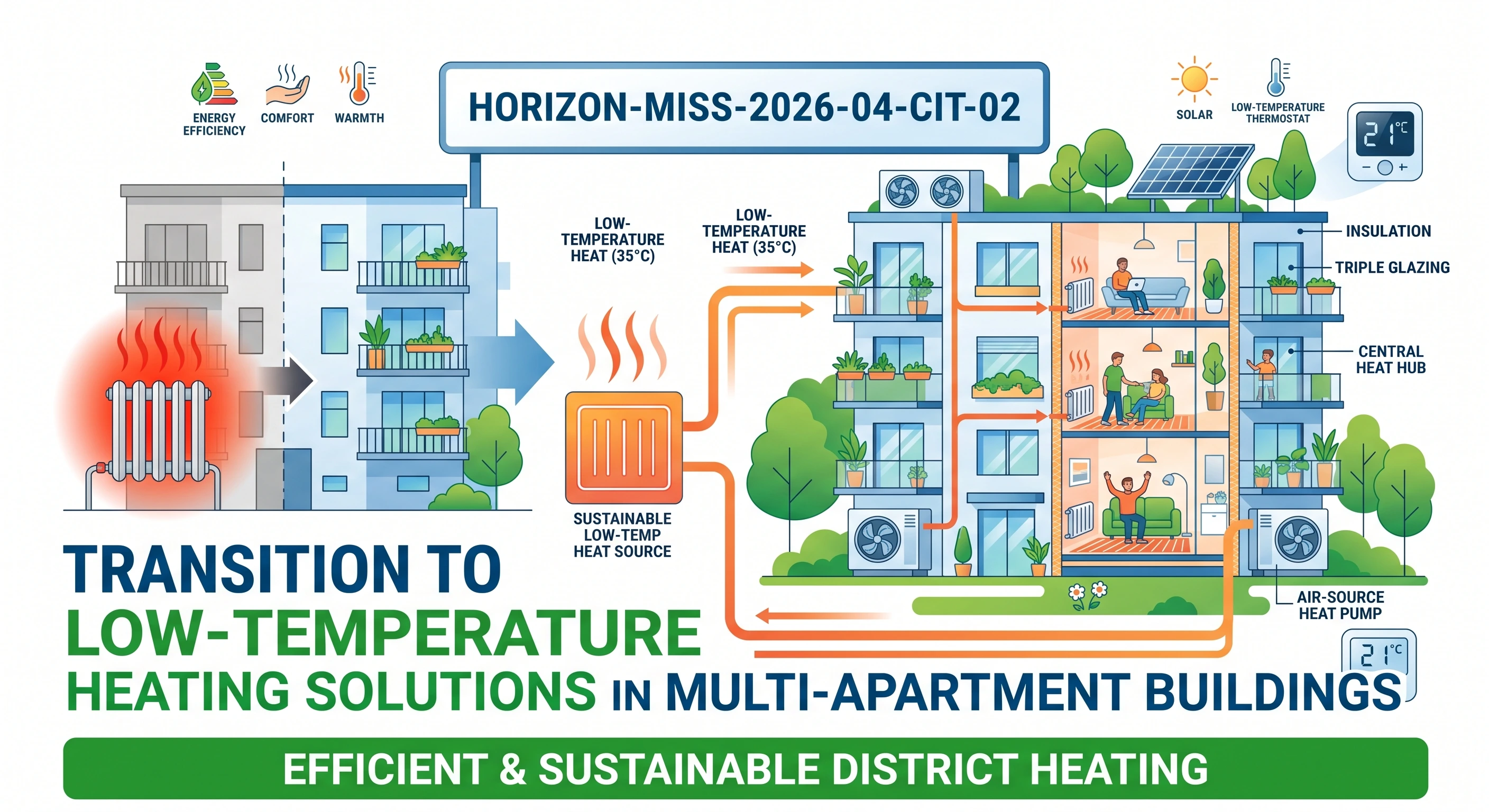
HORIZON-MISS-2026-04-CIT-02: Transition to low-temperature heating solutions in multi-apartment buildings
The Commission wants to unblock a real bottleneck. Old apartment buildings were built for hot radiators, so district heating stays stuck at high temperatures. This topic funds demonstrations that flip existing supply into low-temperature heating, both at district and building level, while pulling in renewables and waste heat. In short, make the switch work in real buildings, not in a report.
Download the MIC Horizon Europe 2026/2027 Calls Calendar:
Discover more!
Administrative facts: what do we know about the HORIZON-MISS-2026-04-CIT-02 call?
Which call is it, and when is the opening and the deadline?
- Call name: Supporting the implementation of the Climate-Neutral and Smart Cities Mission
- Call identifier: HORIZON-MISS-2026-04
- Destination / Mission: EU Mission on Climate-Neutral and Smart Cities
- Topic: HORIZON-MISS-2026-04-CIT-02
- Opening date: 04 February 2026
- Deadline: 08 October 2026, 17:00 Brussels time
- Type of action: Innovation Action (IA)
What about the budget and estimated size of the project?
- Overall topic budget: EUR 18.00 million
- Number of projects: around 3
- Budget per project: EUR 6.00 million (18 divided by 3)
What are the key eligibility and evaluation conditions?
- TRL 7 to 8 by the end of the project
- At least two cities, each from a different Member State or Associated Country, as beneficiaries, represented by their local authority or an entity with explicit consent
- At least one of those cities must be among the 112 Mission cities
- Portfolio rule: at least one top-ranked proposal funded in each category, district heating and building-level heating
- Grants use lump sum funding and link to HORIZON-MISS-2021-CIT-02-03
- Mandatory collaboration with the Cities Mission Platform, formalised by a Memorandum of Understanding
- Subject to restrictions for the protection of European communication networks
Scientific range: what does the Commission expect from the HORIZON-MISS-2026-04-CIT-02 grant?
What outcomes are expected?
Faster conversion of both district and building heating towards low-temperature operation, with more renewables and waste heat feeding the system. Publication series are not what the Commission is after. It wants working demonstrations in real residential buildings that other cities can copy.
What is within scope?
- Low-temperature district heating running below 70°C, in line with Article 26(1) of Directive (EU) 2023/1791
- Heat-pump systems replacing central and individual fossil-fuel boilers in existing multi-apartment blocks
- Building-level hot water and heating up to 50°C supply, meeting water safety rules, in at least four buildings of 1000 m2 or more
- Shared ambient or geothermal loops, on-site renewables, or a district connection
- Digital tools for control, monitoring, planning and standardised replication
- Heat storage and flexibility, including energy communities
The boundary: this is demonstration, not lab research. If it does not run in real buildings across two climate zones, it falls out of scope.
What are the specifically proposed research directions?
Proposals must address at least two of the listed lines. The Commission points fairly clearly toward:
- System design integrating mixed heat sources and cutting building heat load
- Building-level solutions at 50°C that stay safe and stay transferable
- Connecting buildings via networks and geothermal loops to lower total demand
- Bringing energy communities in, and measuring the social and economic payoff
Advanced controls that exploit flexibility collectively are treated as a must, not a nice-to-have.
Scientific strategy: how can you enhance your chances of being funded through HORIZON-MISS-2026-04-CIT-02?
What scientific choices matter most?
- Pick your category early: District heating, building-level, or both. The portfolio rule rewards a clear position.
- Show two climate zones: Not optional.
- Prove the numbers: Environmental, social and economic assessment, with regional and regulatory context baked in.
- Handle water safety head-on: Low supply temperature and Legionella don’t mix by accident (this one catches people off guard).
- Reference EU-funded predecessors: A concise state of the art is explicitly required.
- Standardise for replication: Reviewers want solutions the next city can lift, not one-offs.
Consortium & proposal-writing plan: what works best with this type of call?
- You need at least two qualifying cities, so build the consortium around committed local authorities first.
- For a 6 million euro IA at this scale, somewhere between eight and twelve partners usually works, maybe a couple more if you cover several demo sites.
- Mix municipalities, district heating operators, heat-pump and controls manufacturers, universities, and energy communities.
- Bring in an innovative SME. Their agility on sensing, controls or testing often carries the demonstration.
- Besides the technical partners, plan real resources for the Cities Mission Platform MoU and clustering. Evaluators check for it.
- Writing tip: lead with the demonstration story, buildings, temperatures, results, then the tech. Hence the impact reads first.
How would microfluidics contribute to this topic?
Low-temperature heating sounds far from microfluidics, and mostly it is. But two concrete needs sit right in that space. Conventional pilot loops are slow and costly to instrument when you want to know how a new heat-transfer fluid or coating behaves before you scale it.
- Micro heat exchangers and microchannel test rigs let you screen fluids and surfaces fast, on a bench, before a full building loop.
- Water safety is the sharp one. At 50°C hot water, Legionella risk rises. Say you need to prove your system stays safe. A microfluidic lab-on-chip can flag pathogens in hours, not days, and you get the same answer twice.
- Small-scale characterisation of phase-change and storage materials, so your flexibility claims rest on real data.
For your consortium, microfluidics is not the headline. It’s the tool that de-risks the water-safety and heat-transfer claims your reviewers will probe. That’s where MIC could plug in.
The MIC already brings its expertise in microfluidics to Horizon Europe:
H2020-NMBP-TR-IND-2020
Microfluidic platform to study the interaction of cancer cells with lymphatic tissue
H2020-LC-GD-2020-3

Toxicology assessment of pharmaceutical products on a placenta-on-chip model

FAQ - HORIZON-MISS-2026-04-CIT-02
What is the HORIZON-MISS-2026-04-CIT-02 topic about?
It funds real demonstrations that move existing district heating and building heating to low-temperature operation in multi-apartment buildings, while bringing in renewables and waste heat.
When does the call open and close?
The call opens on 04 February 2026 and closes on 08 October 2026 at 17:00 Brussels time. The Director-General may shift the opening by up to a month and the deadline by up to two months.
What is the budget and how many projects will be funded?
The topic budget is EUR 18.00 million. The Commission expects to fund around three projects, so roughly EUR 6.00 million per project.
What type of action is it, and which TRL is expected?
It is an Innovation Action (IA). Activities are expected to reach TRL 7 to 8 by the end of the project.
Which cities must take part in the consortium?
At least two cities from different Member States or Associated Countries must be beneficiaries, and at least one must be among the 112 Climate-Neutral and Smart Cities Mission cities.
How does the balanced-portfolio award rule work?
Grants are awarded to keep a balance between district heating and building-level heating. At least one top-ranked proposal in each category is funded, provided it clears the thresholds.
Is collaboration with the Cities Mission Platform mandatory?
Yes. Collaboration with the Cities Mission Platform is essential and must be formalised through a Memorandum of Understanding soon after the project starts.
Check the Funding and Tenders Portal for more information.
What temperature and water-safety limits apply?
District heating should run below 70°C, and building-level solutions up to 50°C supply. Low temperatures raise Legionella risk, so water safety compliance is required.
How large should the consortium be, and who should be in it?
Somewhere between eight and twelve partners usually fits a project of this size. Mix cities, district heating operators, heat-pump makers, universities, energy communities, and an innovative SME.
How could microfluidics contribute to this topic?
Mostly indirectly. Micro heat exchangers, bench-scale fluid testing, and a lab-on-chip for fast pathogen detection help de-risk your water safety and heat-transfer claims. See the Microfluidics Innovation Center.