
Tips & Tricks for a successful HORIZON-MISS-2026-04-CIT-01 proposal
Opening
Deadline
Keywords
climate-neutral cities
public transport
IA
shared mobility
electrification
energy efficiency
urban mobility
climate neutrality
smart cities
Your microfluidic SME partner for Horizon Europe
We take care of microfluidic engineering, work on valorization and optimize the proposal with you
HORIZON-MISS-2026-04-CIT-01: Energy efficient urban and sub-urban public transport, complemented by shared mobility
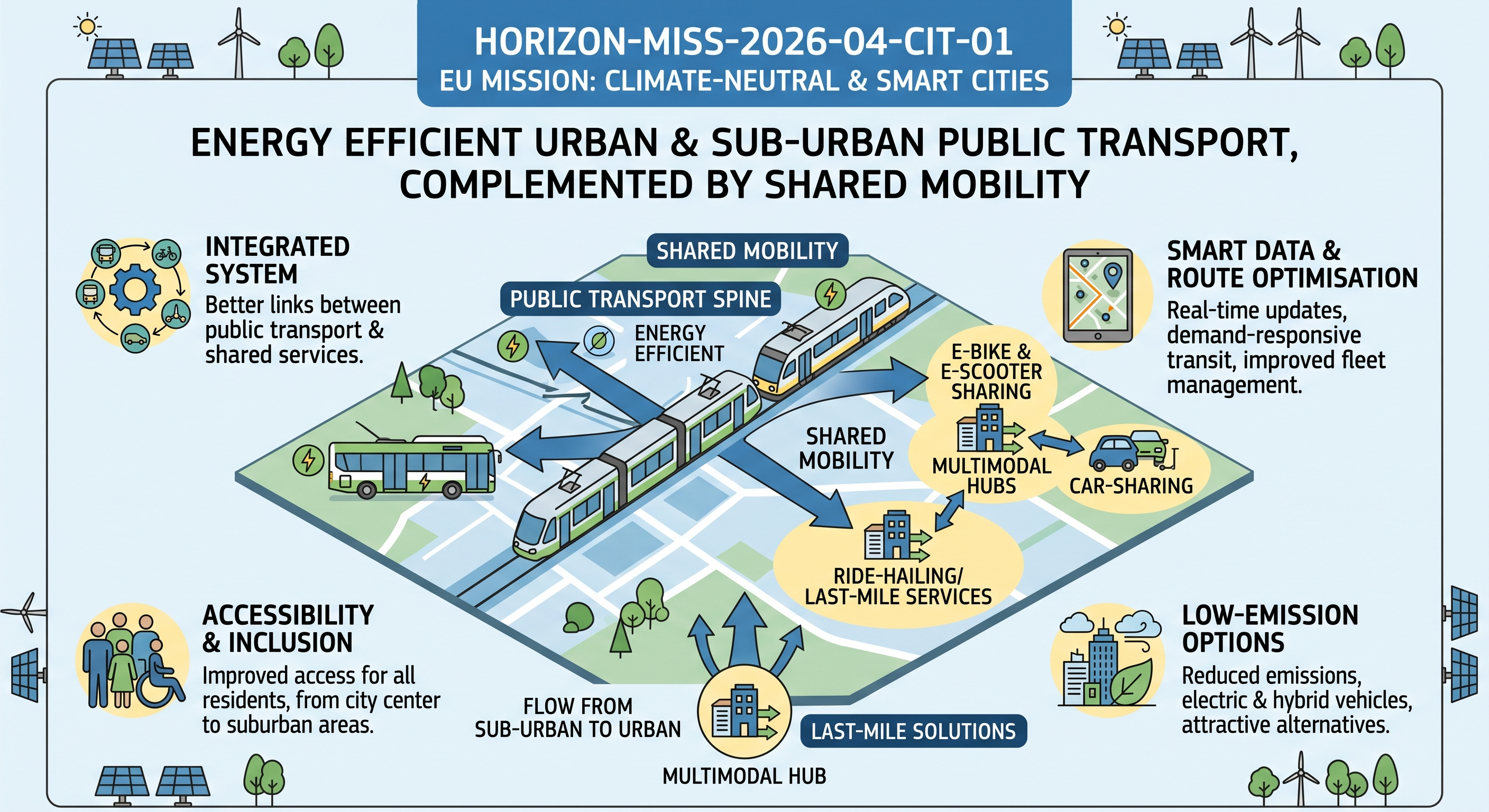
The Commission wants cities to move people with far less energy and much cleaner fleets. This topic pushes public transport, taxis, ride-hailing and shared mobility to work as one connected system. It is about testing real solutions in real pilot cities, not writing another study. The aim is climate neutrality, with cleaner air as the co-benefit.
Download the MIC Horizon Europe 2026/2027 Calls Calendar:
Discover more!
Administrative facts: what do we know about the HORIZON-MISS-2026-04-CIT-01 call?
Which call is it, and when is the opening and the deadline?
- Call name: Supporting the implementation of the Climate-Neutral and Smart Cities Mission
- Call identifier: HORIZON-MISS-2026-04
- Destination: 100 Climate-Neutral and Smart Cities by 2030
- Topic: HORIZON-MISS-2026-04-CIT-01, Energy efficient urban and sub-urban public transport, complemented by shared mobility
- Opening date: 04 Feb 2026
- Deadline: 08 Oct 2026, 17.00 Brussels time
- Type of action: Innovation Action (IA)
What about the budget and estimated size of the project?
- Overall topic budget: EUR 20.00 million
- Number of projects expected: 2
- Budget per project: around EUR 10.00 million (20 divided by 2)
What are the key eligibility and evaluation conditions?
- Target maturity: TRL 7-8 by the end of the project
- At least three lead cities from different Member States or Associated Countries, plus at least three follower cities, with good geographical balance
- At least one lead city must be among the 112 cities selected for the Cities Mission
- Legal entities established in China cannot participate in the IAs under this part of the programme
- Subject to restrictions for the protection of European communication networks
- Grants linked to the earlier action HORIZON-MISS-2021-CIT-02-03
- Clustering with the Cities Mission Platform through CIVITAS is mandatory, formalised by a Memorandum of Understanding
- SSH expertise is a formal requirement, not a nice-to-have
Scientific range: what does the Commission expect from the HORIZON-MISS-2026-04-CIT-01 grant?
What outcomes are expected?
By the end, the pilot cities should show measurable drops in greenhouse gas and air pollutant emissions from transport. The Commission is after a current, honest picture of electrification across buses, coaches, service car fleets and shared mobility, with the gaps named. Guidance that local authorities and operators can actually use counts more than a stack of reports.
What is within scope?
- Electrification and energy efficiency of urban and sub-urban public transport, coaches included
- Urban mobility service car fleets: taxis, ride-hailing, car sharing
- Integration of mass transit with last-mile and shared mobility
- Data and AI tools that make multimodality work in practice
- New operating and business models, plus soft measures like real-time info and awareness campaigns
- Replication, upscaling, training and outreach for public authorities
One boundary. Pure research with no testing in real pilot sites is not what this call rewards.
What are the specifically proposed research directions?
- Assessment tools that quantify direct benefits and co-benefits of decarbonised fleets, modal shift included
- Whole-value-chain ecological footprint, air quality included, watching for rebound effects
- Trade-off analysis between competing solutions to recommend the best implementation strategy
- Redistribution of public space tied to integrated urban planning
- Tailored solutions for peri-urban, rural and underserved areas, not just the centre
The text stays vague on business models. We read that as room to be bold on financing and operating models.
Scientific strategy: how can you enhance your chances of being funded through HORIZON-MISS-2026-04-CIT-01?
What scientific choices matter most?
- Put the pilots first. Reviewers want real deployment in real cities, with before-and-after numbers.
- Show your measurement plan early. Vague impact claims sink otherwise strong proposals.
- Cover the whole chain, rebound effects and lifecycle footprint included.
- Design for replication from day one.
- Bring SSH in as a partner, not a subcontractor. This one trips up more than one consortium.
- Connect to CIVITAS credibly, with named activities and budget.
Consortium & proposal-writing plan: what works best with this type of call?
- You need at least three lead cities and three followers, so the consortium is city-heavy by design. Aim for somewhere between eight and fifteen partners, maybe a couple more if geographical balance demands it.
- Mix local authorities, transport operators, fleet and shared-mobility providers, and academia for the evaluation side.
- If your data or sensing work is thin, an innovative SME can fill that gap fast and add flexibility a big consortium often lacks.
- Keep public and private balanced, and make SSH visible in the work packages.
- Writing tip: lead each work package with the pilot, then the method. Evaluators read for impact first.
- Keep the geographical story clean. Reviewers check it.
How would microfluidics contribute to this topic?
Let’s be straight. This is a cities-and-mobility call, and microfluidics sits at the edge of it, not the centre. Conventional bench methods struggle to test small air-quality sensors or battery chemistries fast and cheap. Microfluidics can help there, in a supporting role.
- Air quality is a stated co-benefit. Microfluidic sensors measure pollutants in small, low-cost, portable units. Useful for the before-and-after data cities need.
- Say your fleet swap depends on new battery or fuel-cell chemistry. Microfluidic test rigs let you screen those under controlled flow before scaling. You get the same answer twice.
- Lab-on-chip air sampling can feed the data platforms the call asks for.
Point is, microfluidics won’t lead this proposal. If your consortium touches emissions sensing or clean-fleet component testing, it’s a genuine but narrow fit. For most CIT-01 proposals, it stays optional.
The MIC already brings its expertise in microfluidics to Horizon Europe:
H2020-NMBP-TR-IND-2020

Microfluidic platform to study the interaction of cancer cells with lymphatic tissue
H2020-LC-GD-2020-3

Toxicology assessment of pharmaceutical products on a placenta-on-chip model

FAQ - HORIZON-MISS-2026-04-CIT-01
What is HORIZON-MISS-2026-04-CIT-01 about?
It funds Innovation Actions that make urban and sub-urban public transport more energy efficient, complemented by shared mobility. Cities test real solutions in real pilot sites.
Who can apply and what is the budget?
The topic budget is EUR 20.00 million for about 2 projects, so roughly EUR 10.00 million each. You need at least three lead cities and three follower cities.
When does the call open and close?
It opens on 04 February 2026 and closes on 08 October 2026 at 17.00 Brussels time.
What type of action is it?
An Innovation Action (IA), targeting TRL 7-8 by the end of the project.
What cities must take part?
At least three lead cities from different Member States or Associated Countries, plus three follower cities. At least one lead city must be among the 112 Cities Mission cities.
Check the Funding and Tenders Portal for more information.
Is SSH expertise required?
Yes. The topic explicitly requires an effective contribution of Social Sciences and Humanities (SSH) disciplines and experts.
What about clustering with the Cities Mission Platform?
Collaboration with the Cities Mission Platform through CIVITAS is mandatory, formalised by a Memorandum of Understanding or a collaboration agreement.
Are there participation restrictions?
Legal entities established in China cannot participate in the Innovation Actions under this part of the programme. Restrictions for the protection of European communication networks also apply.
What outcomes does the Commission expect?
Measurable emission cuts in pilot cities, a current picture of electrification, and practical guidance for local authorities and operators.
How could microfluidics help?
In a supporting role. Microfluidic sensors can measure air pollutants cheaply, and microfluidic test rigs can screen new battery or fuel-cell chemistries. For most proposals it stays optional.