Tips & Tricks for a successful HORIZON-CL5-2027-03-D5-17 proposal
Opening
15 December 2026
Deadline
Keywords
ZEWT Partnership
waterborne transport
RIA
zero-carbon fuels
marine ecosystems
TRL 5
pollution mitigation
Water Resilience Strategy
Your microfluidic SME partner for Horizon Europe
We take care of microfluidic engineering, work on valorization and optimize the proposal with you
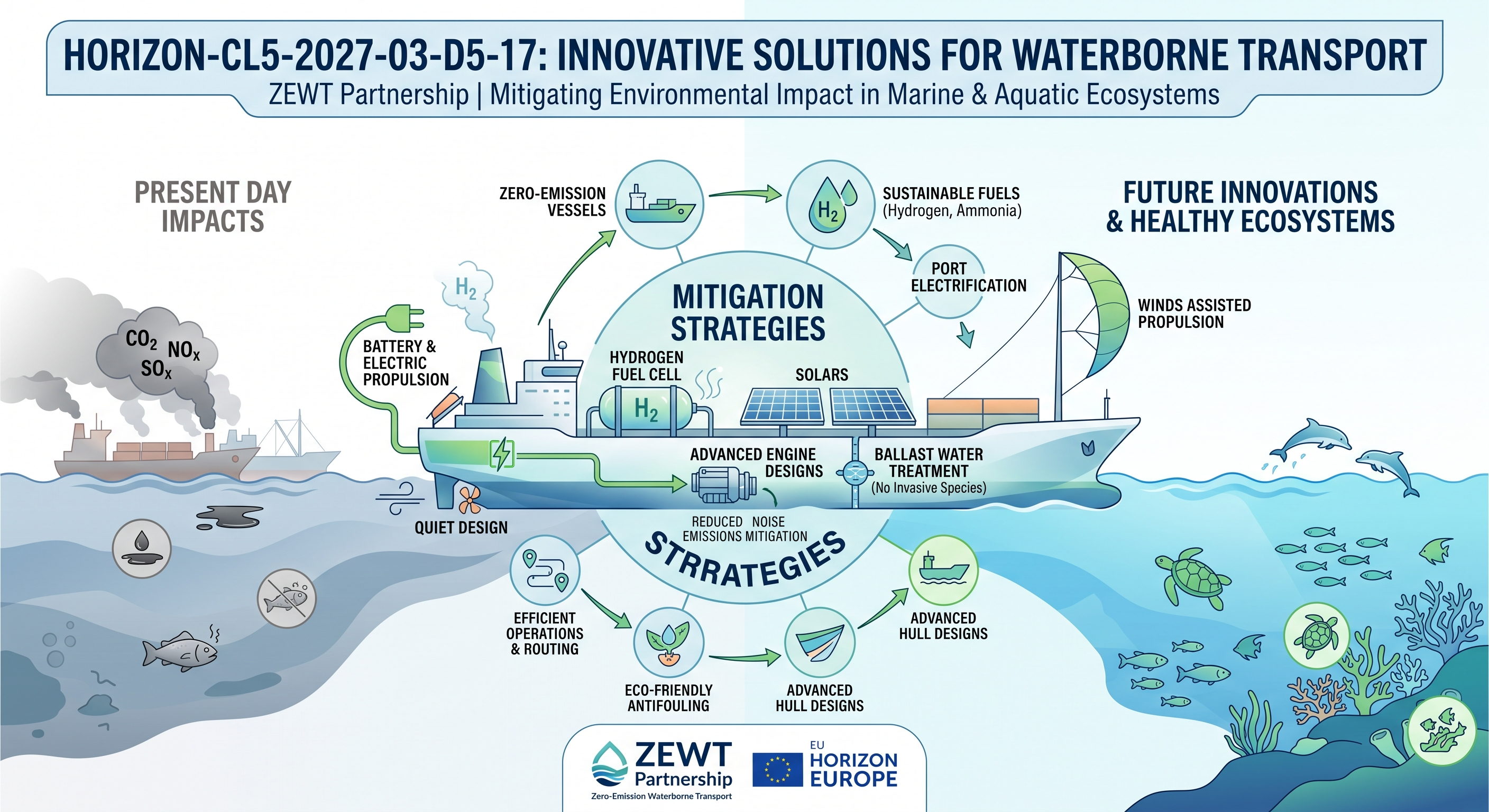
HORIZON-CL5-2027-03-D5-17: Innovative Solutions for mitigating the environmental impact of waterborne transport in marine and aquatic Ecosystems (ZEWT Partnership)
Decarbonising shipping solves one problem and opens another. Ammonia, methanol and hydrogen are cleaner in the air, but nobody really knows what they do to water when a tank leaks. This topic wants that evidence, plus hardware to contain the damage. It runs under the ZEWT Partnership.
Download the MIC Horizon Europe 2026/2027 Calls Calendar:
Discover more!
Administrative facts: what do we know about the HORIZON-CL5-2027-03-D5-17 call?
Which call is it, and when is the opening and the deadline?
- Call name: MOBILITY
- Call identifier: HORIZON-CL5-2027-03
- Destination: Destination 5, Clean and competitive solutions for all transport modes
- Topic: HORIZON-CL5-2027-03-D5-17
- Opening date: 15 December 2026
- Deadline: 14 April 2027, 17.00.00 Brussels time
- Type of action: Research and Innovation Action (RIA)
What about the budget and estimated size of the project?
- Overall topic budget: EUR 14.00 million
- Number of projects expected: 2
- EU contribution per project: around EUR 7.00 million
What are the key eligibility and evaluation conditions?
- Eligibility: General Annex B, with one exception
- Exception: satellite data must come from Copernicus and/or Galileo/EGNOS
- Technology Readiness Level: TRL 5 by the end of the project, any TRL at the start
- Funding form: lump sum grant
- IP: the granting authority may object to a transfer of ownership or exclusive licensing, for 4 years after the action ends
- Award criteria: General Annex D, no topic-level exception, no JRC clause, no clustering
- Reporting: results reported to the ZEWT Partnership for KPI monitoring
Scientific range: what does the Commission expect from the HORIZON-CL5-2027-03-D5-17 grant?
What outcomes are expected?
The Commission wants a clear picture of what low and zero-carbon fuels do to water, plus abatement systems that work. Water resilience and Good Environmental and Good Ecological Status are the targets, tied to the Water Resilience Strategy and the Ocean Pact. A series of publications is not what the Commission is after.
What is within scope?
Impact assessment and mitigation. Fuel development sits in neighbouring ZEWT topics.
- Impacts on marine waters, rivers, lakes and port areas
- Pollution from normal operation on low and zero-carbon fuels, and from spills
- Prevention, abatement and mitigation systems
- Modelling of water and air pollution per ship type
- Antifouling coatings, wastewater discharges, invasive species from hulls and ballast water
- Training needs and emergency response preparedness
What are the specifically proposed research directions?
- Evaluate and forecast impacts, with spill experiments explicitly allowed
- Response scenarios for uncontrolled releases: equipment, procedures, guidelines
- Cost-effective abatement systems demonstrated at TRL 5
- Solutions improving the resilience of European waters
- Stakeholder engagement with environmental, industry and academic associations
EMERGE is named as prior work. Read that as a baseline you are expected to beat.
Scientific strategy: how can you enhance your chances of being funded through HORIZON-CL5-2027-03-D5-17?
What scientific choices matter most?
- Pick your fuels early: Ammonia, methanol, and hydrogen behave nothing alike in water. Two covered properly beats four covered thinly.
- Put the spill experiments in the workplan: The text permits them, and most proposals will not dare.
- TRL 5 is the contract: Name the site, the vessel, or the port, and the date.
- Tie every result to a Good Environmental or Good Ecological Status indicator.
- Don’t neglect air: Water gets the attention, but atmospheric deposition is in the text.
Consortium & proposal-writing plan: what works best with this type of call?
- Somewhere between ten and fourteen partners, a couple more if you need several sea basins covered.
- Marine ecotoxicology labs, hydrodynamic modellers, a classification society, a port authority, a shipowner to host.
- An innovative SME carrying sensing or abatement hardware is worth having. Small teams move faster on a TRL 5 demonstrator, and evaluators like the supply chain argument. The MIC has taken this role in over sixty collaborative research projects.
- If you can get a national maritime authority onto your advisory board, use it. Regulatory uptake is half the impact story.
- Map each work package to one expected outcome bullet. Evaluators check.
- Lump sum: the work package split is the budget.
How would microfluidics contribute to this topic?
Standard ecotoxicology runs on tanks, batches of organisms and weeks of waiting. You get an endpoint, rarely a mechanism. Microfluidics shrinks that onto a chip where you control chemistry, flow and dose second by second. For a topic asking you to forecast the impact of fuels nobody has spilled at scale yet, that matters.
- Say you need to know what a diluted ammonia plume does to gill tissue. A gill-on-chip runs ten concentrations in a day, and you watch the damage happen rather than count dead fish at the end.
- Droplet systems for screening. Thousands of conditions, microlitres of fuel.
- Chip-based portable sensors for ports and vessels: pH, ammonia, dissolved metals, continuously.
- Microfluidic rigs reproduce the dilution gradient of a real spill. Same compound, different gradient, different outcome. Tanks flatten that. Encapsulation work at the MIC rests on the same control of the compartment.
- Cause and effect, not correlation. Change one variable, hold the rest, and you get the same answer twice.
Microfluidics won’t write your impact section. It gives you mechanistic data fast enough to feed the modelling work packages, and hardware to point at when a reviewer asks what TRL 5 looks like. New pollutants, thin evidence base. A card worth holding.
The MIC already brings its expertise in microfluidics to Horizon Europe:
H2020-NMBP-TR-IND-2020

Microfluidic platform to study the interaction of cancer cells with lymphatic tissue
H2020-LC-GD-2020-3
Toxicology assessment of pharmaceutical products on a placenta-on-chip model
FAQ - HORIZON-CL5-2027-03-D5-17
What is HORIZON-CL5-2027-03-D5-17 about?
The topic asks what renewable low and zero-carbon fuels do to marine waters, rivers, lakes and port areas, and what can be done about it. Two halves: evidence on one side, prevention and abatement hardware on the other. It implements the co-programmed ZEWT Partnership.
When does the call open, and when is the deadline?
Opening is 15 December 2026. The deadline is 14 April 2027, at 17.00.00 Brussels time. Single stage. The Director-General may shift the opening by up to a month and delay the deadline by up to two months, so check the Funding and Tenders Portal before planning your writing schedule.
How much money is on the table per project?
The indicative topic budget is EUR 14.00 million and two projects are expected. That puts the EU contribution per project at around EUR 7.00 million. Asking for a different amount is allowed, but you would need a reason the evaluators accept.
What type of action is it, and which TRL must be reached?
It is a Research and Innovation Action (RIA). Activities may start at any TRL, and TRL 5 must be reached by the end of the project. In practice that means a working abatement or mitigation system validated in a relevant environment, not a concept note.
Check the Funding and Tenders Portal for more information.
Which fuels does the topic actually target?
The work programme speaks of renewable low and zero-carbon fuels without naming a shortlist. Read that as room to choose. Ammonia, methanol and hydrogen are the obvious candidates. Other pollution sources are in scope too: antifouling coatings, hazardous substances in wastewater, invasive species carried by hulls and ballast water.
Are spill experiments allowed inside the project?
Yes. The text states that the proposal may include testing and experimental work in relation with spills. Few proposals will take that up, which is exactly why it is worth doing. Plan the permits early.
What are the eligibility conditions?
General Annex B applies, with one exception: if the project uses satellite-based earth observation, positioning, navigation or timing data, beneficiaries must use Copernicus and/or Galileo/EGNOS. Other data and services may be added on top. No JRC participation clause and no clustering condition are attached to this topic.
What does the lump sum funding form change for applicants?
Eligible costs take the form of a lump sum. Payment follows completed work packages, not reported costs. So the work package split you submit is the budget you live with. Get the breakdown right before submission, and keep deliverables inside work packages you can honestly declare complete.
What kind of consortium fits this topic?
Somewhere between ten and fourteen partners, a couple more if several sea basins have to be covered. Marine ecotoxicology labs, hydrodynamic modellers, a classification society, a port authority, and a shipowner willing to host a demonstration. An innovative SME carrying sensing or abatement hardware is worth having, since small teams move faster on a TRL 5 demonstrator.
How can microfluidics strengthen a HORIZON-CL5-2027-03-D5-17 proposal?
Microfluidics gives you mechanistic data at a speed tanks cannot match. Organ-on-chip models let you watch what a diluted fuel plume does to living tissue, droplet platforms screen thousands of conditions on microlitres of fuel, and chip-based sensors monitor pH, ammonia and dissolved metals in ports continuously. That feeds the modelling work packages and gives the reviewer something concrete to attach TRL 5 to.