
Tips & Tricks for a successful HORIZON-WIDERA-2027-04-WIDENING-01 proposal
Opening
02 September 2026
Deadline
Keywords
Widening countries
Excellence Hubs
CSA
R&I ecosystems
quadruple helix
smart specialisation
deep tech
research excellence
industry collaboration
Your microfluidic SME partner for Horizon Europe
We take care of microfluidic engineering, work on valorization and optimize the proposal with you
HORIZON-WIDERA-2027-04-WIDENING-01: Excellence Hubs
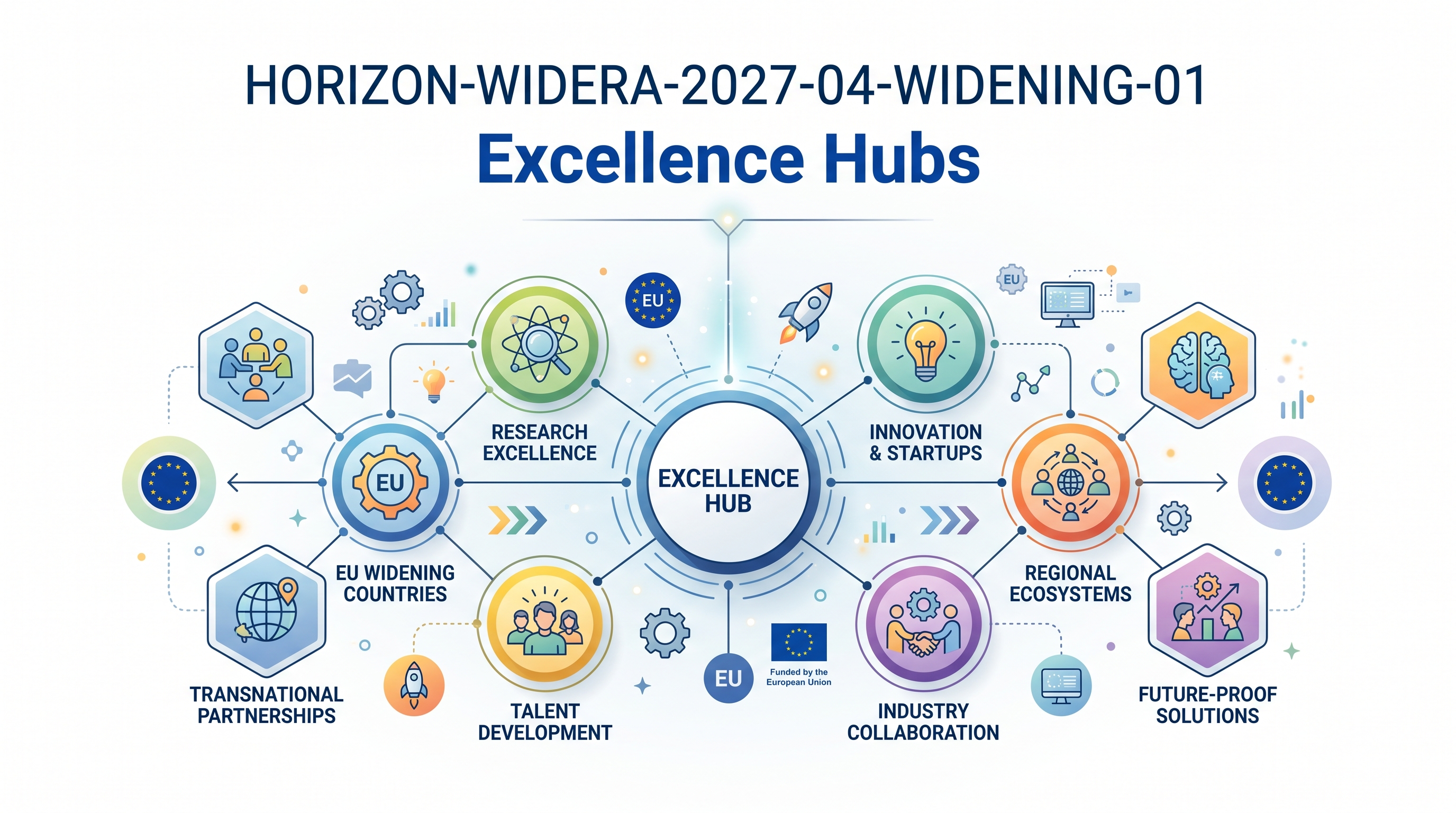
The Commission wants regional innovation ecosystems in Widening countries to stop working alone. Excellence Hubs pay for at least two of them to build a shared R&I strategy, an investment plan and real links between labs, companies, public authorities and citizens. Research is encouraged, but it cannot dominate the project.
Download the MIC Horizon Europe 2026/2027 Calls Calendar:
Discover more!
Administrative facts: what do we know about the HORIZON-WIDERA-2027-04-WIDENING-01 call?
Which call is it, and when is the opening and the deadline?
- Call name: Excellence Hubs
- Call identifier: HORIZON-WIDERA-2027-04
- Destination: Widening participation and spreading excellence
- Topic: HORIZON-WIDERA-2027-04-WIDENING-01 Excellence Hubs
- Opening: 02 September 2026
- Deadline: 04 March 2027, 17:00 Brussels time
- Type of action: Coordination and Support Action (CSA)
What about the budget and estimated size of the project?
- Overall topic budget: EUR 100 million (EUR 15 million from 2026, EUR 85 million from 2027)
- Number of projects: 30
- Budget per project: EUR 3.33 million on average. The work programme quotes EUR 1.50 to 4.50 million
- Funding rate: 70 percent. The proposal must explain how the remaining 30 percent is secured
- Financial support to third parties: grants capped at EUR 60 000 per third party, SMEs and start-ups only
- Expected duration: up to 5 years
What are the key eligibility and evaluation conditions?
- Coordinators must be legal entities established in a Widening country
- At least two R&I ecosystems from two different Widening countries
- Each ecosystem must cover four categories of actors: academic institutions, business entities, regional or local public authorities, societal actors
- With individual entities, one business per ecosystem needs two consecutive years of proven turnover, with balance sheets annexed
- Entities from non-Widening countries may join when justified
- Page limit: 40 pages
- Award criteria and thresholds: General Annex D, no topic specific exception
Scientific range: what does the Commission expect from the HORIZON-WIDERA-2027-04-WIDENING-01 grant?
What outcomes are expected?
By the end, the Commission wants an ecosystem that keeps running without EU money. That means a long term joint R&I strategy with a concrete action plan, an investment plan reaching national, regional and private funds, and new business for spin-offs and deep tech start-ups. A pile of workshop reports is not what they are after.
What is within scope?
- Cross-border joint R&I strategies aligned with smart specialisation strategies (RIS3) and European priorities
- Joint research projects closing a knowledge gap, with market potential
- Investment plans, business models, routes to private capital
- Conceptual design and pre-planning of pilots and demonstrators, financed from sources other than the grant
- Knowledge transfer, skills, secondments, staff exchanges, engagement with local governments and citizens
The R&I component sits in its own work package and must not become the dominant part of the project. Overlaps with European Innovation Ecosystems, EIC Pathfinder, EIT KICs or the JRC Partnerships for Regional Innovation will be checked.
What are the specifically proposed research directions?
No scientific field is named. You choose the domain. From what we have seen, the safer picks are deep tech areas where the region already has some industrial base.
- A domain with a credible long term vision beyond the state of the art
- Something where academia and business genuinely need each other
The wording is vague, which gives you room to frame this your way.
Scientific strategy: how can you enhance your chances of being funded through HORIZON-WIDERA-2027-04-WIDENING-01?
What scientific choices matter most?
- Pick one domain and stay in it: Two ecosystems chasing two unrelated fields reads as a marriage of convenience.
- Size the R&I work package honestly: Roughly a quarter to a third of the effort, not more.
- Show the money: Reviewers look for the 30 percent co-funding before almost anything else (this one trips people up).
- Name your quadruple helix actors, with roles.
- Use the third party funding scheme: Grants of EUR 60 000 to local SMEs are a cheap way to prove the hub feeds the regional economy.
Consortium & proposal-writing plan: what works best with this type of call?
- Somewhere between eight and fourteen partners, maybe a couple more if you run three ecosystems.
- Two Widening ecosystems is the floor. Three is defensible. Four gets heavy.
- If your business category looks thin, bring in an innovative SME with real turnover and a technology of its own. It fixes the eligibility box and it gives the research work package credibility.
- Public authorities are not decoration. A regional agency that controls RIS3 money changes the whole investment plan.
How would microfluidics contribute to this topic?
Regional R&I strategies usually stall at the same spot. The lab has a promising result, and nobody turns it into something a company can sell. Microfluidics shortens that gap. Chips are cheap to iterate, and a consortium can go from concept to working prototype inside five years.
- Say your hub picks water quality or food safety. A lab-on-a-chip sensor can be designed, tested, then handed to a local SME for manufacturing, all inside one work package. You learn quickly whether the thing works outside the lab.
- Organ-on-chip platforms give health-oriented regions a shared facility that universities and companies both use.
- Droplet screening. Fast, cheap, and you get the same answer twice.
Bringing microfluidics into your R&I work package gives you something demonstrable at the end. Not a strategy document, a device. That is the kind of evidence evaluators remember. MIC has run this kind of work inside more than sixty collaborative European projects.
The MIC already brings its expertise in microfluidics to Horizon Europe:
H2020-NMBP-TR-IND-2020

Microfluidic platform to study the interaction of cancer cells with lymphatic tissue
H2020-LC-GD-2020-3

Toxicology assessment of pharmaceutical products on a placenta-on-chip model

FAQ – HORIZON-WIDERA-2027-04-WIDENING-01
What is HORIZON-WIDERA-2027-04-WIDENING-01 about?
Excellence Hubs fund networks of regional innovation ecosystems in Widening countries. The point is to connect academia, business, public authorities and society around one shared R&I strategy, with an investment plan behind it. It is a CSA, so coordination work dominates. Research is welcome but stays in a single work package.
Who can coordinate an Excellence Hubs proposal?
Only legal entities established in a Widening country as defined in the Horizon Europe regulation. Partners from non-Widening countries may join, but the consortium has to justify why they are needed for the expected impacts.
For more information, check the Funding and Tenders Portal of the European Commission.
How many R&I ecosystems must the consortium include?
At least two, from two different Widening countries. Each ecosystem must cover four categories of actors: academic institutions, business entities, regional or local public authorities, and societal actors such as civil society organisations, citizens, end users or cultural actors.
Can one organisation represent a whole ecosystem?
Yes. An umbrella organisation whose membership covers the four categories can act as beneficiary for that ecosystem. The alternative is to bring individual legal entities for each category. In that second case, one business per ecosystem must be an established firm with at least two consecutive years of turnover, evidenced by balance sheets or business reports annexed to the proposal.
What is the budget and how many projects will be funded?
The topic carries an indicative budget of EUR 100 million, split between EUR 15 million from 2026 and EUR 85 million from 2027. Around 30 projects are expected. The work programme quotes EUR 1.50 to 4.50 million per project, which averages out at roughly EUR 3.33 million.
Why is the funding rate only 70 percent?
Excellence Hubs are co-funded by design. The grant covers 70 percent of eligible costs and the proposal must explain how the remaining 30 percent is secured and shared among beneficiaries. Regional funds, national programmes and private contributions are the usual answers. Get this settled before writing, not after.
How big can the research component be?
The R&I component must sit in a distinct work package and must not be the dominant part of the project. It should close a real knowledge gap, carry market potential, and come with a long term vision beyond the state of the art. A quarter to a third of the effort is a reasonable target.
Can we fund local SMEs through the project?
Yes, through financial support to third parties. Support is limited to SMEs and start-up companies, in the form of grants, capped at EUR 60 000 per third party. It is one of the cleanest ways to show that the hub feeds the regional economy.
Which initiatives should we avoid overlapping with?
The work programme names European Innovation Ecosystems, EIC Pathfinder, the EIT KICs including EIT Community Hubs in Widening countries, the JRC Partnerships for Regional Innovation, and the Widening Dissemination and Exploitation Facility. Seek synergies, avoid duplication, and say so explicitly in the proposal.
Where does microfluidics fit in an Excellence Hub?
In the research work package, mostly. Lab-on-a-chip sensors, organ-on-chip platforms and droplet systems are cheap to prototype and easy to hand over to a local manufacturer. For a regional investment plan, the equipment cost stays modest. MIC has worked on over sixty European collaborative projects of this kind as an industrial co-creation partner.