Tips & Tricks for a successful HORIZON-INFRA-2027-SERV-01-01 proposal
Opening
09 March 2027
Deadline
Keywords
Research Infrastructures
trans-national access
ESFRI Landmark
ERIC
RIA
single-entry point portal
FSTP
open access
large-scale pilots
Your microfluidic SME partner for Horizon Europe
We take care of microfluidic engineering, work on valorization and optimize the proposal with you
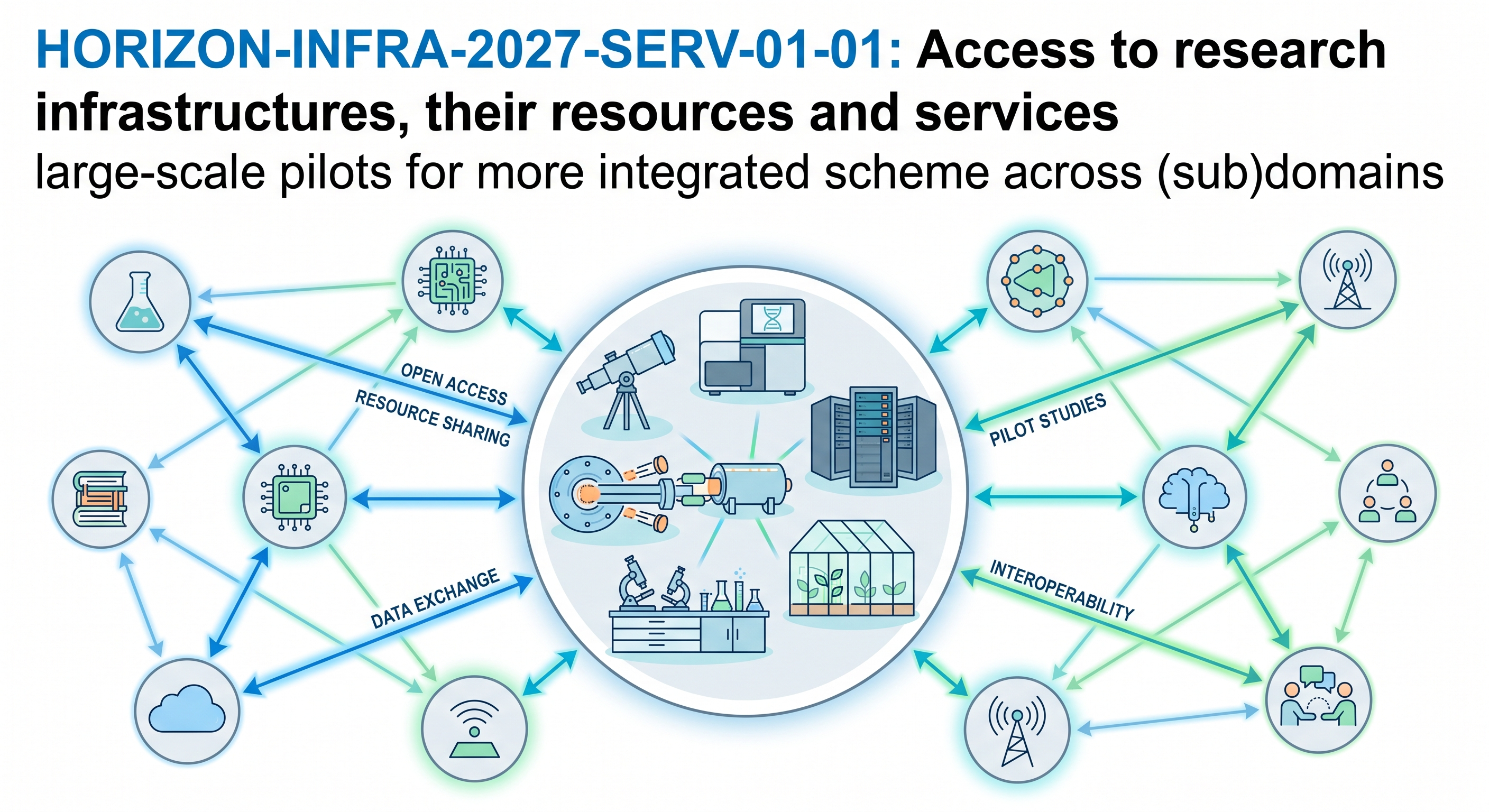
HORIZON-INFRA-2027-SERV-01-01: Access to research infrastructures, their resources and services: large-scale pilots for more integrated scheme across (sub)domains
The Commission wants to stop funding access one facility at a time. It buys three big pilots instead, each covering a broad slice of the ESFRI landscape, each with its own single-entry point portal. Call it a rehearsal for a permanent European access programme. Few winners.
Download the MIC Horizon Europe 2026/2027 Calls Calendar:
Discover more!
Administrative facts: what do we know about the HORIZON-INFRA-2027-SERV-01-01 call?
Which call is it, and when is the opening and the deadline?
- Call name: Research Infrastructures 2027
- Call identifier: HORIZON-INFRA-2027-01
- Destination: INFRASERV
- Topic: HORIZON-INFRA-2027-SERV-01-01
- Opening: 09 March 2027
- Deadline: 15 June 2027, 17.00 Brussels time
- Type of action: Research and Innovation Actions (RIA)
What about the budget and estimated size of the project?
- Total indicative topic budget: EUR 105.00 million
- Indicative number of projects: 3
- EU contribution per project: around EUR 35.00 million
What are the key eligibility and evaluation conditions?
- Thresholds: standard RIA rules of General Annex D, no topic-level exception.
- Extra Excellence aspects: quality of the access offered, integration of access procedures, improvement of online services.
- Portfolio rule: the highest ranked proposal in each area is funded, provided all thresholds are met.
- Page limit: 100 pages. No exploitation and dissemination plan required.
- At least two ESFRI Landmarks and/or ERICs as beneficiaries.
- The JRC may join as a beneficiary with zero funding or as associated partner.
- Exceptionally eligible for funding when providing access: Australia, Brazil, Canada, Chile, India, Japan, Mexico, New Zealand, Republic of Korea, Singapore, USA.
- FSTP allowed, capped at EUR 300 000 per third party.
- Royalty-free access rights on tools and standards for EU institutions and other EU-funded projects.
Scientific range: what does the Commission expect from the HORIZON-INFRA-2027-SERV-01-01 grant?
What outcomes are expected?
By the end of the grant a researcher should find, request and obtain access through one portal, under conditions that look the same whatever the facility. The Commission is after a working prototype of a harmonised access scheme, not a report describing one. Training new users, notably early-career and widening-country researchers, sits right next to that.
What is within scope?
- Trans-national access, on-site or remote, and virtual access to integrated and customised installations.
- One area per proposal, and you must say which: Area 1 (Physical Sciences and Engineering, plus Data, Computing and Digital RIs), Area 2 (Health & Food, plus Social Sciences and Humanities), Area 3 (Environment, Energy).
- Short-term service improvement, provided the improved service is actually offered during the action.
Long-term R&D on instrumentation is not what this topic buys. Access is.
What are the specifically proposed research directions?
- Converging call conditions, selection procedures and access modalities across domains that have never shared any.
- A single-entry point portal per pilot, designed so the three can later merge into a common front page.
- Peer review of user projects, with joint applications pairing a user group and the third party provider it needs.
- Continuous coordination with HORIZON-INFRA-2025-01-DEV-05, HORIZON-INFRA-2026-01-DEV-02 and HORIZON-INFRA-2027-SERV-01-02.
Scientific strategy: how can you enhance your chances of being funded through HORIZON-INFRA-2027-SERV-01-01?
What scientific choices matter most?
- Pick your area early and defend it: Cross-area ambition is welcome through third-party providers, but the pilot itself belongs to one area.
- Define your units of access precisely: Reviewers read this part closely, and vague units are a classic weak point (worth checking twice).
- Budget the FSTP envelope generously: A thin third-party line signals you did not believe your own design.
- Show governance: Who arbitrates between domains when demand shifts.
- The call says collaboration with the other pilots; in practice, evaluators want a named mechanism, not goodwill.
Consortium & proposal-writing plan: what works best with this type of call?
- Somewhere between fifteen and thirty beneficiaries, maybe more, because an area covers several communities and each needs a credible provider.
- Two ESFRI Landmarks or ERICs minimum. Above all, pick ones with real transnational access experience.
- Bring in an innovative SME as service or technology provider. It sharpens the industrial user story, and industry users are eligible.
- Widening and candidate country partners: not a box to tick here, they are part of the outcome.
- Write the access tables first, then the narrative around them.
- If your portal partner is weak, the whole proposal reads weak.
How would microfluidics contribute to this topic?
Access catalogues in Health & Food or Physical Sciences still lean on big instruments. Much of the demand sits elsewhere. Microfluidic platforms are small and cheap to run per experiment. A visiting team tests a hypothesis in days instead of booking beamtime for months.
- Organ-on-chip and vessel-on-chip services fit naturally in an Area 2 catalogue. Say a user group wants to know whether a candidate drug hits the gut barrier before it reaches the liver. You give them a chip, three days, and an answer.
- Droplet screening as a unit of access is easy to define. One run, one number of droplets. Clean for reporting.
- Your consortium can offer chip customisation as user support. Exactly the short-term service improvement the topic allows.
- Same platform, different community, different question. That is the interdisciplinarity the call asks for, without inventing anything.
The Microfluidics Innovation Center works as an industrial co-creation partner on this kind of service line. Practically, your access portfolio gains services that are quick to deliver, easy to price per unit, and attractive to SME users. Which is what this call wants to prove.
The MIC already brings its expertise in microfluidics to Horizon Europe:
H2020-NMBP-TR-IND-2020

Microfluidic platform to study the interaction of cancer cells with lymphatic tissue
H2020-LC-GD-2020-3

Toxicology assessment of pharmaceutical products on a placenta-on-chip model

FAQ - HORIZON-INFRA-2027-SERV-01-01
What is HORIZON-INFRA-2027-SERV-01-01 actually funding?
It funds access, not instrument development. Three large pilot projects will each provide trans-national access (on-site or remote) and virtual access to a wide portfolio of research infrastructure installations and services. The idea is to test what a single, harmonised European access programme would look like across a whole group of ESFRI domains.
When does the call open and close?
The call HORIZON-INFRA-2027-01 opens on 09 March 2027. The deadline is 15 June 2027 at 17.00 Brussels time. Note that the Director-General may open the call up to one month earlier or later, and may delay the deadline by up to two months.
How much money is on the table, and for how many projects?
The total indicative topic budget is EUR 105.00 million. The Commission expects to fund 3 projects, with around EUR 35.00 million of EU contribution each. Requesting a different amount is allowed, but you would need a very good reason.
What are the three areas, and can we cover more than one?
Each proposal must state explicitly which area it addresses. Area 1 covers Physical Sciences and Engineering plus Data, Computing and Digital Research Infrastructures. Area 2 covers Health & Food plus Social Sciences and Humanities. Area 3 covers Environment and Energy. Core access providers must sit in the chosen area. Third party providers can extend access across areas for interdisciplinary work.
For more information, check the Funding and Tenders Portal of the European Commission.
Who must be in the consortium?
At least two ESFRI Landmarks and/or ERICs must be beneficiaries. Beyond that, expect a broad set of core access providers plus on-demand third party providers. The inclusion of an innovative SME as a service or technology provider is a sensible move: industry users, including SMEs, are explicitly part of the target audience of this topic.
Can non-European infrastructures be funded?
Yes, exceptionally. Legal entities established in Australia, Brazil, Canada, Chile, India, Japan, Mexico, New Zealand, Republic of Korea, Singapore and the USA are eligible for EU funding under this topic, provided they give access to their state-of-the-art infrastructures to researchers from Member States and Associated Countries.
How does financial support to third parties work here?
FSTP is the mechanism used to pay third party access providers requested by user groups. The cap is EUR 300 000 per third party, which is higher than usual because operating costs of state-of-the-art facilities are high. FSTP calls can be merged with the access calls, so a user group and its needed provider apply together in one step.
What is a unit of access, and why does it matter so much?
A unit of access is the countable measure of the service you open: one beam hour, one sample analysed, one chip run, one dataset deposited. It must be identified and precisely defined in the proposal, and it is what you report against during the project. Vague or inflated units are one of the classic weak points in access proposals.
What are the specific evaluation angles for this topic?
Under Excellence, evaluators additionally look at the quality of the access offered and at how far the project integrates access procedures, improves services and develops online services. There is also a portfolio rule: the highest ranked proposal in each area is funded provided all thresholds are met, so the ranking is not purely linear.
Where can microfluidics fit into an access portfolio?
Mostly as a fast, cheap, easy-to-count service line. Organ-on-chip platforms suit an Area 2 catalogue for barrier, toxicity or drug transport questions. Droplet microfluidics gives high-throughput screening with a clean unit of access. Chip customisation can be offered as user support, which matches the short-term service improvement the topic allows. See the MIC page on Research and Innovation Actions for how an industrial partner usually contributes to this kind of work package.