
Tips & Tricks for a successful HORIZON-INFRA-2027-TECH-01-01 proposal
Opening
09 March 2027
Deadline
Keywords
research infrastructures
co-creation
INFRATECH
deep-tech innovation
ESFRI and ERIC
technological sovereignty
industry partnership
Your microfluidic SME partner for Horizon Europe
We take care of microfluidic engineering, work on valorization and optimize the proposal with you
HORIZON-INFRA-2027-TECH-01-01: Testing and optimising models of co-creation of advanced research infrastructure technologies
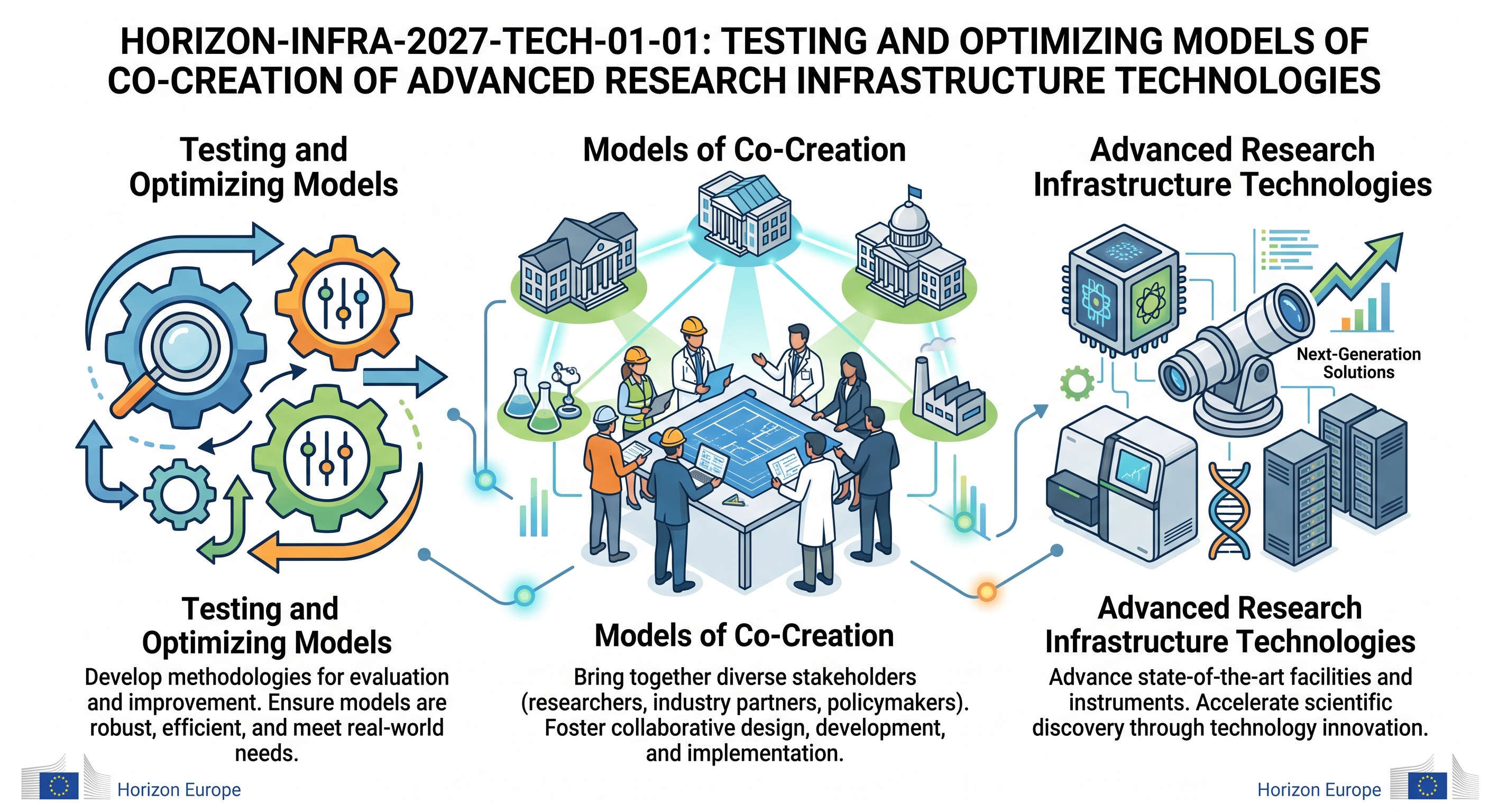
The Commission wants co-creation between research infrastructures and industry to actually work in practice. This topic is not about building one clever instrument. It’s about testing and refining the models through which RIS and industrial partners jointly develop advanced technologies. Brussels wants proof that these partnerships push technology out beyond the science market. You can browse the INFRA 2026-2027 topics ranked by microfluidic relevance for context.
Download the MIC Horizon Europe 2026/2027 Calls Calendar:
Discover more!
Administrative facts: what do we know about the HORIZON-INFRA-2027-TECH-01-01 call?
Which call is it, and when is the opening and the deadline?
- Call name: Research Infrastructures 2027
- Identifier: HORIZON-INFRA-2027-01
- Destination: INFRATECH
- Topic: HORIZON-INFRA-2027-TECH-01-01
- Opening date: 09 Mar 2027
- Deadline: 15 Jun 2027, at 17.00 Brussels time
- Type of action: Research and Innovation Action (RIA)
What about the budget and estimated size of the project?
- Overall topic budget: EUR 30 million
- Number of projects: 2
- Budget per project: around EUR 15 million (30 divided by 2), which sits inside the stated 10 to 15 million range
What are the key eligibility and evaluation conditions?
- At least two different research infrastructures as beneficiaries, each an ESFRI infrastructure, an ERIC, or an international European research organisation, all explicitly named in the proposal
- Two nodes of the same infrastructure do not count as two
- Financial support to third parties allowed, capped at EUR 500,000 per third party
- PCP subcontracting permitted
- Legal entities established in China cannot participate under this destination
- Thresholds follow General Annex D (standard RIA: 3/5 per criterion, 10/15 overall)
- JRC research infrastructures may be included; that collaboration is set up after approval
Scientific range: what does the Commission expect from the HORIZON-INFRA-2027-TECH-01-01 grant?
What outcomes are expected?
Brussels wants RIS positioned as centres of gravity for deep-tech innovation, with EU technological sovereignty stronger at the end than at the start. Publication series are not what the Commission is after. They want working partnerships, and technologies that survive outside the lab.
What is within scope?
- Co-creation of advanced technologies answering real RI needs, with resource efficiency and environmental impact kept in view
- Partnerships between RIs and industry, including SMEs, startups and scaleups, to co-develop solutions and drive their uptake
- A shared reading of commercial potential, with RI technology transfer teams brought in early
- Developments for the RI use case beyond TRL 4; wider applications up to TRL 3-4
A boundary worth flagging: a pure academic exercise with no exploitation path sits outside what this topic funds.
What are the specifically proposed research directions?
- Piloting new modes of co-creation and co-innovation between RIs and industry
- Growing innovation ecosystems around RIs, not one-off supplier contracts
- Testing how technologies get exploited outside the science market
- Sharing co-creation experience with the project funded under HORIZON-INFRA-2025-01-DEV-05, area 3
The wording leans toward the collaboration model itself, not a specific piece of hardware. That vagueness is an opening. It gives you room to frame your consortium’s method as the innovation.
Scientific strategy: how can you enhance your chances of being funded through HORIZON-INFRA-2027-TECH-01-01?
What scientific choices matter most?
- Make the co-creation model the star: Reviewers judge how you co-create here, not only what you build.
- State your TRL endpoint for each development: The topic asks for this explicitly.
- Bring industry in as a co-creator: Not a subcontractor you invoice at the end.
- Show the exploitation path early: This one trips people up more than you’d expect.
- Address greening and resilience: Not optional dressing.
- Plan the knowledge exchange with the 2025 DEV project.
Consortium & proposal-writing plan: what works best with this type of call?
- Two RIs is the floor, not the target. Spread them across different RI types so your model gets tested more than once.
- Somewhere around eight to twelve partners usually reads well for a 15 million RIA, maybe a couple more if you cover several technology domains.
- Mix public labs, established industry, and at least one innovative SME that actually builds the technology. A technology transfer office helps too.
- If you’re proposing a method for partnership, the consortium has to look like one. Intersectoral balance matters here more than usual.
- Writing tip: give the co-creation methodology its own work package, with its own evaluation. Don’t bury it in a task.
- Keep the impact section concrete about uptake outside the science market.
How would microfluidics contribute to this topic?
Conventional lab instrumentation is slow to adapt and awkward to share between facilities. Microfluidic platforms sidestep that. They shrink an experiment onto a chip, which makes a technology far easier to co-develop, copy across sites, and hand to an industrial partner.
- Microfluidics is exactly the kind of advanced RI technology this topic wants co-created. Small, modular, transferable. Your consortium can use it as the concrete deliverable that proves the co-creation model works.
- Say two RIs want a shared sample-prep tool, but each runs different protocols. A microfluidic module standardises the front end. Build it once, test it at both sites, and you get the same answer twice. That is your co-creation pilot, done.
- Your industrial partner can take a chip design to market far more easily than a room-sized instrument. That’s the spillover outside the science market the Commission keeps asking for.
- With MIC on board, you bring a partner who has co-designed microfluidic instruments with public labs before.
Microfluidics gives this proposal a real object to co-create, not just a governance diagram. It turns an abstract topic about partnership models into something you can build, test at two sites, and license out. For a topic that lives or dies on demonstrating co-creation, that’s the difference between a plan and a proof.
The MIC already brings its expertise in microfluidics to Horizon Europe:
H2020-NMBP-TR-IND-2020

Microfluidic platform to study the interaction of cancer cells with lymphatic tissue
H2020-LC-GD-2020-3

Toxicology assessment of pharmaceutical products on a placenta-on-chip model

FAQ – HORIZON-INFRA-2027-TECH-01-01
What is the HORIZON-INFRA-2027-TECH-01-01 call about?
It funds projects that test and refine the models through which research infrastructures and industry jointly develop advanced technologies. The focus is the co-creation process itself, not a single instrument.
When does the call open and close?
Opening is 09 March 2027 and the deadline is 15 June 2027 at 17.00 Brussels time. It runs under the Research Infrastructures 2027 call (HORIZON-INFRA-2027-01).
How much funding is available per project?
The topic budget is EUR 30 million, split across two projects, so roughly EUR 15 million each. The stated per-project range is 10 to 15 million.
What type of action is it?
It is a Research and Innovation Action (RIA). That means TRL-oriented development work with a strong collaboration component.
Who must be in the consortium?
At least two different research infrastructures as beneficiaries, each an ESFRI infrastructure, an ERIC, or an international European research organisation, all named in the proposal. Check the Funding and Tenders Portal for more information.
Can industry and SMEs join?
Yes, and the topic encourages it. Co-creation with industry, SMEs, startups and scaleups is central. Financial support to third parties up to EUR 500,000 is allowed. Check the Funding and Tenders Portal for more information.
Are there participation restrictions?
Legal entities established in China cannot participate in Research and Innovation Actions or Innovation Actions under this destination.
What TRL is expected?
Developments for the RI use case go beyond TRL 4. Wider applications outside the RI use case go up to TRL 3-4. State the endpoint per development.
What outcomes will evaluators look for?
Improved RI services, stronger cooperation between RIs and other organisations, RIs acting as centres of gravity for deep-tech innovation, and stronger EU technological sovereignty.
How can microfluidics fit this call?
Microfluidic platforms are exactly the kind of small, transferable RI technology this topic wants co-created. They give your consortium a concrete object to build, test at two sites, and license out. See how the MIC works with Horizon Europe consortia.