Tips & Tricks for a successful HORIZON-MISS-2027-02-CANCER-01 proposal
Opening
10 February 2027
Deadline
Keywords
Cancer Mission
functional genomics
novel cancer targets
tumour heterogeneity
paediatric cancers
UNCAN.eu
RIA
Your microfluidic SME partner for Horizon Europe
We take care of microfluidic engineering, work on valorization and optimize the proposal with you
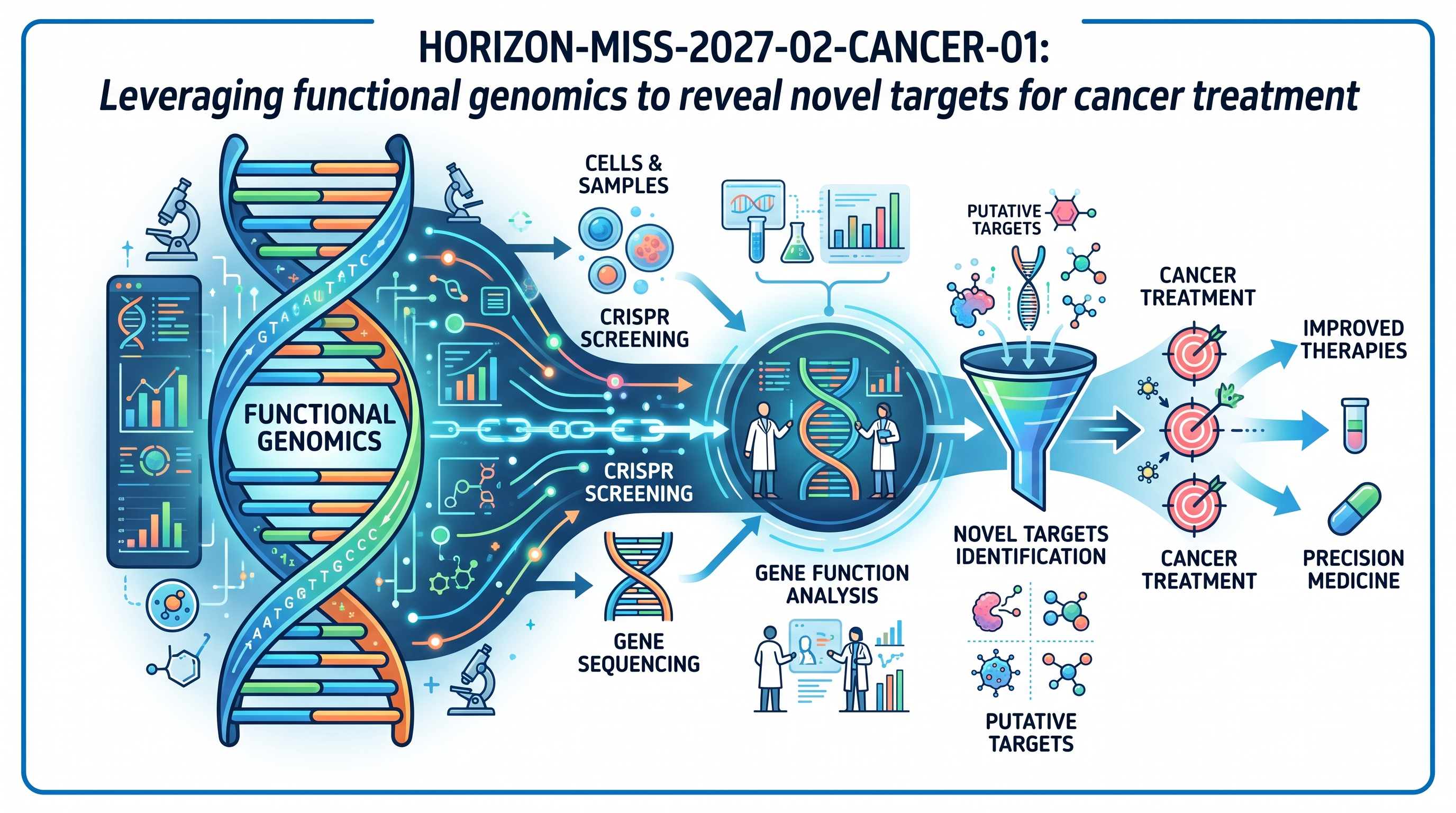
HORIZON-MISS-2027-02-CANCER-01: Leveraging functional genomics to reveal novel targets for cancer treatment
The Commission wants functional genomics turned into new drug targets for cancers that still resist treatment. Paediatric, adolescent, rare and refractory tumours are where it focuses. The work should feed the UNCAN.eu platform and connect with the Cancer Mission cluster. In short, understand tumour heterogeneity well enough to point at something druggable.
Download the MIC Horizon Europe 2026/2027 Calls Calendar:
Discover more!
Administrative facts: what do we know about the HORIZON-MISS-2027-02-CANCER-01 call?
Which call is it, and when is the opening and the deadline?
- Call name: Cancer, Supporting the implementation of the Cancer Mission
- Call identifier: HORIZON-MISS-2027-02
- Destination: EU Cancer Mission
- Topic: HORIZON-MISS-2027-02-CANCER-01, Leveraging functional genomics to reveal novel targets for cancer treatment
- Opening date: 10 February 2027
- Deadline: 21 September 2027, 17.00 Brussels time
- Type of action: Research and Innovation Actions (RIA)
What about the budget and estimated size of the project?
- Overall topic budget: EUR 32.32 million
- Number of projects expected: 4
- Budget per project: around EUR 8.08 million (topic budget divided by four)
What are the key eligibility and evaluation conditions?
- Thresholds: 4 for Excellence, 4 for Impact, 4 for Implementation, cumulative 12
- Eligibility follows General Annex B, with a restriction linked to the protection of European communication networks
- Portfolio rule: at least one highest ranked proposal targeting children and adolescents (0-19 at first diagnosis) is funded if it clears all thresholds
- IP condition: the granting authority can object to a transfer of ownership or exclusive licensing of results up to 4 years after the action
- Clustering: funded projects join the ‘Understanding’ cluster and coordinate with UNCAN-CONNECT
- No JRC involvement is specified for this topic
Scientific range: what does the Commission expect from the HORIZON-MISS-2027-02-CANCER-01 grant?
What outcomes are expected?
A deeper grip on how tumour heterogeneity drives cancer, and from it, more precise targets. It also wants tools and models that feed UNCAN.eu with interoperable data. Publication lists are not what they are after here.
What is within scope?
- Functional genomics and structural biology: rapid gene sequencing, single-cell studies, spatial transcriptomics, epigenetic profiling
- Liquid biopsies and functional precision oncology pipelines
- Exploratory mechanistic studies on longitudinal patient bio-samples, plus clinical proof-of-concept, observational and translational work
- Causal inference, computational modelling and AI for large, messy, multimodal datasets
- Experimental models of any kind: in silico, in vitro, in vivo, ex vivo
The focus stays on cancers with poor options. Common cancers with good survival are not the target.
What are the specifically proposed research directions?
- Identify and validate new targets by building models that reveal the functional effects of tumour temporal heterogeneity on initiation, progression and relapse
- Work out the interplay between a tumour’s multi-omics profile, its microenvironment and patient factors like age, sex and immune status
- Explain adaptive resistance to therapy, using clinical data where useful
- Integrate and analyse FAIR multimodal longitudinal patient data, and make digital assets available through UNCAN.eu
- Build on existing biobanks, cohorts, ESFRI infrastructures, the European 1M+ Genomes and European Cancer Imaging initiatives
Scientific strategy: how can you enhance your chances of being funded through HORIZON-MISS-2027-02-CANCER-01?
What scientific choices matter most?
- Pick a hard cancer: Pediatric, adolescent, rare, or refractory tumors match the mission’s own priorities.
- Show cause and effect, not correlation: Reviewers want a mechanism, not another association study.
- Design for UNCAN.eu from day one: FAIR metadata and data interoperability are graded, not optional.
- Bring the children-and-adolescents angle: if you plausibly can, that portfolio rule gives it a real edge.
- Connect early with UNCAN-CONNECT.
- Keep the AI honest: Fancy modelling on thin biology rarely convinces this panel.
Consortium & proposal-writing plan: what works best with this type of call?
- Size: somewhere between eight and twelve partners, a couple more if clinical and biobank coverage demands it.
- Mix: academic labs, clinical oncology centres, health-IT and AI teams, research infrastructures, and at least one innovative SME bringing a real platform.
- Interdisciplinary balance matters here. The footnotes spell out the stakeholder mix they expect.
- If you already sit inside a cohort or biobank, say so up front. It signals feasibility fast.
- Writing tip: put the target-discovery logic on one page, visible at a glance.
- Budget for networking and cluster meetings. Expected, not a bonus.
How would microfluidics contribute to this topic?
Bulk assays and animal models miss much of what happens inside a single tumour, and rarely capture how one patient’s cells change over time. Organ-on-chip and droplet microfluidics work at that smaller scale. You get controlled conditions where a functional-genomics hypothesis can actually be tested on living cells.
- Say you want to know whether a candidate target drives invasion or just tags along. A tumour-on-chip lets you knock it down and watch the cells respond under flow.
- Single-cell and droplet platforms sort thousands of cells one by one, good for spotting the rare resistant clone that seeds relapse.
- Liquid biopsy on chip pulls circulating tumour cells or DNA from tiny blood volumes. Useful when your samples are paediatric and precious.
- Patient cells on a chip, same compound, different microenvironment, different outcome. That is the cause-and-effect readout the panel asks for.
- You get the same answer twice more often on a chip than in a plate.
For a target-discovery proposal, microfluidics is where your biology gets tested before it becomes a claim. It sits between the omics and the clinic. Bring it in and your consortium shows function, not just genomic association, which this call rewards. For worked examples, see our tumour-on-chip review.
The MIC already brings its expertise in microfluidics to Horizon Europe:
H2020-NMBP-TR-IND-2020

Microfluidic platform to study the interaction of cancer cells with lymphatic tissue
H2020-LC-GD-2020-3
Toxicology assessment of pharmaceutical products on a placenta-on-chip model

FAQ – HORIZON-MISS-2027-02-CANCER-01
What is HORIZON-MISS-2027-02-CANCER-01 about?
It funds work that turns functional genomics into new cancer drug targets, with a focus on tumour heterogeneity. Priority goes to paediatric, adolescent, rare and refractory cancers. Results should feed the UNCAN.eu platform.
When does the call open and close?
Opening is 10 February 2027. The deadline is 21 September 2027 at 17.00 Brussels local time.
How much funding is available and how many projects?
The topic budget is EUR 32.32 million, funding around four projects. The EU contribution guided per project is EUR 7.00 to 8.00 million.
What type of action is it?
Research and Innovation Actions (RIA), under the Cancer Mission call HORIZON-MISS-2027-02.
Which cancers are in scope?
Paediatric and adolescent cancers, cancers with limited treatment options, refractory cancers, rare cancers and types with low five-year survival.
What technologies does the Commission encourage?
Rapid gene sequencing, single-cell studies, spatial transcriptomics, epigenetic profiling, liquid biopsies and functional precision oncology pipelines, plus AI and computational modelling for messy multimodal data.
What must a proposal deliver into UNCAN.eu?
FAIR multimodal patient data, interoperable digital tools and models, and metadata records in the EU dataset catalogue of the European Health Data Space.
Are there special evaluation conditions?
Thresholds are 4 for Excellence, 4 for Impact, 4 for Implementation, cumulative 12. A portfolio rule guarantees funding to at least one top-ranked proposal targeting children and adolescents (0-19), if it clears all thresholds. Check the Funding and Tenders Portal for more information.
What partners should a consortium include?
A mix of academic labs, clinical oncology centres, health-IT and AI teams, research infrastructures and biobanks. We would also add at least one innovative SME that brings a real platform.
How can microfluidics strengthen a proposal?
Tumour-on-chip, single-cell and droplet platforms, and liquid biopsy on chip let you test target-discovery hypotheses on living cells. You show cause and effect, not just genomic association.