Tips & Tricks for a successful HORIZON-MISS-2027-03-OCEAN-02 proposal
Opening
09 February 2027
Deadline
Keywords
Mission Ocean and Waters
seafood circularity
Innovation Action
fisheries by-products
aquaculture
organic feed
EMODnet
Your microfluidic SME partner for Horizon Europe
We take care of microfluidic engineering, work on valorization and optimize the proposal with you
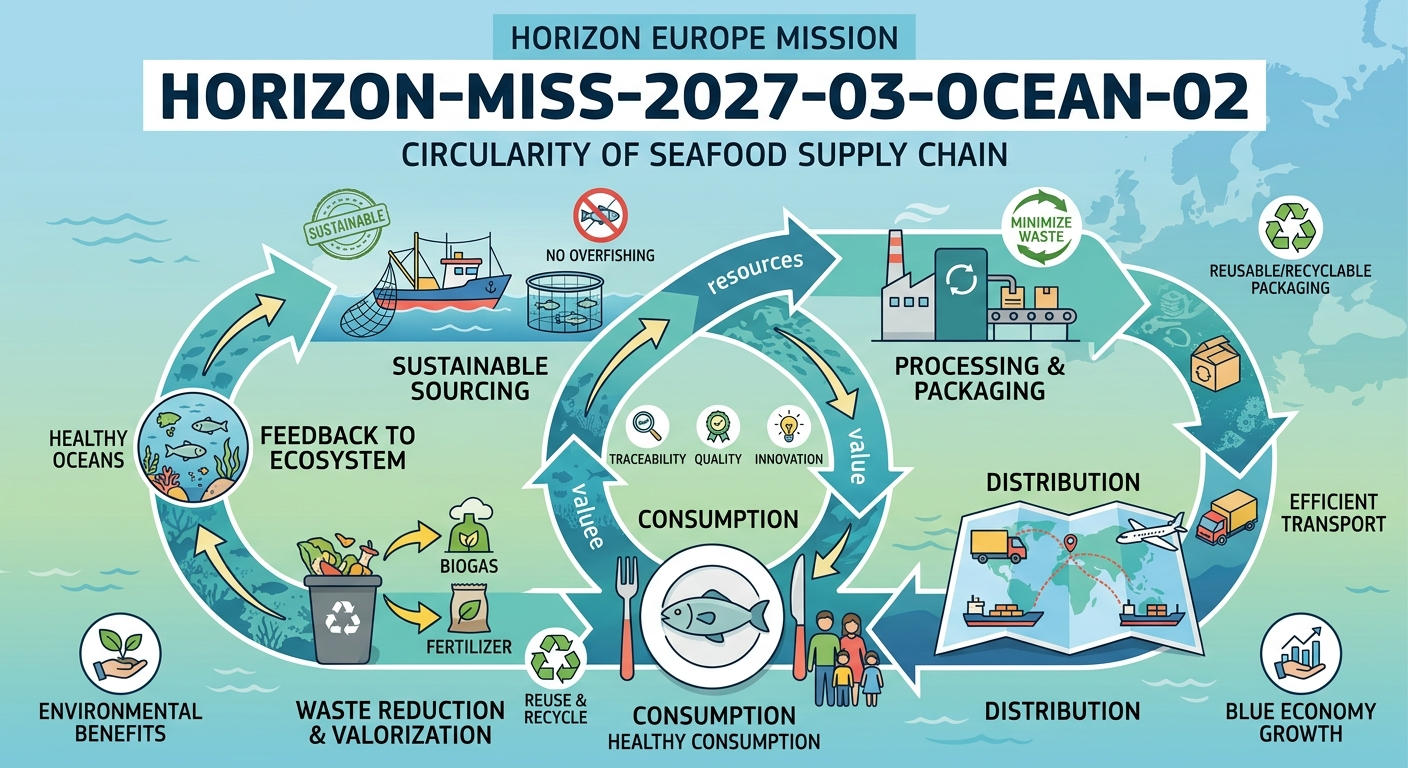
HORIZON-MISS-2027-03-OCEAN-02: Circularity of seafood supply chain
The Commission wants the seafood industry to waste less and earn more from what it discards. Fish sludge, viscera, shells, algal residues: all of that should become an input for another industry. This is an Innovation Action, so demonstration in real conditions counts more than new science. And each project picks one sea basin, then stays there.
Download the MIC Horizon Europe 2026/2027 Calls Calendar:
Discover more!
Administrative facts: what do we know about the HORIZON-MISS-2027-03-OCEAN-02 call?
Which call is it, and when is the opening and the deadline?
- Call: Supporting the implementation of the Restore our Ocean and Waters Mission
- Call identifier: HORIZON-MISS-2027-03
- Mission: Restore our Ocean and Waters by 2030
- Topic: HORIZON-MISS-2027-03-OCEAN-02, Circularity of seafood supply chain
- Opening: 09 February 2027
- Deadline: 21 September 2027, 17:00 Brussels time
- Type of action: Innovation Action (IA)
What about the budget and estimated size of the project?
- Overall topic budget: EUR 30.90 million
- Projects expected: 4
- Budget per project: EUR 7.725 million (30.90 divided by 4)
- Work programme range per project: EUR 7.20 to 7.725 million
What are the key eligibility and evaluation conditions?
- Award criteria and thresholds: General Annex D, no exception at topic level
- TRL 6 to 8 by the end of the project
- Portfolio rule: beyond ranking, the top proposal in each Mission basin is also funded
- One basin per proposal, stated explicitly: Atlantic and Arctic, Mediterranean, Baltic and North Sea, or Danube including the Black Sea
- At least three use cases per project, in real conditions
- In situ data and marine observations must be published through EMODnet, following FAIR principles
- Excluded: alternative energy and pharmaceutical applications
Scientific range: what does the Commission expect from the HORIZON-MISS-2027-03-OCEAN-02 grant?
What outcomes are expected?
Working circular solutions, measured. The Commission asks for competitiveness gains and less waste in fisheries and aquaculture, plus evidence that the usual barriers came down: processing cost, regulatory friction, weak market demand. Benefits for local communities must be measurable too, not simply asserted.
What is within scope?
- High value compounds extracted from by-products and unwanted catches: sludge, trimmings, viscera, shells, algal residues
- Downstream uses such as feed, food, fertilisers, nutraceuticals, cosmetics, bioplastics, bio-based packaging
- Organic feed ingredients replacing fish meal and fish oil, with attention to Feed Conversion Ratio
- Integrated Multi-Trophic Aquaculture and diversification to lower trophic species
- Digital tools and predictive models that monitor pollution and waste
Energy and pharma applications are out of scope.
What are the specifically proposed research directions?
- Two issues are named, you need at least one: compound extraction, or organic feed ingredients. One is enough.
- Waste quantification and monitoring, so the circularity gain can be counted
- Feasibility, economic viability and effectiveness, all demonstrated, and tailored to the chosen basin
- Respect of Regulation (EU) 2018/848 on organic production, plus animal welfare
- Cooperation with EMFAF and past Horizon projects, with HORIZON-CL6-2027-01-CIRCBIO-11 and the CBE JU
Scientific strategy: how can you enhance your chances of being funded through HORIZON-MISS-2027-03-OCEAN-02?
What scientific choices matter most?
- Pick your basin first. Partners, waste streams, regulation and market all follow from that choice.
- Choose one issue and go deep. Covering both extraction and feed spreads 7.7 million thin.
- Quantify the baseline. No tonnage figures today, no credible impact section tomorrow.
- Name the three use case sites and the operators running them.
- Treat digital monitoring as a real work package. We see it under-resourced more often than not. Our overview of Horizon Europe 2026-2027 topics ordered by microfluidic relevance may help you position that work package.
- Map the regulatory pathway for your compound. Feed, food and cosmetics play by different rules (this one catches people off guard).
- The wording on socio-economic benefits is loose. That leaves room to define your own indicators.
Consortium & proposal-writing plan: what works best with this type of call?
- Somewhere between ten and fifteen partners, maybe a couple more if the three sites sit far apart.
- Producers, processors, technology providers, researchers, plus a regional authority. The call asks for the whole chain, so the evaluator looks for it.
- Bring the offtaker in as a beneficiary. Whoever buys the compound belongs inside the consortium, not in a letter of support.
- An innovative SME holding the processing or analytical technology usually strengthens the exploitation story. That is exactly the role we play when we join a Horizon Europe consortium as an industrial partner.
- Early stakeholder involvement is written into the scope. Put dates and formats in the proposal, not intentions.
- If every partner sits in one country, your basin argument gets weak.
- Impact first, then work packages.
How would microfluidics contribute to this topic?
Testing a hundred extraction conditions on fish waste the classic way means kilos of material, weeks of bench work and a lot of solvent. Microfluidics runs that screening in droplets of a few nanolitres. More conditions, faster, on a fraction of the material.
- Say you want to know which enzyme and which pH actually pull the peptide out of shrimp shells. Droplet screening runs those combinations side by side, on grams instead of kilos. Within days you know which two are worth scaling.
- Lab-on-chip sensors sit in the tank and measure ammonia or phosphate continuously. That feeds the predictive models the call asks for.
- Uniform microcapsules for feed additives. Microfluidic encapsulation gives you control over size and release.
- Contaminant checks before by-products enter a feed or cosmetics chain. Heavy metals, marine biotoxins. Small device, quick answer, no shipping samples to a central lab.
None of this replaces your pilot line, it shortens the road to it. And saying you screened two hundred conditions before picking two reads better than a selection based on the literature. If you want to test the idea against your own value chain, here is how we work within a consortium.
The MIC already brings its expertise in microfluidics to Horizon Europe:
H2020-NMBP-TR-IND-2020

Microfluidic platform to study the interaction of cancer cells with lymphatic tissue
H2020-LC-GD-2020-3
Toxicology assessment of pharmaceutical products on a placenta-on-chip model

FAQ - HORIZON-MISS-2027-03-OCEAN-02
When does HORIZON-MISS-2027-03-OCEAN-02 open and close?
The call opens on 09 February 2027 and closes on 21 September 2027 at 17:00 Brussels time. It is a single stage call under HORIZON-MISS-2027-03. The Director-General may move the opening by one month and the deadline by up to two months, so check the Funding and Tenders portal before you plan your submission. Our Horizon Europe calls calendar tracks those changes.
How much funding can one project get?
The work programme sets the total topic budget at EUR 30.90 million for 4 projects. Per project, the Commission estimates an EU contribution between EUR 7.20 and 7.725 million. Dividing the topic budget by four gives 7.725 million, which is the top of that range. Asking for a different amount is allowed, but you will have to justify it.
What type of action is this, and what TRL is expected?
It is an Innovation Action. Activities are expected to reach TRL 6 to 8 by the end of the project. In practice that means demonstration in an operational environment, not lab proof of concept. Budget your pilot lines and your field sites accordingly.
Do I have to choose a sea basin?
Yes, and you have to say so explicitly in the proposal. The four options are the Atlantic and Arctic basin, the Mediterranean Sea basin, the Baltic and North Sea basin, and the Danube River basin including the Black Sea. Activities must be tailored to the specificities of that basin. One basin per proposal, no hedging.
What is the portfolio rule and why does it matter?
Grants are not awarded on ranking alone. To keep a balanced portfolio across the four Mission basins, the highest ranked proposal in each basin is also funded, provided it passes all thresholds. So the competition is partly internal to your basin. A well built proposal in a less crowded basin can have a real advantage.
Which by-products and waste streams are in scope?
Discards from unavoidable unwanted catches and waste products such as fish sludge, fish manure, trimmings, viscera, shells, seaweed and algal residues. Extracted compounds can go to animal feed, food production, fertilisers, nutraceuticals, cosmetics, biotech, bioplastics and bio-based packaging. Applications in alternative energy sources and pharmaceuticals are excluded.
What does the call say about organic feed?
The second issue covers organic feed ingredients as alternatives to fish meal and fish oil. They must support good growth and a sound Feed Conversion Ratio, taking single species nutritional needs into account. The aim is to cut dependency on wild fish stocks. Solutions must respect Regulation (EU) 2018/848 on organic production.
How many use cases are required?
At least three per project, demonstrated in real conditions. Effectiveness, feasibility and efficiency all have to be shown, not just the technology running. Name the sites and the operators in the proposal. Reviewers read vague use case descriptions as a sign the partnerships are not in place yet.
What data obligations come with this topic?
If your project collects in-situ data or marine observations, they must be made openly available through EMODnet, following FAIR principles. This is an additional obligation on top of the usual open science rules. Budget the data management effort, and say who does it.
Where does microfluidics fit in a seafood circularity project?
Mostly in the screening and monitoring parts. Droplet microfluidics tests extraction conditions on grams of by-product instead of kilos, which shortens the road to a pilot line. Lab-on-chip sensors feed the pollution and waste monitoring the call asks for. And microcapsules give you control over how feed additives release. If that sounds useful for your consortium, we can join as the microfluidics partner.